• Skip to main content
  • Skip to footer

Digital Ducats Inc.

SEO Consulting & Services

  • Home
  • About
    • SEO Consulting
  • Services
    • SEO
    • Local SEO
  • Contact
    • Pricing
    • Write For Us
  • Blog
You are here: Home / Blog

Nov 09 2020

The Advantages Of An Internal Link Building Strategy

Every website needs a link building strategy. Most people who are familiar with link building will immediately think of external links and the many link building tactics that have become the norm for acquiring backlinks. The truth is you need an internal link building strategy in order to capitalize on the many benefits it provides to your website.

What are internal links?

An internal link is the hypertext link between two pages located on the same domain. They provide contextual meaning through descriptive anchor text and lead visitors to related content.

Example of internal link structure with three pillars and interlinked content

Internal links provide link equity by passing on page authority.  Like any other link, topical relevance is a big component for providing a quality internal link.

For example, the relationship between a web page about dog training that links to a page on dog tricks is obvious. They are topically relevant and therefore the traffic that travels between pages is likely to be engaged with the content on both sides of the link.

Good things happen when you have a strong internal link structure. Increase the optimization of your pages by linking pages that compliment each other with relevant topics.

Enhance your pages optimization

The link target becomes more optimized through descriptive anchor text. It’s recommended to avoid exact match anchor text in excess and to avoid using the same anchor text to the same page. 

Over-optimization is a risk you can avoid by using long-tail descriptive anchor text.

The linking page also enhances its optimization by showing a direct relationship to related content. Search engines don’t rank based on keywords anymore, but based on keyword topics.

When your page demonstrates stronger depth in the keyword topic you’re covering, you gain more credibility for covering a keyword topic in breadth.

Google discovers new pages by following links

When a search engine crawls your website, they find and index new pages by following links. You can index new pages on your site much faster by providing a link to its page from existing content.

Without linking to your content, the only other way for a search engine to find the page is to have it listed in your sitemap.

When a page has no internal or external links and is not listed on the sitemap it’s considered an orphaned page since it has no way of being discovered.

For websites with a high number of pages, an internal link building becomes a necessary part of getting your pages indexed since there is a limit to the crawl budgets Google assigns to your website.

Increases user engagement statistics

As you may or may not know, the user engagement statistics your website generates are used as a way of determining whether users are enjoying your site and whether it answers the user’s intent.

Increased Dwell time

For instance, the time that the average visitor spends on your website can tell search engines whether users are engaging with your content. Google uses Rankbrain specifically for this aspect. 

If your site has an average time of 5 minutes while the competing websites are at one minute, your website is going to move up in rank. It becomes obvious that users are finding your content useful and worthwhile checking out.

Improve the dwell time of your website by linking to as many related articles and pages within your content. It needs to be related to each other of course so that people can explore other related topics that will capture their attention.

Internal links improve time on site, reduce bounce rate and increase the number of pages visited per session

Improved click-through rate

The internal click-through rate on your site is also a user engagement statistic. The average number of pages visited per session is the name of the official column you can look in to see this metric on Google Analytics. If your site demonstrates a high value in this area, it means visitors are clicking through to additional content because they’re interested in what they’re finding.

Decreased bounce rate

The bounce rate is the percentage of people that immediately back out of your page after landing on it. A higher bounce rate means that fewer people stay on your site and click through to internal pages. The lower your bounce rate the more visitors are staying on your page and engaging with your content.

Although high bounce rates can indicate that visitors are either not liking your content, they can also result from a lack of internal links that leave a user with no way to move further into your website. By adding internal links you provide another path to access more pages within your website. The addition of internal links therefore reduces the bounce rate.

Internal links can generate more conversions

A lot of good things happen when you’ve implemented an effective internal link building strategy properly. The increased click-through rate and increased dwell time contribute to getting more content in front of your visitors. This leads to more confidence in your brand and ultimately more conversions.

The links you place in your content should lead visitors towards a conversion goal you’ve set for your website. Set up your goals in analytics to track how well your website is accomplishing this task.

Whether your goal is to get a phone call, contact form, sign up for a newsletter or purchase your product, you can set it up in Analytics. 

Use internal links to lead visitors to high converting pages and contact forms throughout your content.

Internal links build authority in a keyword topic

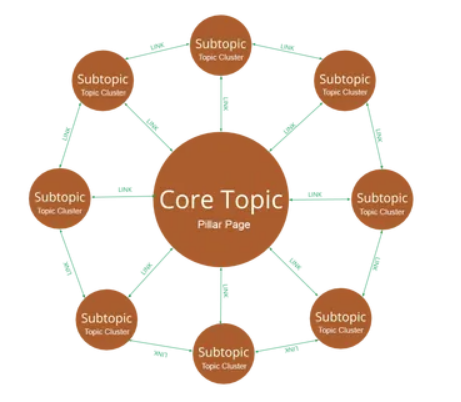
Use your internal links to create topic clusters. A topic cluster is composed of a pillar page, which is the main keyword topic. The pillar page will cover a keyword topic in breadth but not depth. Rather than go into detail it will link to smaller articles that have a narrow focus on a smaller subtopic but dive into greater detail. 

Topic cluster content structure is the perfect model for your internal link building strategy

The smaller articles should link to each other where it’s appropriate, and all of them will link to the pillar page. The pillar page links to the smaller articles, which creates the topic cluster model.

Technically, the pillar page accumulates authority because of the number of links pointing to it from the cluster content. This establishes the keyword topic as a pillar of your website which helps your website show up for more keyword related searches.

Use internal links to increase the user experience

At the root of all ranking factors lies user experience. Implement an internal link building strategy to create more entry points to your pages and allow users to explore more related topics that interest them.

Link to topically relevant pages to create topic clusters while improving the user experience. The additional effort you provide in establishing our website in your major keyword topic will pay off in dividends.

User engagement is a powerful ally to have in your corner, so keep your users happy by offering links to more content they’ll love and you’re guaranteed to enjoy more success in the search results.

Written by Christian Carere · Categorized: Link building, On-page optimization, Web development

Nov 04 2020

Why Web Design & SEO Are Inseparable

Web design and SEO are inseparable. Without a website, you can’t have SEO and what’s the point of having a website, if no one can find it? Incorporating SEO at the earliest stages of your website’s development is a smart decision that will save you an enormous amount of time, money and resources.

Search engine optimization involves a lot of moving parts but when you isolate the fundamentals, you can incorporate these aspects into your website design from square one. This article will detail the necessary design elements that impact how search engines view and rank your website.

Choosing your domain

Choosing your domain may sound like an easy task, but there are specific features that you should take into consideration. To give your website the most competitive advantage you should consider optimizing your selection as well as choose the correct domain extension and protocol.

Incorporate a keyword

If the opportunity presents itself, choose a descriptive domain that summarizes your brand and the products and services you offer. When you’re competing against a bunch of other websites for the same keywords, the added edge in having a keyword or two within your domain results in increased search visibility.

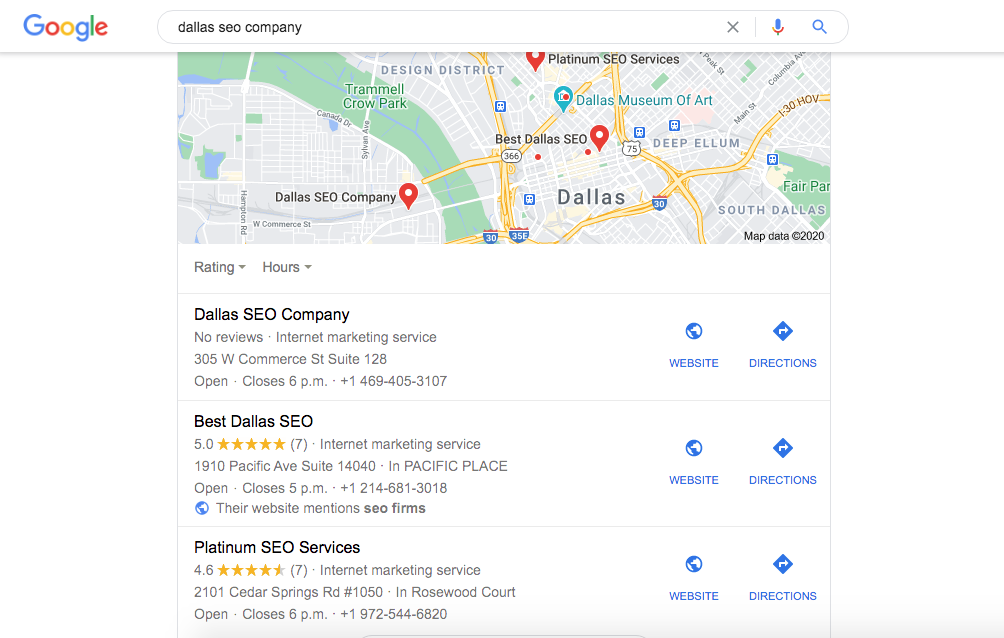
This isn’t absolutely necessary, as you can optimize to compete without it, but it provides a competitive advantage in local SEO. If your website represents a specific location, you can get the upper hand in appearing for localized search results. Google tends to display keyword-optimized businesses in the local pack.

Example of how keyword in business name is favoured by Google in local SEO

You can see examples like this in every niche. With a keyword within your business name and URL you’re company is optimized to appear in the Local Finder for keyword related searches.

Domain extension

The second part of your domain selection is choosing the domain that you want to represent your business. In Canada, local businesses use .ca’s to rank highly in localized search results.

Of course, .com’s are the best option for the US and work well for global search results. They also work well in Canada but when you want to focus on appearing for search results within your country choose the appropriate extension for the best results.

Domain protocol

Choose the protocol that every version of your domain will redirect to so there’s only one domain with canonical URLs.

For example, consider the following options for domain protocols that can be entered for one website:

  • example.ca
  • http://example.ca
  • www.example.ca
  • https://www.example.ca
  • http://www.example.ca

All of these versions of your URL should redirect to one URL only. This will avoid confusion and any potential duplicate content issues.

Choosing a hosting company

The company you choose for hosting should be reliable and offer your site fast server response time. The time it takes for your pages to load will directly affect user engagement metrics, which we’ll get into later in this article regarding page speed.

Choose a hosting company with a data centre that’s in your country or close to your location. It makes no sense to choose a company in India when all of your traffic is originating in Canada.

Keyword research

This becomes a crucial aspect of your website design because you need to incorporate the most important search terms your clients are using into your site architecture, URL structure and content strategy.

By establishing the search terms that will drive the most traffic to your business you can embed these terms into the very fabric of your website. This affects how you silo your website with descriptive URLs for categories, subcategories, products and services and how you plan your content.

The keywords that represent your business should be determined in the planning phase of building your website. This ensures that your website takes the right direction from the very start by targeting the terms that will drive the most traffic with visitors that convert into clients.

Site architecture and URL structure

The way your website is organized should resemble that of a filing cabinet. Your website is the filing cabinet, the drawers are the categories, the folders are the subcategories and the files are the pages.

Filing cabinet

–Drawers

—-Folders

——–Files

For example, Woo commerce template for websites that sell retail products looks like the following:

Homepage

–Categories

—-Subcategories

——–Products

Your site architecture needs to make sense for both search engines and users. This level of organization makes it easy to assign a hierarchy of pages and assign value to the most important aspects of your business.

URL structure

The URL structure should follow suit with your site architecture with descriptive terms that indicate where a user is on your website. Each level of depth that a user goes into should be divided by a subfolder so the can get to where they’re going within four clicks as well as find their way back to where they came from.

Example.com

Example.com/services/

Example.com/services/SEO/

Example.com/services/SEO/link-building/

Using descriptive words in your URL structure makes for a more user-friendly and search engine-friendly website. Depending on the CMS you’re using your URLs may be automatically generated which can result in the following:

Example.com/rtsh%7j

Example.com/12-04-2020/lghtn345

This type of structure has no order and no meaning to users or search engines. Plan the URLs before building your website to avoid sloppy and nonsensical URLs.

Navigation

The navigation on your website needs to be clear, concise and take a user to all of the most important parts of your website within a few clicks. Your homepage is where most users will land so it’s necessary to have the means to get to all the important places quickly and provide a way for users to find those places without thinking.

Confusing sign post to signify what happens with bad navigation in your website design

Think of creating your website’s navigation as if you were putting up signposts. You want traffic to be guided to their destination with the least resistance. If your website navigation forces people to think or sends them the wrong way, it makes for a poor user experience and you will lose visitors.

Mobile usability

We live in a mobile-first era which makes mobile design the most important version of your website. Although this varies in importance with industry, Google indexes the mobile version of your website first. Your website is reviewed and assessed based on the mobile version since more than 50% of users search for information on a mobile device.

Responsive vs. mobile-friendly

Websites have been made responsive for some time, however just because a site is responsive doesn’t mean that translates into being mobile-friendly. There are other elements to being mobile-friendly that need to be taken into account.

A mobile-friendly site is a site that’s easy to use on a mobile device and provides a good user experience. It’s possible to have a responsive website without it being mobile-friendly. It’s important to address these issues, which can be identified using Google’s mobile-friendly test.

Page speed

The speed at which your pages load plays an important role in how your site is viewed by search engines and users. Most people are too impatient to wait for a page to load for more than a few seconds. In fact, Google states that after 3 seconds of load time, visitors are five times more likely to leave your web page.

From an SEO perspective, this reduces user engagement statistics. The overall dwell time is reduced, the bounce rate increases and the click-through rate is lowered. The effect of slow page speed has a negative impact on your search engine results.

This mainly stems from the fact that what’s good for a user is also good for search engines. If people are leaving your site before the pages even load, it signifies a poor user experience. Your site would seem unpopular and therefore would get pushed down in the search results.
Mobile friendly attributes

Make your site mobile friendly to improve your websites SEO. If your website is not easy to use, you’re going to lose visitors.

An example of a poor usability issue is when the text is too small. This causes users to “pinch” the screen to read the text, which also leads to scrolling side to side. Making changes to the mobile attributes of your website will affect the way users view your site and whether they continue to use it, or seek out an easier website to use.

Simple mobile attributes like button functionality is a major issue in the usability of your website. If buttons are too close together and users are clicking on the wrong ones, it can be frustrating and lead to the loss of visitors.

Test the mobile-friendliness of your site to determine what changes need to be made. Not only will you improve your website for users, but the changes will affect how your site is displayed in the search results.
Marketing funnel

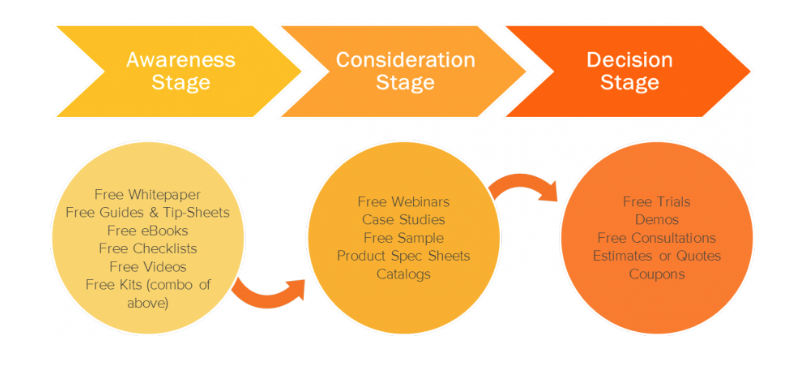
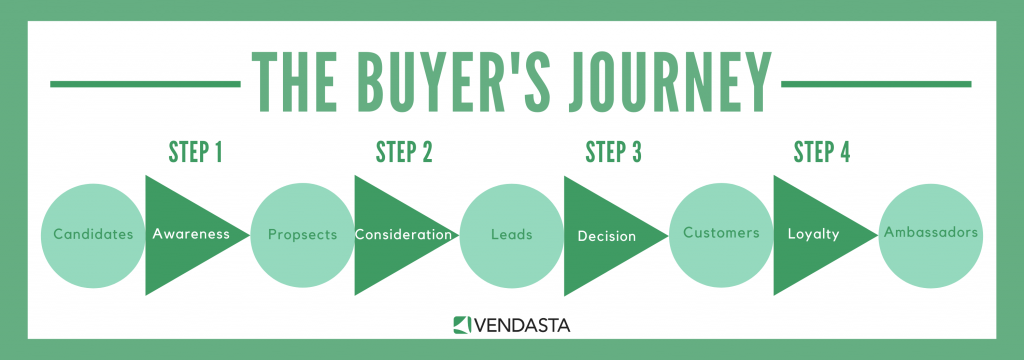
A major aspect to how you structure your content is how you address users at each stage of the buyer journey. The keywords you plan on using to drive traffic should be represented by content that creates awareness, consideration and influences decisions.

the buyer journey and the content to include when incorporating SEO with web design

Content that’s published at the awareness stage includes ultimate guides, top ten lists, etc. Content that’s published at the consideration stage includes case studies, original research, etc. Content at the decision stage includes product pages, service pages, free trials and consultations.

A visitor that lands on your website should be guided through all three stages of the buyer journey. This planning takes place in your keyword research.

Publish the bottom of the funnel content at the beginning stages and work your way up. This way you can facilitate those that are in the later stages of the buyer journey to make a purchase. You can then expand your reach as your site develops more content.

On-page optimization

Here’s where a lot of the magic happens for a website’s search visibility. The communication you have between your website and the search engines can make the difference between a highly successful website and a site that generates a mediocre performance.

Use your keyword in your h1 headline

The H1 tag you’ve assigned to your pages is a major clue for summarizing the most important content to users and search engines. Use your keyword in the headline to target that search term.

Stick to titles that are less than 60 characters long, since anything longer will be truncated in the search results-especially on the smaller screen sizes.

Include your keyword in the front end of your headline so that’s displayed no matter what happens. You can attract more clicks to your website with an optimized headline that tells users your page is about what they’re searching for.

Include your keyword in your URLs

The URL of your page helps to describe to users and search engines that your content is targeting the very search term that they’re using. Keep your URL under 90 characters, with a maximum of five words in the slug (extention after the .com).

Meta description

The meta description is not an actual factor that search engines take into account when ranking your web page, however, it does influence the click-through rate. The meta description is all about winning the click to your website. BY writing an accurate and captivating description you can encourage more visitors to land on your page.

It’s best practice to include your keyword near the beginning of the meta description. Users are more likely to notice the keyword and be drawn to your search listing (especially since Google highlights it with bold text in a search result).

If you don’t’ include a meta description, Google will extract snippets from your content to summarize your page. In some cases, they may represent your page the way you want, and in others, you would do better to write it in your own words.

Image optimization

Although search engines can identify images, they still rely on the information you provide to categorize images properly.

Use descriptive words in your filename to contribute to a better understanding of what your image is about.

The alt tags are still the main area that needs to be optimized with your keyword. Avoid keyword stuffing and use natural sentences to explain what the image represents.

Using captions will also add to the context of your images.

Keep in mind that images don’t just enhance the on-page optimization of your content, but also appear in image searches. Adding descriptive metadata will improve the number of searches your image can appear for, creating another stream of traffic to your website.

As always, make sure you reduce the file size of images and use compression. If you’re using a plugin you can implement lazy loading to decrease the time it takes the page to load the items above the fold.

Structured data markup

The more communication you have with search engines the better. Enhance the way your page is read and displayed by deploying Schema through structured data markup.

Schema.org was invented by the major search engines as way of making a universal language for identifying entities. There is a category and markup for almost every item on a web page.

You can further a search engine’s understanding of your website, and the type of content your publishing by using structured data markup. As a bonus, there are a number of rich results that your page could be eligible that provide an enriched search result.

Rich results

Users are naturally attracted to enhanced search results. Rich results add to the marketability of your search listing to attract more attention and therefore win more clicks to your page.

The most popular types of rich results that you can influence with structured data are:

  • FAQ
  • Reviews
  • How-to
  • Q & A
  • Events/Showtimes

If you’re able to implement the correct structured data markup from the start, you will drive more traffic to your website through higher click-through rates.

Incorporate SEO at the earliest stages of web design

It should be obvious how important it is to have SEO in mind when designing your website. The performance of your site should be the major concern since design alone will not contribute to your bottom line.

Start with the fundamentals of web design and SEO at the earliest stages of web design and enjoy the rewards of a website that drives traffic and generates leads and revenue on a regular basis.

Written by Christian Carere · Categorized: Web development

Oct 23 2020

SEO Basics: Search Engine Optimization Made Simple

What’s the point of owning a website if no one can find it online? Your website is your means for educating an audience and generating leads. You can’t drive new business unless new users are landing on your pages. At a bare minimum, you need to apply SEO basics.

Here’s an old SEO joke: Where do you hide a dead body so no one can find it?

A: On the second page of Google!

More than 90% of users click on the first page of search results. That means that if your website appears anywhere other than the first page, you’re missing out on more than 90% of new client opportunities.

What is search engine optimization (SEO)?

SEO is the process of improving the search visibility of a web property for specific keyword search queries. The process includes a number of different tactics and strategies that are intended to improve the likelihood of a web page being displayed as the best solution to a search result. Ideally, this results in the page appearing at the top of the search results.

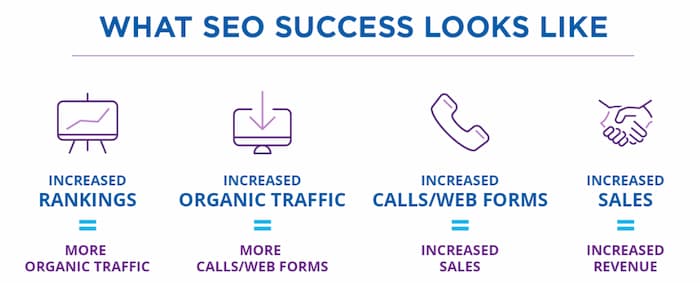
SEO success means increase in organic traffic, leads, sales and revenue
Image source

The overarching goal of SEO is to increase revenue

The ultimate goal of SEO is to increase revenue by driving more traffic to a website. Search engines assess the quality of web pages using a number of different factors. Improving the SEO of a web page increases the number of positive ranking factors that lead to higher search engine rankings and increased search visibility.

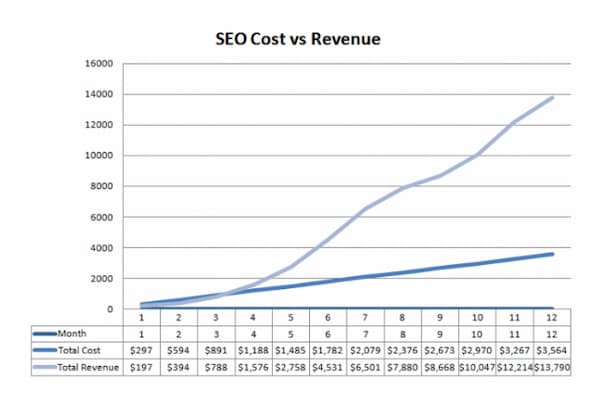
SEO basics: A chart showing cost vs. revenue where revenue is compounding overtime
Image source

SEO separates your content from the masses

Did you know that there are over 2 million WordPress blog posts published each and every day? That means that more than 20 blogs are published every second. Considering the vast number of blog post being published, how can you publish an article and expect people to find it?

That’s where SEO comes into effect. For every person who searches Google, they are required to enter a word or phrase that describes what they’re looking for. When your page is optimized to answer the intent of a user (referred to as search intent), your answer is more likely to appear on the search engine result page (SERP).

What is user intent/search intent?

Search intent is the underlying reason a user initiates a search. Satisfying search intent refers to the content that will put an end to a user’s search. This concept is extremely important to SEO because Google has been able to accurately interpret user intent and assess web pages to determine whether they are able to satisfy search intent.

Optimize for search intent to increase user engagement

To be the best solution to search query, your page not only needs to be optimized for the query, but it needs to be accurate and adequate in the content it serves. If users click on your page and then back off of it, it indicates low user engagement. The metric used to measure the number of users that land on your page and back off is known as bounce rate.

(Click here to read 9 Ways To Reduce Your Bounce Rate)

This is an important user engagement statistic because it alludes to whether users find your page relevant to the search query. When people refuse to stay on your page for more than a second, but they spend time on a competing page, the competing page will more than likely rank ahead of the page no one wants to spend time on.

For this reason, keywords and content play a massive role in determining how search engines assess your page and display it in the search results.
How does SEO work?

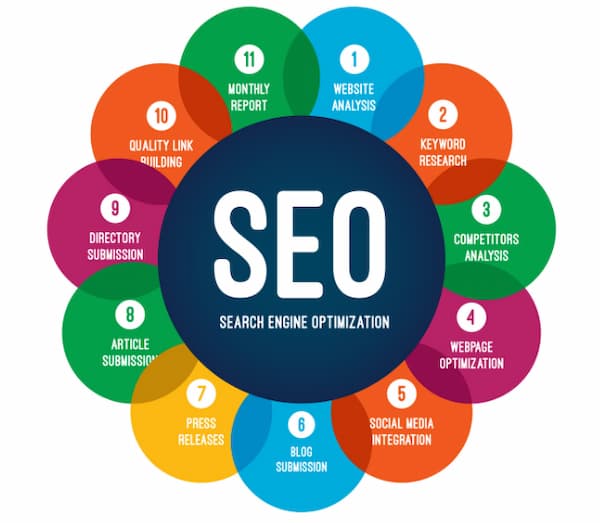
SEO is a process that combines keyword research, content creation, on-page optimization and off-page optimization, data-driven analysis and technical performance for the purpose of increasing traffic for lead generation. The end result is keyword-optimized pages that receive more visitors from improved search visibility.

An image showing 11 SEO basic strategies and practices
Image source

SEO identifies the traffic opportunities available and works towards implementation to achieve a regular flow of traffic from organic keyword rankings (and paid traffic) that results in more leads, new clients and increased revenue.

The role of keywords

The words that a user types into a search are considered keywords. SEO is primarily keyword based due to the way users search for information. A typical SEO campaign involves publishing pages that are optimized for specific keyword searches. This makes keyword research one of the most important aspects of developing an effective SEO strategy.

The keywords your website appears for should benefit your business by attracting visitors that have or will have intentions to buy the product or service you offer. What’s the point in ranking for a keyword when the visitors aren’t ever going to buy from your company? Keyword research is a process that results in the confirmation of what is actually being sought after in a search, and what content you need to provide to satisfy that intent.

Keyword research

Keyword research establishes the true search intent of a search phrase. It’s not just about avoiding a terrible mistake, but also identifying the content required that would propel your web page to the top of the search results.

If you’re going to rank in the best positions you need the best content.

The process involved in researching keywords requires you to go through a series of steps that provide hints and clues to what will make the best content for the search term in question.

Create a list of potential options

An easy way to start your keyword research is to make a list of the words that you want your website to be known publicly. These initial terms can describe your business and are most likely products and services.

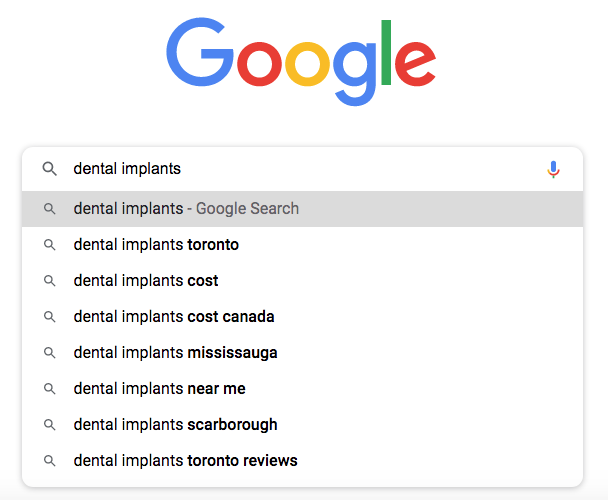
Generate more ideas with Google autosuggest

Type these phrases one by one into Google and write down any relevant keywords that appear in autosuggest.

Google autosuggest for a dental implant keywords

Confirm the business value by analyzing the organic results

For every keyword you consider targeting, you’ll need to check the 10 organic results to see if the competing pages are a match for your business. Google may surprise you with how it interprets intent. The organic results should be direct competitors in your industry.

If there are search listings that are NOT your competition it could be an indication your keyword has diluted search intent. Perhaps not all of the people searching your keyword will be interested in what you offer and another alternative should be considered.

There are endless ways in which you can come up with keyword options. To evaluate a keyword, ask these three questions.

Does the true search intent represent a high business value?

Search intent is the biggest factor because you need to determine whether the content that currently ranks for the keyword is something that would benefit your business. If there’s no value in the keyword then it doesn’t make sense to waste your time and effort in creating the content.

How much volume makes a keyword worthwhile?

You can drive 50K visitors to your site but if no one converts to a new client the volume of traffic from that keywords is useless. If you can drive 20 people from a keyword and 5 of them end up making a purchase, you’ll need to assess the number of resources needed to acquire those 20 people on a regular basis.

If the traffic from a keyword results in high ticket purchases, then even keywords with low monthly search volume are worthwhile in pursuing.

The bottom line: Volume is ony as important as the business value of the keyword in question.

How difficult is it to rank your content on the first page for that keyword?

In a perfect world, we want high converting keywords that have tons of monthly searches and zero competition. Since this is rarely the case for any keyword the strength of the competition needs to be weighed in against the business value and volume of searches.

If the websites on the first page have been around for years, there’s a good chance they’ve accumulated a lot of backlinks and have made a name for themselves in the industry. When all 10 organic results are competitors with massive domain authority, there is little to no chance for a newish website to rank ahead of them and so it would make sense to consider another option.

Find alternative keywords when the competition is difficult. You can choose a synonym or related keyword, or you can use a long-tail version of the keyword you initially wanted to pursue.

Reduce competition using long-tail keywords

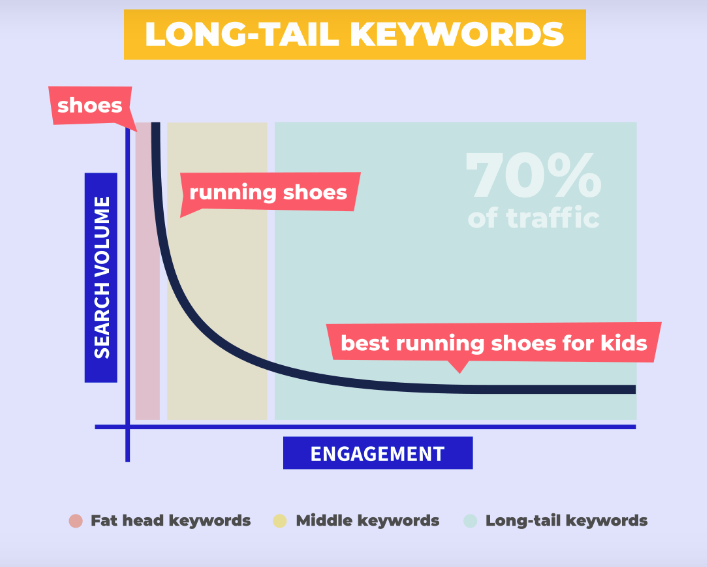
Three or more words used as a search term are considered a long-tail keyword. The majority of searches made on Google (70%) are long-tail keywords.

Long-tail keywords make up the largest percentage in number of searches

Increase conversions by targeting long-tail keywords

Most people try to describe what they are looking for in more detail when they know what they want. This means that long-tail keywords convert at a higher rate than head keywords (one to three words used in a search term).

The more words a person uses to describe what they are looking for, the more you can provide an accurate match as a solution to search intent. The benefits of long-tail keywords are:

  • Higher engagement statistics
  • Higher conversion rates
  • Lower competition

The only downside to optimizing for a long-tail keyword is that they typically have less search volume. That being said, it’s better to get 10 people to buy your product out of 50 than it is to get 1 person out of 1000.

It’s much easier to nail search intent with long-tail keywords because the focus is much narrower.

For example, if a user were to search for summer shorts, there are a vast amount of options that this keyword could possibly mean. Does the user want spandex, cotton, nylon, a specific colour, style or fit?

If your website doesn’t sell every single option a visitor might be looking for when they search summer shorts, then driving traffic from this keyword would lead to high bounce rates and ultimately poor search visibility.

If your business only sells cotton shorts with various camouflage patterns, there would be no sense in optimizing for the keyword summer shorts, when you would have more success with terms like camouflage shorts or army shorts or more descriptive search terms.

When your products or service has a narrow focus, it’s a better approach to optimize for more accurate keywords.

Establishing a keyword strategy

Your keyword strategy should consist of keywords that are exact matches to your products and services to drive traffic with visitors with buyer intent. Your strategy should also include keywords that address the most commonly asked questions, common problems and the answers to those issues.

This type of strategy affords you the time it takes to rank for more difficult terms while ranking faster for long-tail phrases that ultimately lead to visitors on your main pages.

By assigning keywords topically, you can address more relevant issues and then find the best keywords that match your business through data-driven analysis.

Keyword tools are the most convenient at this stage of the process and can help finalize your target keyword in the content you publish.

Content Creation

To get your content to rank and outperform competing pages, it needs to be the best response to a search query. A large part of creating content that performs is figuring out whether you’re going to publish something unique, or whether you’ll publish something that’s just better than what’s already out there.

Analyze the top ten results for clues on search intent

One of the biggest clues to establishing search intent is in the page titles of the top ten organic results. The titles will show you what type of content has the best possibility of ranking highly.

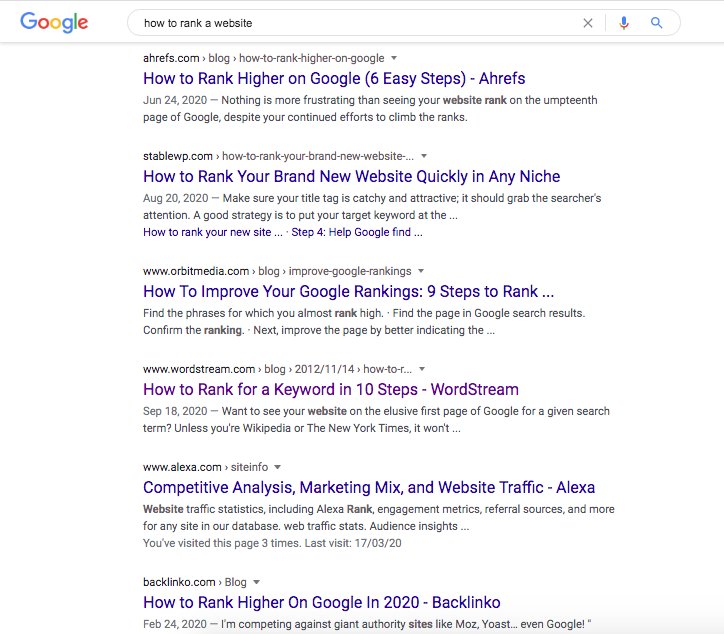
Take the search term, how to rank a website for example.

SEO basics dictate to analyze the SERP for clues that establish search intent

Out of 10 search results, 7 have titles that start with “How-to” indicating that the type of article users click on the most are how-to articles. This example is super obvious but the same holds true for any keyword in question.

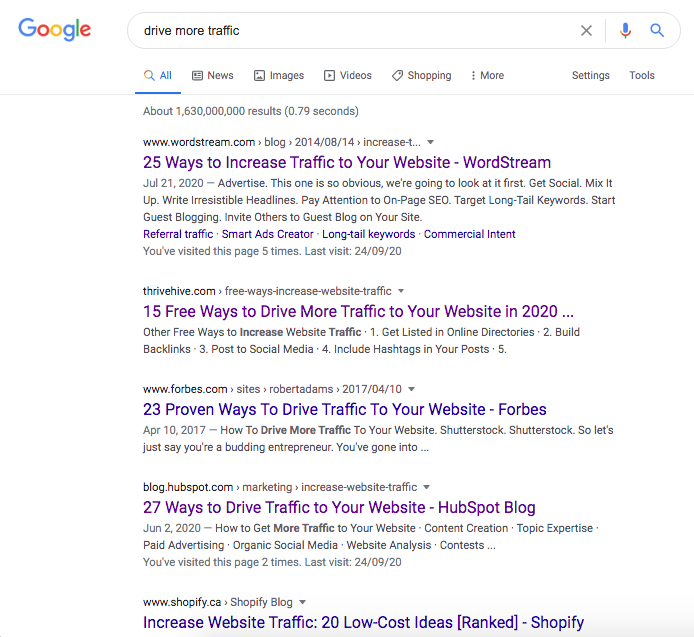
Another example is to try searching the term drive more traffic.

Basic SEO example of how a search term can indicate the best content type to publish for a keyword

Again, 7/10 search results have titles with numbered lists that detail the different ways to drive traffic to your website. Evidently, the best opportunity to rank for this search term is to produce an article with a numbered list.

Analyze SERP features to improve your solution to search intent

There’s no one who understands search intent better than Google. Take into account the various SERP features that appear for your keyword. You can use the appearance of SERP features as clues to publishing content that is optimized to satisfy user intent.

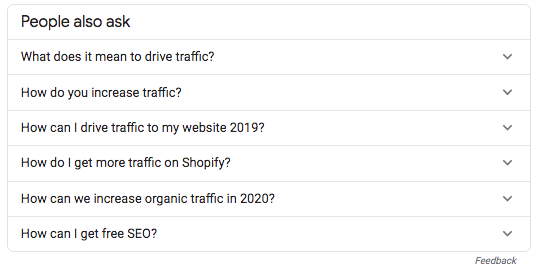
Extract topically relevant questions and answers from the People Also Ask Box

The People Also Ask box, for example, is packed full of topically relevant questions that people also search in addition to searching for your keyword. If you can provide the answers to those questions within your page, it’s one less search your visitor would have to make and one more reason for them to stay on your page.

Use the PAA box as a way to find topically relevant content

Incorporate the content from the PAA boxes to supercharge the number of topics your content covers as well as commonly asked questions. This content addition will make your page more user-friendly by directly answering popular questions.

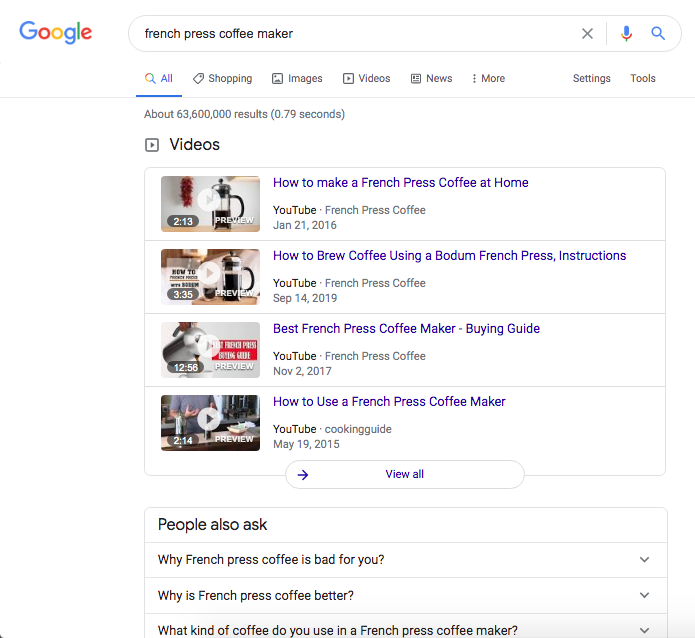
Optimize your page with multimedia

If any videos or images appear directly in the SERP, it’s an indication that users are actively looking for one or both types of media. When Google is displaying a carousel of videos at the top of the SERP, it would improve your pages ability to have a video on your page as well.

SEO basics indicate that when videos appear at the top of the SERP, including a video in your content will help satisfy search intent

Outperform existing content

In order to outperform existing content, you need an accurate idea of what will make your version better than what’s already ranking.

You’ll need to determine the areas in which you can create a better piece of content.

Look to outperform existing content by publishing more in-depth content to better answer intent. Create more user-friendly features that lead to longer dwell time, higher click-through and lower bounce rates.

Reverse engineer top rankings

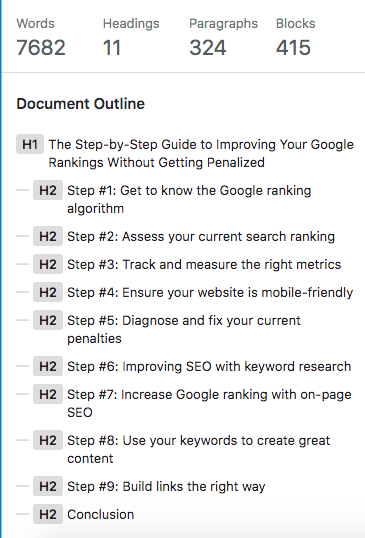
Create 10x content (content that’s 10 times better than what’s out there) by covering the details of every topic and subtopic on your competing pages.

If you use WordPress, copy and paste one of the pages that rank in the top positions. Click on the information icon to get a full summary of their article for a clear perspective on the word count, the number of topics covered and the hierarchy of content.

A Neil Patel article that ranks on the first for the keyword How to rank a website
This top-ranking article was cut and pasted into my HTML editor to get a quick summary

The information can provide you with a birds-eye view of how your competitor has constructed their page.

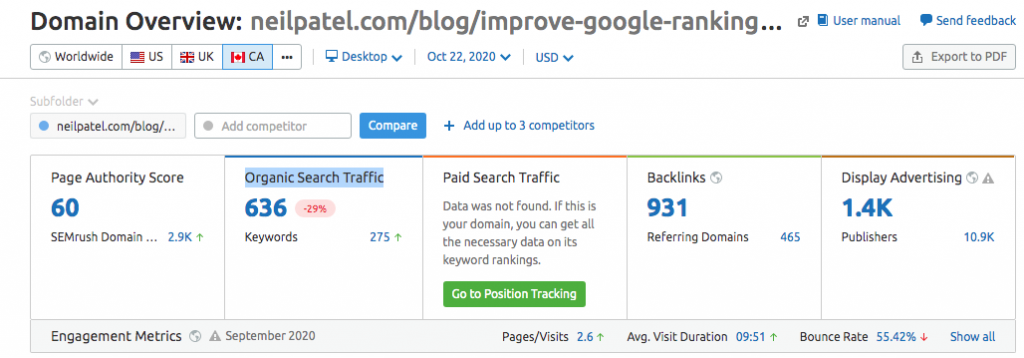
You can also enter a top-ranking URL in any analytic software that generates a keyword report. SEMRush will show you the value of organic traffic for any page.

SEO Basics dictate using a free software like SEMRush to acquire the domain overview

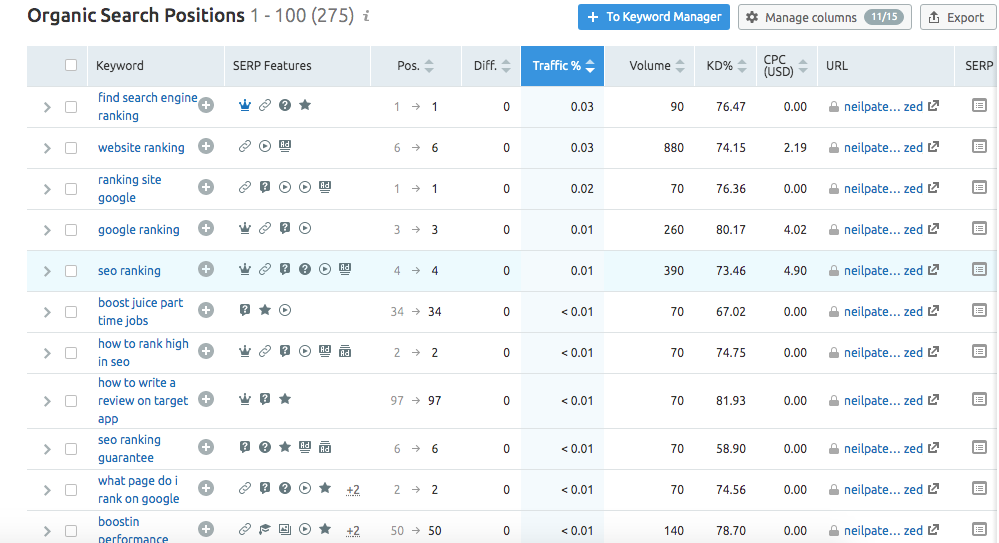
Click on the link and it will take you to another breakdown of all the keywords that URL is ranking for in the top 100 positions.

Keyword report for competition to identify content gap analysis

This report gives you insight into any gaps in content your page may or may not have. By identifying keywords you’re not optimized for, you also identify segments of content that will need to be added in order to meet and exceed the quality of the page that’s currently ranking.

Organize your site topically to enhance the performance of major keyword topics

SEO revolves around content because, without it, there wouldn’t be any SEO. Every page on your website should be optimized to target a specific keyword and play a role in driving traffic and converting visitors into clients.

An effective structure to implement in your content creation is to create topic clusters. A topic cluster consists of three different components; pillar pages, cluster content and the links that bind them.

A pillar page is typically a major keyword theme and it covers all aspects of that topic in breadth, but never dives deep into detail. Rather than cover every detail within the pillar page, a pillar page will link out to more narrowly focused articles. These articles are considered cluster content.

Example of pillar page and cluster content

Cluster content, for the most part, targets a long-tail keyword and has a narrow focus on one specific topic. Cluster content goes deep into detail and attempts to fully answer the search intent associated with the keyword it targets.

A pillar page will link out to its cluster content and in return, the cluster content will link back to the pillar page. Cluster content will also link to related content within its cluster. This interlinking strategy is what forms a topic cluster.

The blueprint for your topic cluster is created within your keyword strategy. It begins with brainstorming the most important keywords to your website.

For every major keyword theme break it down into smaller subtopics.

Break down the subtopics into common problems faced by prospective clients. The collection of subtopics should adequately describe your business as well as provide ways for searchers to become aware of your product.

For example, if you were creating a top cluster for your dental practice, you might have the following pillar pages on your website: Cavities, Cleaning, Root Canals, etc.

For each of these pillars you would break down the topic into a number of different subtopics.

For cavities you might include the following as subtopics:

  • How to know if you’ve developed a cavity
  • Do filling cavities hurt after it’s finished?
  • How long does it take to fill one cavity?

Potential keywords could be how patients are describing the pain they have. Keywords posed as questions “Why does my tooth hurt when I chew?”

Whether they know it’s a dental issue or not, a person will type in the symptoms they’re experiencing. Your cluster content would be optimized to address this issue and explain how your services can help them with their problem.

This type of content would be considered top of the funnel content to create awareness in your service or product.

The content you publish on your site should start with the most important pages to your business. The pillars can be category pages, service pages, or landing pages to convert visitors to clients.

Build cluster content to lead visitors to these pages. This can often be done by targeting specific issues (long-tail keywords) as well as publishing comparative content that forces visitors to consider your company as the best choice.

On-page optimization

The contextual meaning of your content can be communicated through the metadata, text, images and structured data markup on your page. Using each of these aspects of your page allows you to highlight the most important keywords you intend to target in the search results.

Metadata

The metadata is extremely important because search engines will read and use this information to categorize your content. Including your keyword in the title, URL, image alt tag as well within the body of content will improve the optimization of your page for a specific keyword.

Text

Use your keyword sparingly in the body of your text. A common mistake website owners make is to repeatedly use the keyword excessive and unnaturally. This will over-optimize your page.

Make sure your keyword appears in the first 100 words or so and a few times within the body of the text. You can use keyword synonyms to enhance the optimization of your target keyword as well as promote a rank for secondary search terms.

Images

Despite the large leaps forward in technology, Google will still use the description in the alt tags as the primary clue for optimization. Use your keyword within the alt tag to enhance the optimization of your page, but this also optimizes the image itself.

Web pages aren’t the only means for driving traffic. Image sources can drive a huge percentage of your traffic if you’ve optimized them correctly.

Include the keyword in the filename, fill out the captions and give your image a descriptive title (avoid using the same words as in the alt description).

Structured data markup

The language of search engines, otherwise known as Schema, clearly communicates contextual meaning and other important information located on your web page. Schema.org has a list of entities that have been defined with appropriate markup and can be used on your page to break down any barriers of communication between search engines and your page.

Apart from providing a faster method of delivering accurate information, Google offers enhanced search results with the right markup. Google displays rich results for markup that informs search engines of reviews, FAQ sections, Q & A pages and How-to articles-just to name the top ones.

Rich results lead to higher click-through rates in the SERP by making your search result more marketable.

Off-page optimization

Anything that affects the optimization of your page, but doesn’t occur on your page is considered off-page optimization. This is largely the process of building external and internal links, but can also include improving technical performance.

Internal links

Internal links are among the easiest links to build because they are links to your page from within your website. Internal links create more link equity between pages, which can improve authority and ranking ability.

For example, suppose you have a page that converts visitors to clients really well. Let’s imagine it’s a product page for an incredible razor that does things that you only imagine in your dreams.

The problem is, it’s difficult to get external websites to link to your product page, so how do you get it to rank and generate traffic?

Enter internal link building.

Based on the topic cluster model, you can create content that external websites would be more likely to link to because they provide objectionable value. An article on 10 Ways To Reduce Shave Time And Frequency would be good content asset and has more rank ability then a page with just a product.

By building links from the pages that generate the most traffic, to the pages that convert at the highest rates, you can increase the number of visitors you convert as well as give your product page more authority to rank.

You can also use internal links to optimize for your target keyword by using a mix of exact match anchor text links as well as long-tail anchor text links and keyword synonyms.

External links

As one of the most powerful ranking factors, external link building can create a top-ranking page-even if your content isn’t technically “the best” stuff out there. With enough websites vouching for your credibility, you can literally rank a page for just about anything as long as you have really good links.

Using keyword-optimized external links will enhance the optimization of your page if done correctly. If you only use exact match anchor text, you may end up over-optimizing your web page. This will send your site back in the search results.

Using a mix of exact match, branded, naked URL and non-optimized anchor text will give your page a good balance of in your backlinks profile and promote a healthy ranking for your target keyword.

Social media marketing

Traffic generation is a huge component of SEO, which makes social media marketing an important aspect of your overall SEO strategy. Building a large audience can serve as a way to drive instant traffic to your web pages and get your content in front of a large number of people.

Despite the fact that links from social media don’t count as followed links, there is some value in the user engagement that social traffic creates. Google rewards pages that have high click-through rates, dwell times and low bounce rates.

The law of averages dictates that the more traffic you send to your pages, the more likely you are to acquire backlinks to high-quality content. Social media can drive the additional traffic needed to get you more backlinks.

The incredible number of users on Facebook is enough to make it an attractive source for marketing your business. Facebook is not the only platform that has proven success in building a business.

Retail sales and B2C marketing do especially well on Pinterest and Instagram. Your target demographic will influence the social media website you choose to implement in your marketing.

B2B sales may have more success with websites like Linkedin.

Social media offers a way to market your product for absolutely no cost whatsoever. If you can produce highly engaging, top-notch content you can build a massive number of followers with absolutely zero investment other than time and effort.

Of course, you can also dive into the paid aspect of social media marketing, after all, you’re targeting the same audience that you want to get reading your content. One of the most effective forms of paid traffic is using retargeting.

Retargeting ads will only re-appear to a user once the user has clicked through to your website. Once that happens, the pixel installed on your site will automatically upload a cookie into the user’s browser. Whenever there’s an opportunity for an advertisement to appear, your ad will reappear for however many times you stipulated in the settings.

This is a highly efficient way of getting people more familiar with your company, which opens them up more to doing business with you.

Technical performance

The technical performance of your website can be improved when you know where to make the improvement. In an effort to monitor the various technical aspects of your website, you can run an audit to determine the page speed, the number of broken links, missing metadata, missing pages, duplicate content and indexing issues.

Page speed

The length of time it takes your page to load can greatly affect user experience as well as your ranking (if it’s excessively slow). You can work on page speed by fixing both on-page elements as well as off-page elements.

Reducing the size of your files, compressing your images, and implementing lazy loading can greatly reduce the time it takes your page to load.

You can also use a CDN, inline the HTML, CSS and JavaScript in the header to reduce the time it takes to load. Leveraging browser caching is another one of many tactics that result in faster page speed.

Reducing errors

Every website eventually begins to generate errors with everyday use. Even if you don’t use your website at all and don’t update it, there will eventually be errors generated from incompatible versions of plugins, themes and browsers.

The accumulation of errors on your site can lead to a reduction in the ranking.

Many of the errors that result in a drop in ranking are based on user experience, such as broken links. When a user encounters a broken link, it’s frustrating and causes a slight problem in the fact that the user needs to back up and decide on where they’re headed again.

Having a missing page on your site results in a 404 error message. This can also look bad on your brand and your company could be misconstrued as having a low-quality website.

Fixing broken links and eliminating missing pages is one of many ways to improve the user experience and overall website performance.

Data driven results

Search engine optimization is a highly effective means of marketing for more reasons than just optimizing your pages to appear first in the search result. SEO involves recording, measuring and tracking results, which can give you better insight when making decisions.

Analytics

Google Analytics is one of the most comprehensive tracking software available that comes absolutely free. Once the tracking code is installed you can monitor the volume of traffic, the origin of that traffic and what those visitors did once they were on your website.

Each month you can see how much your traffic is growing and whether the traffic your building is impacting your bottom line. This can give you insight into the effectiveness of ranking keywords and gauge the impact of any SEO campaigns you’re currently engaged in.

Goals and conversions

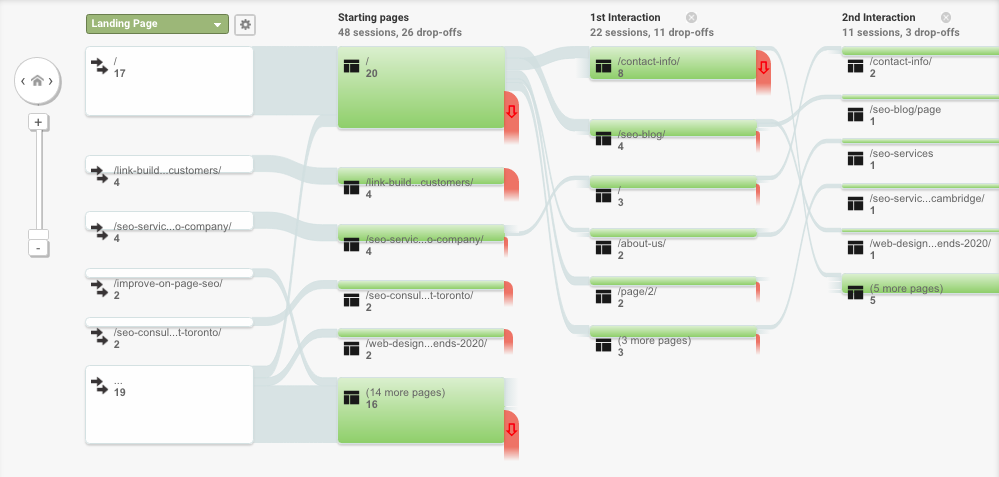
Creating goals and conversions in Analytics can contribute to establishing better paths within your site to guide visitors to a preferred action. You can track the pages that users click-through to as well as where they drop off.

Example of Google Analytics page flow for more advanced SEO

Creating goals is a way to measure the success of your SEO campaigns. By improving on the number of drop-offs you can lead a larger percentage of visitors to pages that help in achieving more conversions and complete more goals.

Compare past and current performance

You can also monitor the traffic on individual pages. This tool allows you to compare any time period with each other to see whether your traffic is above or below the past period’s numbers.

Search console

Search console (another free tool from Google) allows you insight into the performance and health of your website.

You can check to see what queries your pages are appearing for and of those queries how many clicks you earned to your website.

You can build more keyword ideas and content around successful keywords based on the information provided in this tool.

Technical error alerts

The search console informs you of technical errors on your website and will list the URLs of the pages that need work. If your page speed is abnormally slow you can see what pages need improvement.

If your site receives a manual penalty, the search console is the first place to look to confirm whether this has happened. In fact, it’s the first place to look if there’s a sudden drop in traffic since you can see the number of URLs you have indexed as well-just in case the unthinkable is happening and your pages were being taken off of Google’s index (it happens!).

Monitor backlinks

There is a list of the most linked pages as well as the websites that link to you’re the most. You can monitor what backlinks you’re receiving at the fastest time possible since there’s no search engine spider that would know you have a backlink before Google.

Make data-driven decisions

The SEO tools available are numerous and there are more than enough to extract the data you need to make the best decisions for your business. Having insight into the success or failure of specific efforts can save you time and resources in the future.

Analytical tools help to streamline your efforts in creating a more efficient and more effective website that generates traffic leads and new clients.

Implement SEO basics at the earliest stages of development

Search engine optimization is a long-term strategy that can sometimes have quick results. Learn the most important sources of traffic for your business and develop your website to tap into those sources.

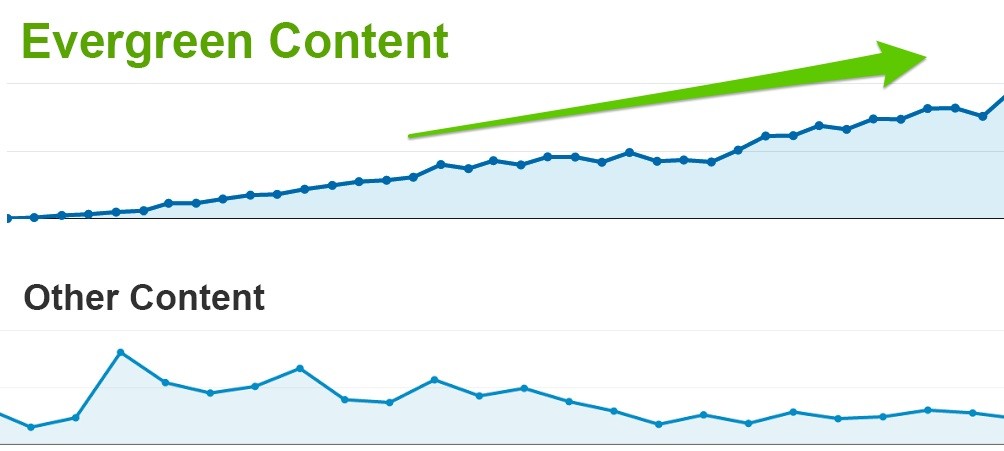
Authoritative content is by far the largest ranking factor when it’s optimized to answer search intent. Creating content assets doesn’t immediately translate into massive streams of traffic-there is a period for that content to settle and make its way to the top of the search results.

Example of how content builds traffic over time

Strategize your keywords, content and link building strategies. The earlier you begin, the sooner you’ll reap the benefits of a well optimized website that generates high converting traffic and contributes to more leads, and revenue.

Written by Christian Carere · Categorized: Web development

  • « Go to Previous Page
  • Go to page 1
  • Interim pages omitted …
  • Go to page 16
  • Go to page 17
  • Go to page 18
  • Go to page 19
  • Go to page 20
  • Interim pages omitted …
  • Go to page 32
  • Go to Next Page »

Footer

Need professional SEO advice?

Give us a call to learn more about how we can help your business

Call for a consultation Request a proposal

Request a free website analysis and proposal for your company by filling out the ” Request a Proposal” form.

  • Privacy Policy
  • Terms Of Service
  • Cities we’ve served

© 2026 · Digital Ducats Inc.