• Skip to main content
  • Skip to footer

Digital Ducats Inc.

SEO Consulting & Services

  • Home
  • About
    • SEO Consulting
  • Services
    • SEO
    • Local SEO
  • Contact
    • Pricing
    • Write For Us
  • Blog
You are here: Home / Blog

Nov 23 2020

What Is Search Intent Optimization In SEO?

Search intent (aka user intent) is the underlying motivation a user has when searching a specific query. Satisfying search intent is Google’s top priority when it displays the organic results and SERP features. Search intent optimization is the process of identifying what exactly users are looking for and optimizing your page with the ability to satisfy search intent.

Why is search intent important?

The importance of identifying search intent, or user intent, is to be able to provide the content and information required to satisfy the user. In order to be the final destination of a search, your website must satisfy the user’s intent. If we miss the mark, visitors will leave your website in search of another that can satisfy search intent.

When you hit the mark on search intent, users spend time on your site. The concept is simple and yet it is of the utmost importance to make sure you understand the intent a keyword implies before creating content to target that word or phrase.

Generally speaking, search intent falls into three broad categories; informational, transactional and navigational.

Informational intent

This type of search is where the user is looking for explanations, answers to problems and is basically researching something specific. Over 80% of searches are informational according to a Penn State research study. The type of content that ranks for informational searches are therefore blog posts, articles, guides, videos, best-of lists, etc.

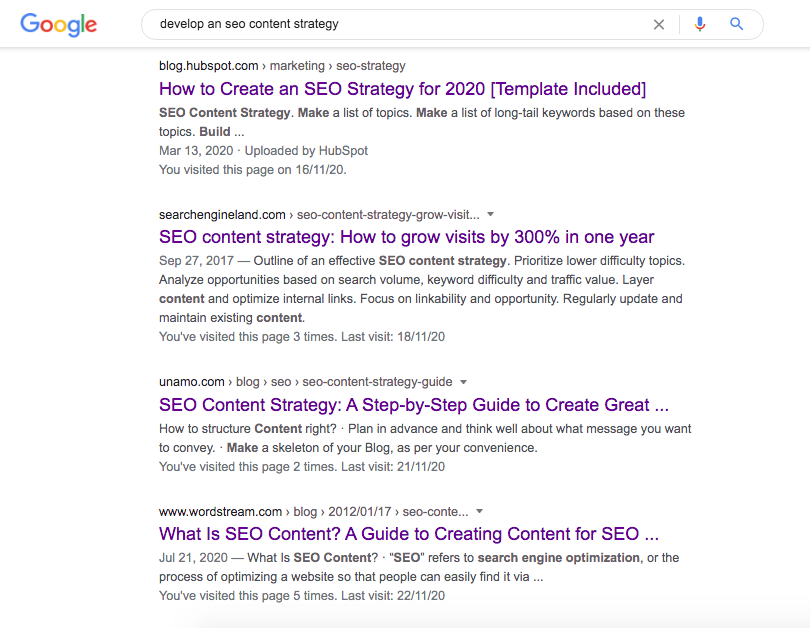
If you were searching for the phrase develop an SEO content strategy, the search results display websites that teach a template approach on how to develop an seo content strategy.
Transactional intent

A user with transactional intent is looking to make a purchase. These types of searches are usually made with buyer keywords such as “where to buy X” or “what stores sell Y”

Transactional searches also include brand names and product names. The first clue to spotting a transactional search is when you see a lot of ads near the top of the page. The websites listed in the organic search results will also have products listed and a means for purchasing them.
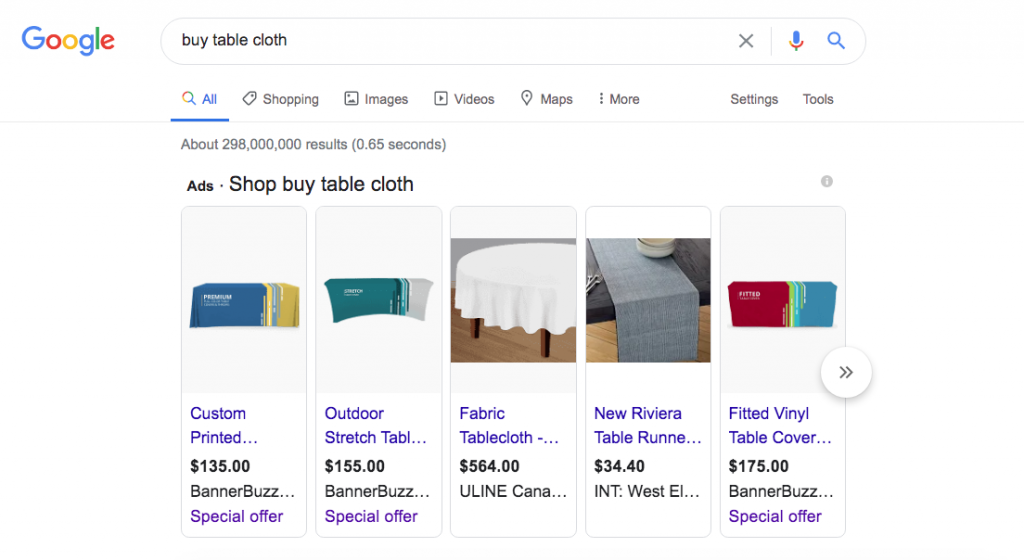
Example of transactional intent when identifying your search intent optimization

Navigational intent

Many people use search engines to find websites or pages that they want to go to specifically. For instance, millions of users type in Facebook login to get to their Facebook page.

Ranking for terms like this have little to no value because the user already knows where they want to go. In most cases the result they’re looking for is within the top one or two results and they’ll click without scanning the rest of the page.

For example, if I want to go to Google Analytics a simple search would give me the URL. Despite the millions of searches being made for this keyword, the other sites ranking below, I would most likely have an extremely low click-through because the answer to the user’s intent is the first result on the page.
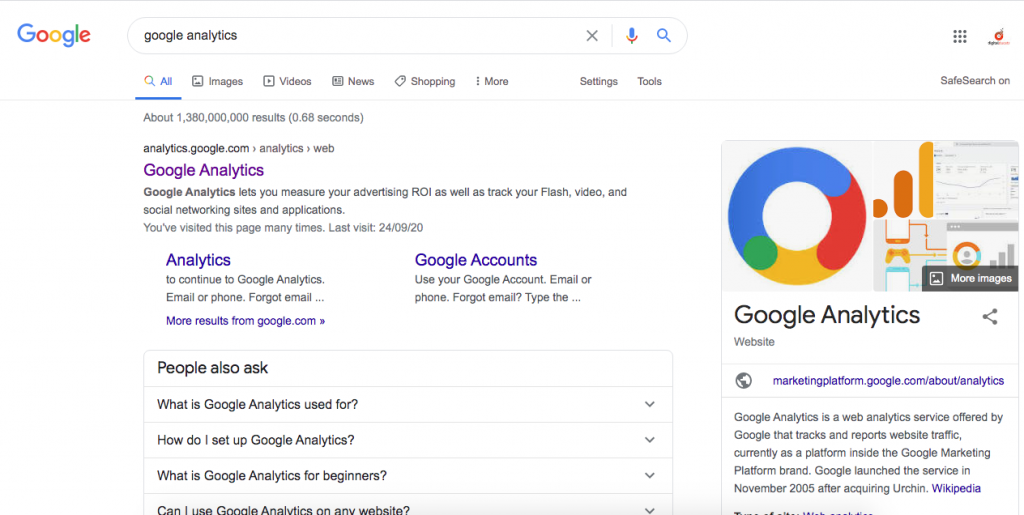
Example of navigational intent when attempting search intent optimization

How to discover search intent

When you’re attempting to rank for specific keywords, you need to know how to discover search intent. You could say that every search engine’s goal is to be as accurate as possible in attempting to satisfy the user’s intent. Therefore, to rank at the top, your page needs to match what the search engine is showing you is the most important content to satisfying user intent.

There is no other method better than extracting clues from the search engine result page itself. If you want to isolate the true intent of a search, you need to see what type of content is ranking in the top ten positions.

Categorize the general user intent

Based on the three categories described above, come to a conclusion on what type of content is a match to user intent. Does the user have transactional, informational or navigational intent? Does your page cover the same content and offer similar solutions to the top-ranking pages?

Scan the top pages for topic coverage

Go through the top-ranking pages to see how they’ve satisfied intent. If you scan the subheadings you can get a general idea of the topics they’ve covered to ensure that you haven’t missed anything.
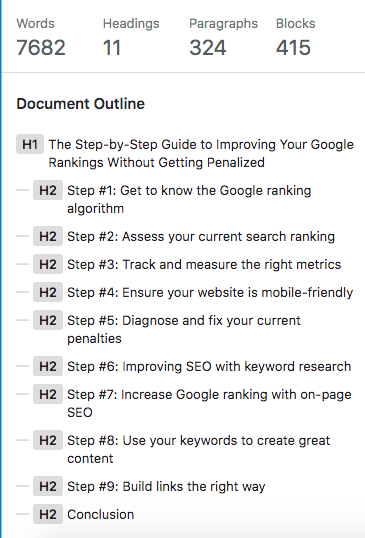
Example of how to analyze a competitors page using the WordPress HTML editors summary button.
An example of an article that ranks for improve Google rankings

Compare top-ranking pages using the WordPress HTML summary as a way to highlight important topics that are being covered on a competitor’s page.

The keywords that the top 10 pages are ranking for are clues to the content they’ve included on their pages. Use the keywords that your page is not optimized to rank for as a guide on how to include the same and better content that the top pages have published.

Scan the SERP for additional clues

Do a sweep of the first page of results for the SERP features that are being displayed. You can get a few good clues that hint at the intent of a search by interpreting what Google is displaying.

Position zero

The first result on a page is often a featured snippet. This immediately shows a user the most convenient result with an answer without clicking further. Use this feature to determine what Google is displaying as the most important information associated with the search term.

PAA boxes

For example, the PAA box will often appear with a bunch of related questions. This is Google’s way of telling you that these questions are relevant to the keyword research. They are questions that people also ask!

Add the questions you find in the PAA box and publish your own answers to improve your page’s ability to answer search intent. It will also make your page eligible to appear in this feature.

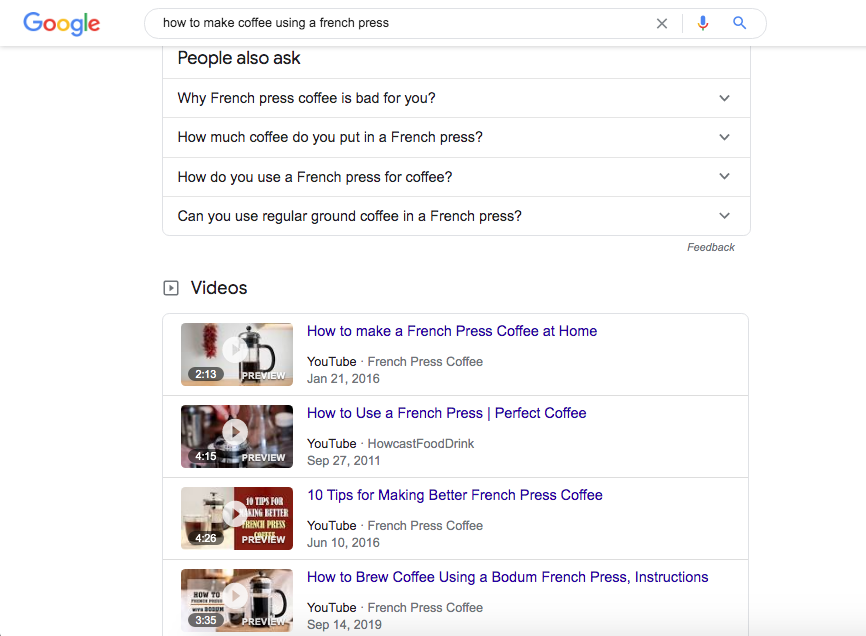
Videos

Videos are important to note when they are placed higher up on the page. The higher up on the SERP that results appear, the more relevant they are to the keyword search. 

Videos will often appear as an answer to queries for how to do something or for product reviews.
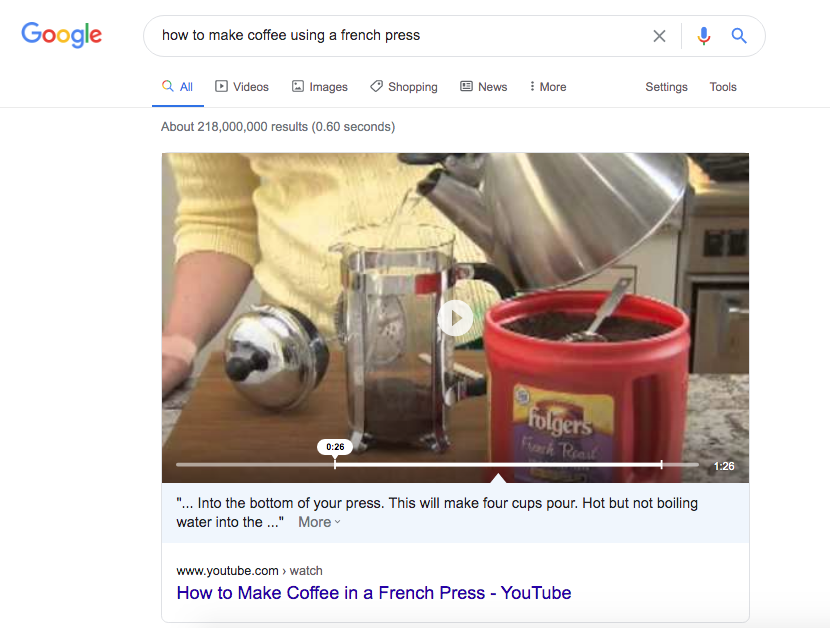
Placing a video on your page can create more relevance to the query. In the above example, a video appears in the featured snippet, followed by the PAA box followed by a stack of video results. It should be obvious Google and users find video the most helpful and the strongest form of content to answer intent.

If you publish a video on YouTube, you may even have a chance of appearing in the video feature as well as strengthen your page to appear in the organic results.

Local pack

When you see the local pack appear, it becomes clear that your keyword indicates local intent. This could change how you optimize your content in order to reflect that your business serves a specific local area.

Google Ads

When you see a lot of Google Ads appear on the SERP, there is a strong transactional intent behind the search query. Users may be looking for a product or service to buy because they’re at the decision stage of the buyer journey. In situations like this optimizing a landing page that gives them the option to make a purchase would be a way to satisfy search intent.

Publish high-quality content

The skyscraper method is not a new concept when it comes to outperforming the competition. Humans will always have the need to conquer and outperform the standard-no matter what situation. The same holds true for SEO and website development.

In order to be the best answer to a search query, you need to produce the best content that satisfies the intent of the query. It’s been established and a well-known fact that Google is choosing to display websites that are typically more in-depth.

Word count is not a ranking factor, but it is an indication of the level of detail or the breadth of the topic your page needs to cover. The average length of a page that ranks first on Google is over 2000 words.
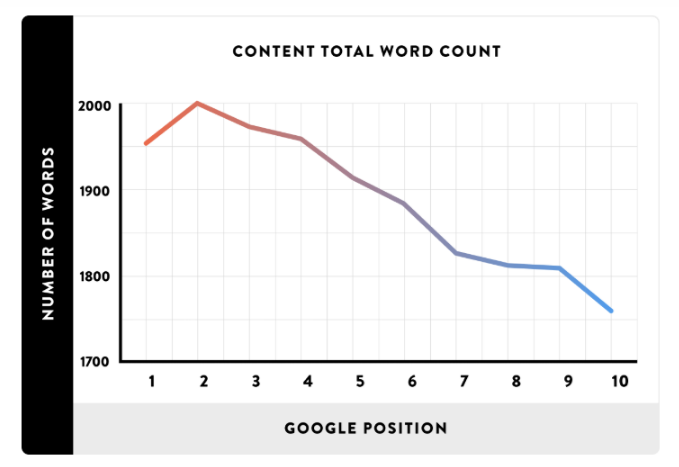
Average word count of the top 10 ranking pages

Knowing this, it seems only logical that you would need to plan out a page that exceeds the standard in the level of depth and coverage.

Interested in other ways to drive traffic? Read about the 33 Ways To Drive More Traffic To Your Website

Address user intent for better rankings

Despite the 200 plus ranking factors that search engines use to assess the ranking ability of your website, none are as important as being able to satisfy search intent. The truth is, if your page doesn’t have what users want, it will never rank on the first page of Google.

As search engines evolve, so does search engine optimization. The general trend has been in favour of providing more accurate and higher quality search results. This being true, search intent optimization has become the most important aspect of achieving a top ranking.

Related reading: Google’s BERT Update: Should You Be Worried?

Written by Christian Carere · Categorized: Content strategy

Nov 22 2020

How To Develop An SEO Content Marketing Strategy

Content is king. It doesn’t get more cliché than that but it needs to be said because it is a major truism in the SEO industry. Without content, SEO doesn’t exist. Developing an SEO content marketing strategy is your blueprint to communicating, convincing and converting visitors into clients.

What is an SEO content marketing strategy?

An SEO content marketing strategy is a plan that strategizes on how to publish and promote content that guides an audience to take action. It’s not only targeted to the visitors on your website, but to those off-site that you want to educate, convince and convert into clients.

Your SEO content marketing strategy establishes the topics, keywords and content tilt to break through your competition and guide visitors to purchasing from your company.

What are the advantages of an SEO content strategy?

Developing an SEO content strategy establishes a measurable goal and a plan for how to achieve it. Publishing content without an SEO strategy can be compared to the likes of throwing darts with a blindfold on. Your content may be high quality but if it’s aimed at the wrong target, its impact will have a minimal effect on your business.

Developing an SEO content strategy establishes your goals, audience, strengths, opportunities and a way of measuring your success. Use the following as a way to develop an SEO content strategy that has a maximum impact on how you drive traffic to your site and convert those visitors into clients.

Set your goal

There’s no point in randomly producing content without having a specific goal in mind. Establish a specific goal from the onset of your SEO content strategy to define your purpose for publishing content. A goal also allows you to refer back to an overarching purpose to clarify the decisions you need to make when developing your SEO content strategy.

If you know that your goal is to get people to purchase more products on a retail website, the content strategy will be different than getting visitors to leave their contact information or subscribe to a newsletter.

Clearly define the goals you have for your company so you can effectively create content that moves visitors further along the marketing funnel.

Target a specific audience

Take the time to carve out a very defined group that you can confidently point to as your target audience. This can be done effectively by creating a buyer persona. A buyer persona allows you to brainstorm the characteristics of your ideal client with greater accuracy by identifying the pain points that are most common within that group.

Determine the larger divisions of your target audience first such as the primary age group that your product or service is most well-received. You can further break your target audience down by the current characteristics your clients share as well as the general commonalities associated with their generation.

Image showing different segments of age to identify your buyer persona and enhance your SEO content marketing strategy

The more detailed you are in creating your buyer persona, the more information you have on what they find important in their lives.

Your buyer persona will set the tone for how you communicate your message regarding language and content type. 

If your target group is mostly teenagers, your content should be more visual with a lean on images and videos.

If your target group is middle-aged businessmen, your content would be more long-form, in-depth articles that provide insight into the topics that matter most.

Identify your unique selling point

There are millions of businesses and even more websites to compete within every industry. What sets you apart from the competition? Identify the USP of your company in order to highlight what you’re offering to those in need of your services.

Every company is faced with competition that more or less offers the same product or service. What is the expertise your company offers that no other company does? What can you promote that will convince prospective clients that your company is the best choice for their needs?

Pricing, superior customer service and convenience are commonly promoted by businesses. However, having a unique skillset or offering that no other business offers will generate the most revenue.

In Canada, Pizza Pizza was able to promote their brand by offering a 30 min or it’s free policy. No other pizza delivery service (at the time) offered the convenience of such prompt service with a guaranteed delivery time.

The recognition that delivery time is one of the most important aspects of choosing a pizza place for delivery, gave rise to the idea of guaranteeing delivery time. Pizza Pizza addressed the pain point of waiting long periods of time for delivery with a guarantee of 30 min or it’s free. 

This USP contributed to them becoming one of the largest pizza chains in Canada.

Find the sweet spot in your industry

Brainstorm topics that are related to your business but have no competition, which is also referred to as finding your content tilt. These topics represent the sweet spot in your industry since you can create high impact content that cuts through the competition and reaches your audience.

The content tilt your company uses can be found by addressing your target audience’s pain points with your unique selling points and expertise. 

Research keywords

The next step in creating your SEO content marketing strategy is to create a list of keywords your audience uses to find solutions to their pain points. Your research should include prioritizing search terms for landing pages, blog content and any gated content or specialized types you’ll use within your strategy..

You should already have your list of topics that represent your content tilt. Break down each topic into a list of pain points and problems most commonly faced by your target audience.

Establish search intent

A major function of keyword research is to make sure that the keywords you choose to target align with the user’s intent of the search and the topics you’ve outlined in your strategy. A common mistake made by business owners is to focus on the metrics of a keyword rather than target terms that are audience-centric. 

Search engines place a heavy emphasis on the ability of a page/website to adequately satisfy the intent of a search. Establish exactly what the user needs to know in order to become the final destination of their search. If your content doesn’t satisfy the user, it results in them returning to the sea of search results to look for another website that has what they need.

Establish the true intent of a search through comparative and competitive analysis. Make sure the search results are filled with pages similar to your own and the content type is a match for what you have planned.

Compare important metrics 

Run each of your ideas through the keyword tool of your choice to identify the terms that have low competition and high search volume. At this point, most of the keywords you’re researching should represent business value since they are all targeted at addressing the issues that are most important to your audience.

Keep in mind that high search volume doesn’t trump business value. You’ll need to establish that a keyword does in fact generate a minimum number of searches, but apart from that if your topic is important to your audience, the volume is merely a vanity metric.

As you identify keywords and add them to your list, keep them separated in groups of intent. You’ll avoid targeting the most competitive phrases or find alternatives and long-tail versions to get your message to the right audience.

Create a content schedule

It’s important to get a general outline of when you’re publishing the content you’ve chosen. By creating an editorial calendar, you’re not left trying to decide what to publish at the last minute, since it has been scheduled ahead of time.

An editorial calendar allows you to plan the content you need to adequately cover a topic. This gives you a broad perspective on how to layer your content from the bottom of the funnel, middle of the funnel to the top of the funnel.

Cluster your content

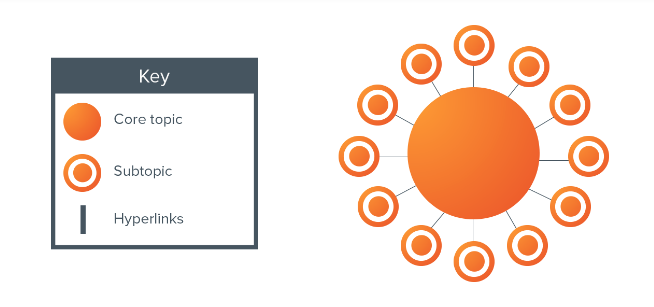
The end result should be a topic cluster to establish the importance of your main keyword theme to search engines and users. A topic cluster is composed of a pillar page and cluster content.

topic clusters concept to structure your content in an SEO content marketing strategy

The pillar page covers a broad range of subtopics that represent one major keyword theme. It will touch upon the topic in its entirety, but not go deep into detail on the subtopics, as this will be the purpose for your cluster content.

Pillar pages link out to cluster content in order to give your audience the option of exploring a specific aspect within the broader topic. Cluster content typically targets long-tail keywords because of the narrow focus they have on exploring a specific area.

Cluster content links back to the pillar page as well as related content within the topic cluster.

This structure generates smaller volumes of traffic from the cluster content, which leads visitors to the pillar page and other pages further within your marketing funnel. 

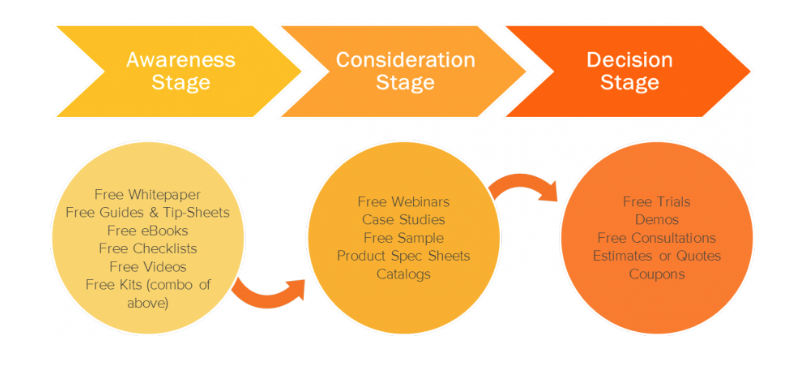
the buyer journey and the content to include when incorporating SEO with web design

As more pages rank within the topic cluster, they transfer authority to the pillar page and your website gains more ranking ability for the keyword topic.

Track, measure, analyze and adapt

Establish a way to measure the success of your SEO content marketing strategy. In order to grow and amplify the efforts that made the most impact, it’s important to know what worked the best and what efforts did not work very well.

If your goal is more sales conversions, you’ll need to track the flow of your visitors from your landing pages. Determine the content that leads visitors to more conversions as well as the content that results in the most exits.

Build more content around the keywords that are converting and try to guide visitors away from the pages that result in a bounce or exit.

Gated content can be used as a way of measuring the interest that your articles are garnering. Have visitors enter their email addresses to receive whitepapers or guides on the topic that they’ve been reading about.

A high number of conversions of visitors accessing your gated content is an easy way to tell whether your content is on target.

Build an email list

If you’ve come this far in building an effective SEO content marketing strategy, you should be building an email list. No matter what your industry, a list of interested people is a welcome asset to have for instant traffic to new content as well as to promote sales and discounts on services.

An email list is an excellent source for finding more out about your prospective clients. Segment your list through a series of questions on what your audience would like to receive in their inbox and then send them the goods!

Use your email list to gain more insight into the interests of your target audience. You can use split-tests that measure the open rates of emails you send to determine catchy subject lines. By seeing which email gets opened the most you identify catchy headlines that will grab the attention of your audience.

Use split tests on the click-through rate from the email to your website to see how engaged your audience is in the content you send. A high click-through rate will indicate the topic is worth exploring and building more content around on your website.

All of these decisions need to be made before you set your plan into effect. When you know exactly what you’re going to need to execute the plan, you’re ready for the last stage of your SEO content strategy.

Publish SEO content

Execute the final stage of your SEO content marketing strategy by publishing the content you need for each area of your plan. Your strategy already details the most important topics, the layered content, your target keywords and an established goal with a method for tracking results.

Approach every content piece with a 10X mentality, where your content will be 10 times better than anything already published. Make sure your content includes every topic and subtopic that is being covered in the top ten search results. Add additional content to make sure your pages outperform the competition through your own additional research.

Your finished product should be a compilation of the best of all worlds. There shouldn’t be a reason that a visitor could leave your page to find something better. SEO content writing accomplishes this task since the process makes sure all bases are covered.

Optimize your page for maximum results

In order to maximize the traffic, your page can receive you want to have all of your basic on-page optimization aspects covered. In addition, explore every opportunity you have to drive traffic from featured snippets, PAA boxes, videos, images and rich results.

Capitalize on every traffic opportunity available by analyzing the SERP for features your content can appear in. Simple formatting and publishing your answers to commonly asked questions can result in being featured in a snippet and PAA box.

It should be clear that the higher up on the SERP the higher your click-through rate will be. The top positions receive the most traffic from any given search term. Place your keyword in the expected places to clearly demonstrate to search engines what search terms your page should appear for.

Rich results will also contribute to a higher click-through rate to your website. Consult with the list of available features your website is eligible to implement the structured data markup required.

Strategize and optimize your content production

The content on your website is a reflection of your business and a tool for educating visitors and moving them closer to making a purchase decision with your company. The content you produce has a major impact on your website’s ability to generate traffic that converts.

In order to maximize the revenue, your company generates, establish an SEO content strategy. It is only when you’ve defined your goals that you’re able to achieve them. Use the strengths of your business to solve your audience’s problems and publish content that educates visitors on how that works.

When people understand what you have to offer that no other company has, they are more likely to side with your cause. Give people a reason to choose your business over the competition.

An effective SEO content marketing strategy is the blueprint for your success in driving traffic that converts and amplifying those results.

Written by Christian Carere · Categorized: Content strategy

Nov 19 2020

14 Benefits Of An Infographic

Infographics may have seen the height of their popularity but don’t underestimate the power they have on your SEO content strategy. In head to head comparisons with text articles, there is no doubt that infographics outperform in every category. The benefits of an infographic include more links, increased traffic and higher levels of engagement by incorporating visually appealing forms of content.

What is an infographic?

An infographic is a collection of visualized data that uses charts, images and graphs with minimal text. Infographics can tell a story, explain instructions or act as a resource that summarizes data-driven facts and statistics. Infographics are used to communicate large amounts of information that is more easily understood through the use of visualized data.

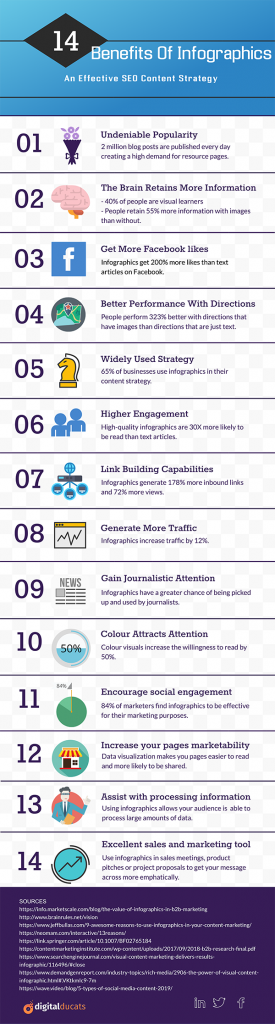
The following infographic lists 14 benefits of an infographic as it pertains to an SEO content strategy.

An infographic of 14 benefits of an infographic

Infographics are an excellent SEO content strategy for creating backlinks and brand awareness. Before the rise of video, infographics were the most widely shared pieces of content. They combine imagery with statistics and facts for a more enhanced and enjoyable learning experience.

Additionally, the benefits of using an infographic are as follows:

Undeniable popularity

One benefit of an infographic that there is a high demand for quotable resources. People are always looking for hard facts to back up an opinion and add credibility to their content. Infographics are ideal as resources since they provide an easy way to navigate through a collection of facts and data points.

With over 2 million blog posts being published a day, there will be no shortage of the demand for statistical resources.

The brain retains more information

According to Brainrules.net after three days of reading a text article a person will retain 10% of what they read. When placing an image in a text article that percentage jumps to allow 65% retention of the same content. This can be attributed to the fact that 40% are visual learners.

Infographics can literally be described as visualized data. Pairing images with the main data points makes up 95% of the entire infographic. They can be used as the ultimate tool for not only getting your message across to an audience but having that message retained for a few days after receiving it.

Get more Facebook likes

Your social network will give you much more traffic and exposure by using infographics over text. Infographics get approximately 200% more likes compared to text articles on Facebook. (~Wave Video)

Better performance with directions

When presented with driving directions that included images, people performed 323% better than those who had directions with text only. It’s a natural tendency for the brain to attach relevant images to text, which would explain the difference in performance.

Consider using infographics for how-to pieces of content. Users will have a higher success ratio for learning and completing a task when there are images to support each instruction. As you are well aware, a picture is worth a thousand words.

Widely used strategy

It’s comforting to know you’re employing a strategy that is proven to be effective. 65% of businesses are using infographics as part of their SEO content strategy because of the benefits gained.

Infographics serve as an excellent tool for B2B marketing because it’s easier to convey large sums of information in a visual display. Using visualized data is also improves the conversion rate to build local links.

Higher user engagement (dwell time)

Engagement is one of the factors that site owners can improve on to boost ranking in the search results. When you know that a high-quality infographic is 30X more likely to be read than a text article, how could you not use infographics?

Now that you know users are much more likely to read visualized data, as opposed to a list of stats and facts., improve the time visitors spend on your page by using engaging images with data-driven facts.

The length of time that visitors spend on your page is an engagement statistic known as dwell time. Increased dwell time contributes to a higher ranking in the SERP.

Enhanced link building capabilities

As a link building strategy, infographics can be a powerful tactic to land you a lot of high-quality backlinks. Infographics generate 178% more inbound links and 72% more views (Hubspot) than content with just text.

Guest posting on high traffic websites can get your image in front of a large audience. It only takes a quality infographic to start the ball rolling for attracting backlinks.

Here at Digital Ducats Inc., we used an infographic on website design trends to generate thousands of backlinks. The project was aimed at acquiring local backlinks from Toronto experts but became one of the most linked pages on the site.

The backlinks we acquired came from a few different sources: Local companies linking to the page, guest posts that linked to the page and were syndicated across hundreds of other websites, and people landing on the page and linking to it after it ranked for a number of keywords. 

We also submitted the image to a few of the most popular infographic directories to get the ball rolling with a few starter links.

Drive more traffic from improved search visibility

One of the three largest ranking factors search engines use is backlinks. It should be no surprise that once your infographic starts accumulating backlinks it’s going to start ranking for a number of different keywords, which drives organic traffic.

More backlinks also equate to more entry points for visitors to find your website. If your article is syndicated across a large number of websites, the backlinks alone will drive significant volumes of traffic.

Optimize your page for phrases that represent business value. Increase the number of keywords your page ranks for by including an explanation of your data point as a text portion within your post. 

Including text on your page (as opposed to only posting the image) provides search engines with the content and context to rank for keyword related phrases.

More engagement, more links, more views lead to more visitors. On average, infographics generate 12% more traffic to your website. (Demand Gen Report)

Gain journalistic attention

Journalists will follow press release sites for interesting stories that they can publish on their blogs. Consider the heightened engagement that infographics generate and it makes sense why journalists are more open to republishing a high-quality infographic.

Colour attracts attention

Use the psychology of colour to your advantage. Colour increases the willingness to read by 50% so make your infographics visually stunning and full of colour. (Neomam)

Increase social engagement

Before video made its big surge in popularity, infographics were the most shared form of content on Facebook. As the second most shared form of content, take advantage of the ability to expand your audience and increase social engagement.

Rather than firing off your entire infographic into your network, use snippets of your image as teasers. Chop your infographic up into multiple pieces of content to create more opportunities to drive traffic and build your audience. 

Using pieces of your infographic also meshes better with the format for Facebook and Instagram. Facebook uses rectangle images and on Instagram, you should try to make each snippet a square so users are able to see the entire image.

Infographics increase your pages marketability

Add value to your content by creating an infographic. Whether you’re engaged in a link building outreach campaign or you’re publishing content on your website for a specific audience, elevate the quality of your content by incorporating data-driven images.

You can improve the success rate of your outreach with infographics by making your value proposition more enticing. Website owners are much more open to sharing an infographic on their website as opposed to publishing an article.

Assist with processing information

Reading straight facts and data can eventually lead to a reader completely tuning out their attention and losing their focus. An infographic helps readers digest data-driven facts and information in bite-sized chunks.

The fact that there’s an image to help break the monotony of numbers and text contributes to an understanding beyond words. Seeing a comparison chart will immediately get the message across as opposed to reading the comparison statistics.

When you want your audience to be able to get through large amounts of data, using infographics makes it easier to accomplish.

Excellent sales and marketing tool

Based on increased data processing and retention, it’s easy to come to the conclusion that infographics are excellent sales and marketing tools. Use infographics in sales meetings, product pitches or project proposals to get your message across more emphatically.

The use of infographics on a sales page within your website works to can keep your company in a prospective client’s mind for a longer period of time. Data-driven images are the perfect tool to help increase sales.

What are the disadvantages of infographics?

Not to be a Debbie downer, but nothing is all rainbows and sunshine. There are always a few clouds that loom on the horizon…

You can’t dive headfirst into creating an infographic without knowing the downside. Here are a few things to consider before deciding on whether you’ll use an infographic or not.

Time consuming to build

Infographics are extremely time-consuming to create when you compare them to publishing your typical blog post with images. The amount of energy and resources that go into creating an infographic can dwarf regular blog content when you consider the research you need or coming up with effective data points.

An infographic isn’t very effective unless it serves a purpose really well. Original research is ideal, which in itself is an entire project. Otherwise, you’ll need to come up with line items in which you can’t take everything from one source. You need to mix up your sources and make sure they get the proper attribution.

The design is also a time-consuming aspect. Original images are preferred which means you’ll need to come up with an image for each data point in your image. Don’t forget to customize the background, the text and header to create something unique.

Not ideal format for social media

Most infographics with a lot of information are long and skinny, which is not ideal for social sharing. Of course you can make infographics specifically for social media, but again, your images won’t be able to pack as much information when you’re limited to a square or rectangle.

Generic templates bore people

There are a few companies that you can turn to for the software to create infographics. What happens when thousands of people are using the same software? You start to see the same generic templates and the same icons and images which devalues the level of professionalism your infographic exudes.

In order to separate yourself from the masses, you need to customize your projects as much as possible. A unique design will be much more appealing to your audience and impressive to prospective clients.

There’s risk associate with your investment in resources

Creating a unique and effective infographic is not something to take lightly. You’ll need to invest the time to make it something that looks professional enough to grab the attention of your audience. There is always an implied risk that your infographic doesn’t live up to expectations.

Suppose you’ve decided to use an infographic as a link building method. After hours of labour-intensive work, you begin a massive outreach to companies and website owners you thought would love your idea. If no one wants to put your infographic on their website or link to yours then you’ve wasted a lot of time in resources on a project with minimal results.

Harder to edit and update

Once your infographic is posted on your website, you already have a URL assigned to it. In order to update your image, you need to go back to the infographic editor, make changes, save, optimize the image, edit the name and upload back to your site with the same URL so you don’t lose any backlinks. It’s a bit of a process….

Enjoy the advantages of using infographics

There’s a lot of publishers that write about the rise and fall of infographics but don’t be fooled into thinking they are an ineffective marketing tool. The truth is that infographics had their golden era and now that they aren’t being glorified, it takes useful data and a well-planned infographic to have the same impact on your website.

If you’ve been in the SEO business since 2013, would know that this was the year the popularity of infographics went absolutely through the charts. If you had an infographic you could get it published on some of the top names in the industry and earn high-quality backlinks.

IN 2016, however, when the industry became saturated with low-quality images, publishers stopped publishing them and journalists stopped sharing them in their columns. That didn’t put an end to infographics, but just made the data that they hosted the main selling point.

The point is that at the end of the day, original data reigns supreme and a well thought out and carefully planned infographic can generate traffic, backlinks and contribute to new sales.

One thing that remains constant is high-quality content translates into more traffic, backlinks and credibility. Incorporate infographics in your content strategy for added value and new sources of backlinks and increased search visibility.

Written by Christian Carere · Categorized: Content strategy

  • « Go to Previous Page
  • Go to page 1
  • Interim pages omitted …
  • Go to page 14
  • Go to page 15
  • Go to page 16
  • Go to page 17
  • Go to page 18
  • Interim pages omitted …
  • Go to page 32
  • Go to Next Page »

Footer

Need professional SEO advice?

Give us a call to learn more about how we can help your business

Call for a consultation Request a proposal

Request a free website analysis and proposal for your company by filling out the ” Request a Proposal” form.

  • Privacy Policy
  • Terms Of Service
  • Cities we’ve served

© 2026 · Digital Ducats Inc.