• Skip to main content
  • Skip to footer

Digital Ducats Inc.

SEO Consulting & Services

  • Home
  • About
    • SEO Consulting
  • Services
    • SEO
    • Local SEO
  • Contact
    • Pricing
    • Write For Us
  • Blog
You are here: Home / Blog

Dec 21 2020

6 Tips To Increase Conversion Rates On Your Website

It’s one thing to get visitors to your site but what’s the point of driving traffic if the visitors don’t end up buying a product or subscribing to your mailing list? The goal of driving high volumes of traffic to your website is to increase the revenue your website generates. This article will give you a few tips on how to increase conversion rates, which leads to new clients, subscribers and ultimately more sales.

What are conversion rates?
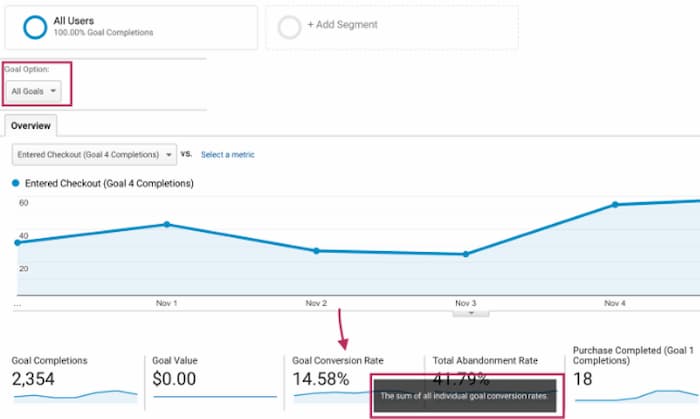
An Analytics report showing the goal conversion rate

A conversion rate is the percentage of visitors that perform a desired action on your website. The action can be whatever you decide is the ultimate goal for your traffic. For instance, if you were selling products a conversion would be when a visitor purchases one of your products.

If 1000 visitors visit your website and 50 visitors make a purchase, your conversion rate is 5%.

50/1000=0.05

Conversions don’t necessarily need to be a purchase. You could also set up conversion goals of acquiring contact information. 

If a visitor subscribes to your mailing list this can also be considered a conversion.
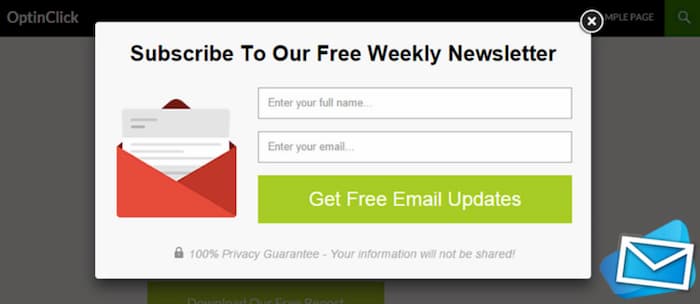
An example of an opt-in sign up popover

If your website is set up for AdSense, a conversion would be for a visitor to click on one of the ads on your pages. This would be the most desirable result when you’re getting paid for every click someone makes on advertisement on your website.
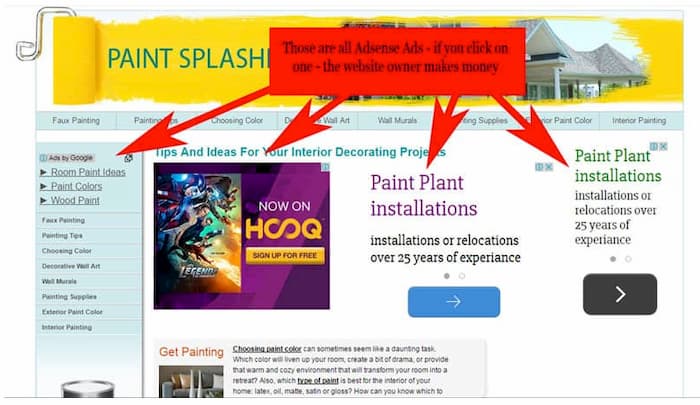
IMage of multiple adsense images that result in the publisher being paid for every click.

You can set up multiple conversion goals for your visitors as well as track the results using Google Analytics. 
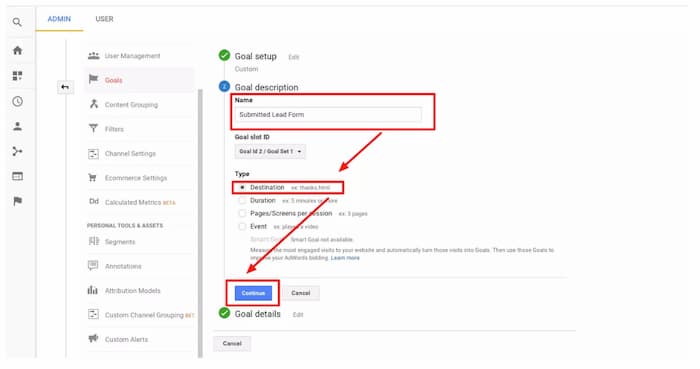
The page for setting up goal conversions on Google Analytics

Once you have your conversion goals in place, you can see where your pages succeed in guiding visitors to making the most conversions. 

Use the following tips to increase conversions rates on your website. 

Use an effective call to action

Never assume that your visitors know exactly what to do on your website. Make it very clear for users what the next steps are to move forward in making a conversion.

For example, if you’re in the service industry let them know how they can get personalized help using your services by clicking the button to call your business at the end of every article.
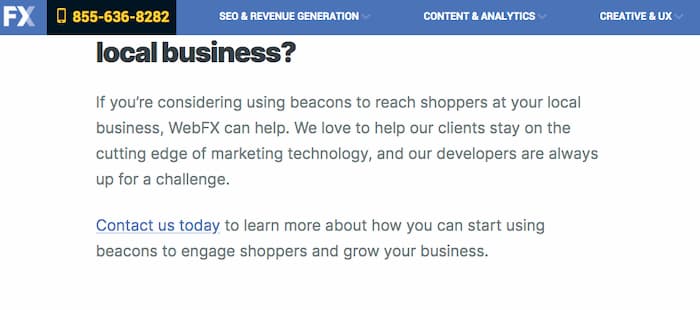
Example of how WebFx tells its readers to place a call to learn more about how they can help to increase conversion rates

Gently urge your users to complete the desired action. If you want people to like or share your article on social media, you need to ask them to do so at the end in a clear and polite way.
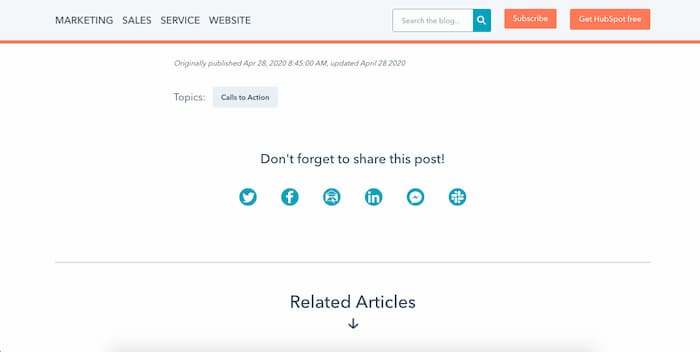
Hubspot uses a call to action asking to share on social media after their articles

If you want your visitors to sign up for your email list, there needs to be a call to action to guide them into doing so. If the only text your opt-in box has is  “Name” and “email address” why would anyone enter their information? 

Opt in form that entices users to fill enter info and increase conversion rates

There has to be a message that urges visitors to fill out your form. Using an effective call to action is an absolute necessity to increase conversion rates on your website.

Internal linking strategy

The internal linking strategy implemented on your website can directly affect your conversion rate. Internal links are a great way to guide visitors through related content within your site. Not only can you get more content in front of your audience, but you can guide them to the pages that convert at the highest rate.

You should already be tracking the conversion rates of your pages on Google Analytics or your analytic tracking software of your choice.

Identify the pages that are converting at the highest rates. You can do this by going to behaviour, Site content, All pages.
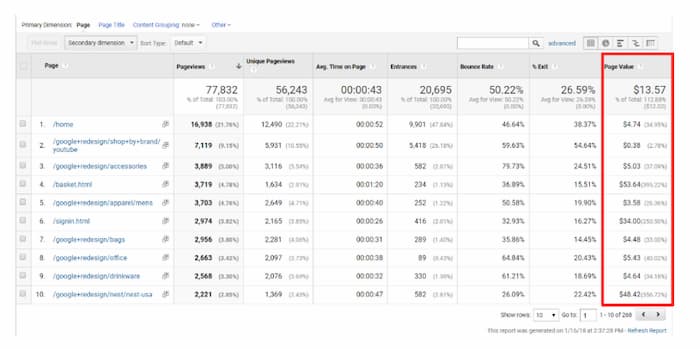
Filter the pages to list the page value starting at the largest amount to the lowest.

Make it a priority to link to these pages whenever possible. Guide users to these pages by using editorial links to hint at the pages they may be interested in.

You can also give users the option at the end of an article to visit the pages that they would also be interested in reading.
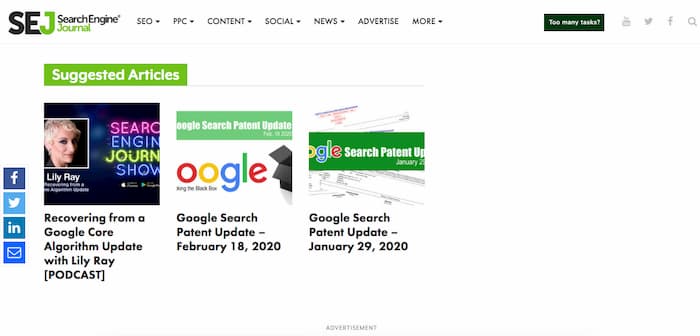
Example of how Search Engine Journal suggests related articles after every one of their articles

The more opportunities you give visitors to get to the pages that convert at high rates, the higher you’ll increase conversion rates will be from your total volume of traffic.

Page load time

The time it takes your pages to load has a direct impact on your bounce rate. It’s been proven that visitors will back off of your page at an alarmingly high rate when your page speed begins to exceed 3 seconds of load time.

By increasing your page speed, you can retain a large percentage of the visitors that land on your website. The lower your bounce rate, the more visitors will have a chance to go through your content.
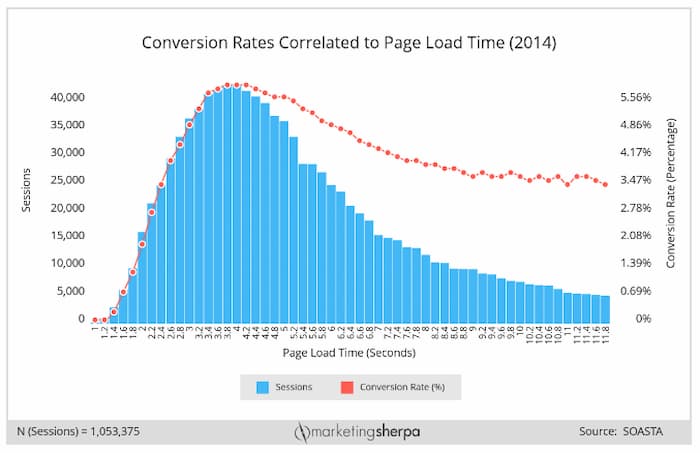
Chart showing how increasing page speed has a positive correlation to increase conversion rates

This ultimately leads to increase conversion rates when a larger percentage of your total volume of traffic is actually getting to the pages you want them to see. Reducing the number of people you lose to slow load time increases the conversion rates.

Email reminders for abandoned carts

Did you know you can increase your conversion rate by up to 69% by sending up to 3 email reminders to those who have abandoned their carts?!

Imagine, a user finds your site, they read your content, they research options and they choose your product, and are filling out the purchase information and they suddenly get called to work or dinner or their kid pukes all over their office. 

These are users who have already decided to purchase your product but life just got in the way for whatever reason. 

Email reminders are the best way to keep your company in mind and get them back to your site to finish checking out. This strategy is definitely one to incorporate in your email marketing.
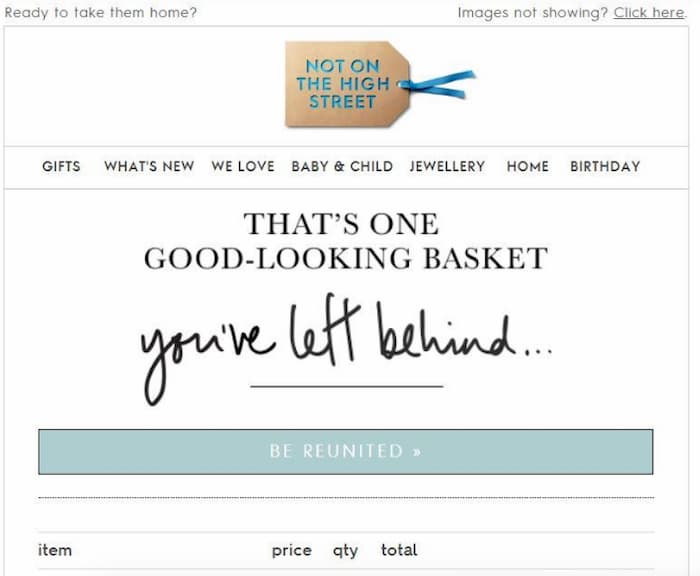
Example of abandoned cart email reminder to increase conversion rates

Send email reminders on a set schedule for anyone who leaves a cart abandoned to get them back on track to finishing the check out process.

Make things happen ASAP (as simple as possible)

In order to increase conversions make the process as easy as possible by eliminating the number of things a user must do to complete a conversion. Reducing the number of obstacles that stand in the way of completing a goal will increase conversions to your site.

Leadpages found that by making a single field for an email address rather than a field for name plus email address, increased conversions by 12.44%. The concept is simple enough to understand; People are less likely to fill out long forms than they are to fill out short ones.
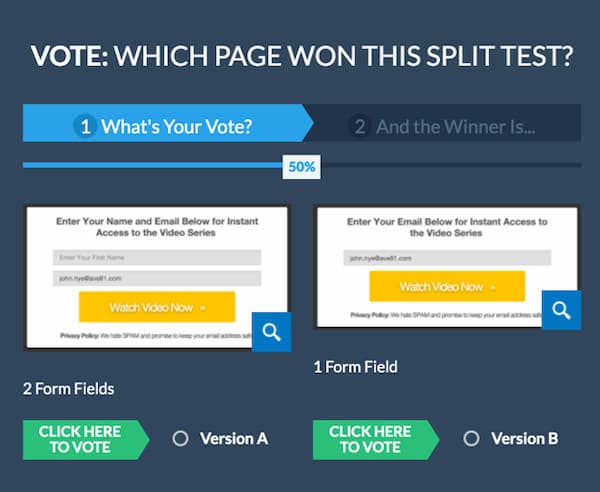
Example of a single entry form increases the conversion rate of the opt-in box

The less effort it is for someone to give you their contact info, the easier it is to entice them to fill out the form.

Amazon realized this and had massive success with their one-click ordering system. When you can order a product with minimal steps, there are more people that will make it through the conversion process.
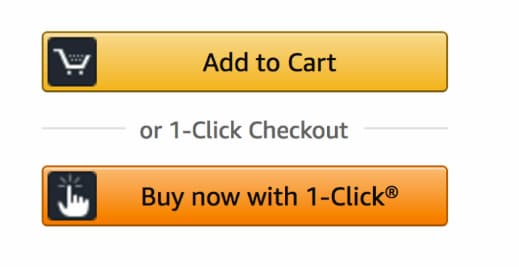
Image of Amazon's option for buy now with 1-click

Although it may be easier for companies to have a user’s information on file for repeat orders and even a history of products purchased, the option to purchase as a guest will increase the number of conversions made by new clients.

Allowing users to avoid a lengthy account set up before buying a product speeds the process up which means less chances of interrupting the conversion process.

Make your conversion process as simple as possible to see more goals completed on-site.

Use split testing to identify preferences

It’s hard to know exactly what the majority of your users prefer without split testing the options you have available. Simple things on your site such as colours, headlines and placement of features can increase conversion rates on your website.

Leadpages found that when they changed the colour of their button from orange to green that conversion rates went up 86.41%.
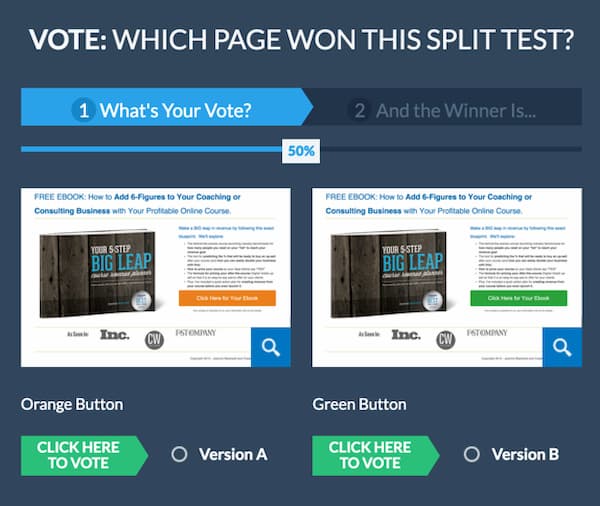
Split test shows that changing the colour of a button can increase conversion rates to over 80%

Split testing can uncover certain patterns or tendencies of your users that result in more desired actions on your website.

Use split tests for everything you can get your hands on. Test headlines for your landing pages to see whether the users that end up clicking are more likely to convert.

Test the placement of buttons, the background colour of optin forms, the images on optim forms the text that you use as a call to action. Literally everything that can be interchangeable in design has the potential of increasing your conversion rates.

Improve conversion rates for increased revenue

Increase the revenue your website generates by improving the way it influences users to perform your desired action.

In an increasingly competitive search environment, improving conversion rates is an effective way to continually improve the efficiency of your website. Increasing your conversion rates are a way to make more money from your website without the wait time for content to rank for a keyword.

Follow these tips for better conversion rates from your website for increased revenue from new clients.

Don’t have time to do it yourself? Click here to speak with an SEO consultant to learn more about how we generate more revenue for our clients.

Written by Christian Carere · Categorized: SEO strategy, Web development

Dec 18 2020

How To Create A Marketing Funnel For An Ecommerce Website

There are always exceptions to the rule but for the most part, it takes more than one visit to a website before a visitor makes a purchase. Learn how to create a marketing funnel for an e-commerce website to drive more targeted traffic and convert more visitors into repeat customers.

The sales cycle that your typical customer experiences from start to finish can be categorized into four distinct stages; awareness, consideration, decision and advocacy.

Consider the possibility that every visitor to your website is at a different stage in the cycle and it only makes sense to publish SEO content that accounts for the various stages within the sales cycle.

What is a marketing funnel?

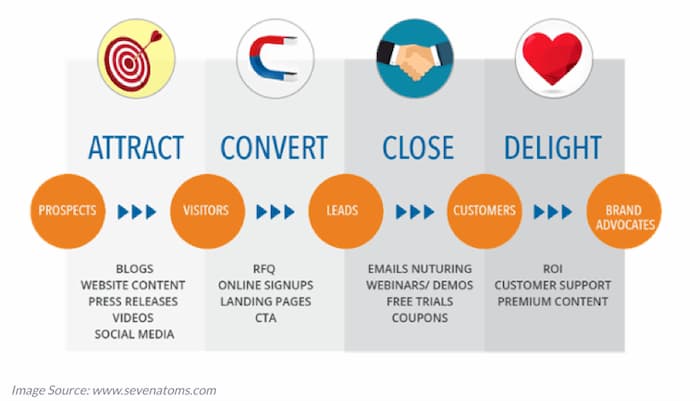
The marketing funnel refers to content that can meet a potential buyer where they are in their understanding and move them closer to making a purchase. The marketing funnel addresses a series of stages that a buyer experiences which is commonly referred to as the buyer journey. 

Sales funnel example for how to create a marketing funnel for an e-commerce website

The content at each level of the funnel caters to the visitors on your site by meeting them at whatever stage of the journey they’re in with the goal of moving them deeper into your funnel.

Imagine a doctor approaching a man with testicular cancer and going to straight to the point about the need for surgery. No explanations, just“This is what has to be done….”

via GIPHY

It’s needless to say that the need for testicular surgery would not be well received by any man who doesn’t understand what’s happening.

There needs to be a sit down about cancer, what it is, how it works and what will happen without surgery and of course, how the surgery will solve the problem.

Similarly, there are multiple stages a person goes through before making a purchase that is represented by a marketing funnel.

To get a visitor to the point they’re ready to buy, there needs to be a basic level of understanding of what they’re buying and why your company is a good choice. The concept of the buyer journey is used to gauge how well your content meets your visitors at the different levels of their understanding.

Four major stages of the buyer journey that mirrors you marketing funnel

Creating content for every possible stage allows you to move visitors along the funnel, to become closer to making a purchase and become loyal brand advocates.

Awareness stage

At this stage, the buyer isn’t aware of the specifics of the problem they have. They know they have an issue they need to be resolved but they’re not sure about what it is and how to resolve it.

An example of this could be extremely dry skin. A person may have psoriasis or eczema, but may not have ever heard of either. If your website sold skincare products to combat eczema or psoriasis, creating content that describes the symptoms would be considered content at the awareness level.

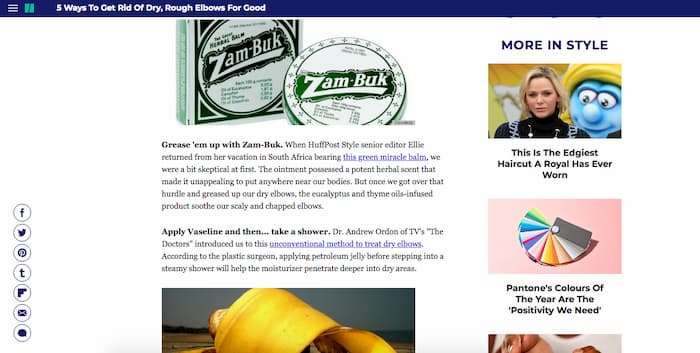
Here’s an article from the Huffington post that ranks for dry skin on elbows. There’s no doubt that the companies in this article needed to pay for placement in return for the thousands of clicks to their website.

Example of ranking for symptoms creates awareness of your brand and product

Content at the awareness level educates your audience about the basic details of their problem and how your product is used to overcome it. At the awareness level, your content would be optimized for symptoms that your product solves like dry skin for a skincare company.

The volume of searches for keywords at the awareness level is the highest of all stages in the buyer journey. These types of keywords are considered top-of-the-funnel keywords that build awareness of your product and brand but aren’t typically “high converting” search terms. The more people you can reach with your content, the more potential clients you drive to your website.

Consideration stage

At this phase of the buyer journey, visitors are aware of their problem and may also be aware of how to fix it, however, they are not ready to buy. At this stage, they are still in research mode and will be looking to compare options to find the best possible solution at the best price. 

At the consideration stage, you would publish content that shows your visitors why your product is effective and superior to other options. This moves buyers forward to the final stage in the funnel by convincing them that you’re trustworthy enough to make a purchase.

Content at the consideration stage includes case studies, visual content, comparative analysis, original research and statistics, etc.

Content that arms your audience with the information needed to make an educated purchase decision builds trust in your brand. Rather than being too “salesy” or “pushy” about how great your product is, it’s considered best practice to create content that educates and demonstrates your expertise in your field.

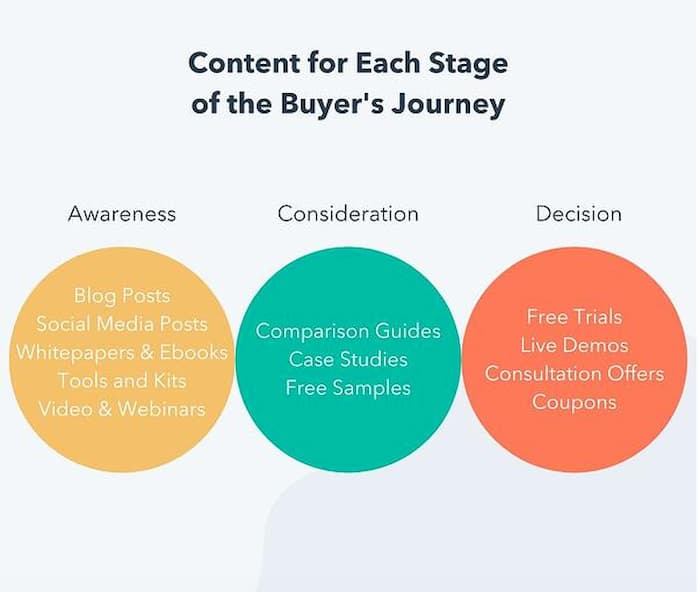
Examples of types of content to use at each stage of the buyer journey.

Case studies

There’s nothing more convincing than a real live case study of the success you’ve had with existing clients. This type of content allows visitors to relate to someone with similar problems and see how your company resolved those issues with your business solutions.

Case studies can also be a form of storytelling, which is a powerful method of branding. People tend to remember stories more than statistics and numbers. Create relatable stories infused with real statistics and results to instill confidence and trust in purchasing with your company.

Original research

This is one of the best forms of advertising when it comes to creating an online presence and moving visitors deeper into your marketing funnel. Original research in your industry sets your company apart from the masses. It gives you the edge for creating new content with statistics and facts that no other company can compete with since they’re statistics that are generated from your research.

A lot of good things happen when you’re able to use original research to your advantage. The first is that original statistics attract backlinks. When you have statistics that no other company has, writers and publishers, tend to link to the source of that stats-and that happens to be your website. This pushes your website up in rank and authority.

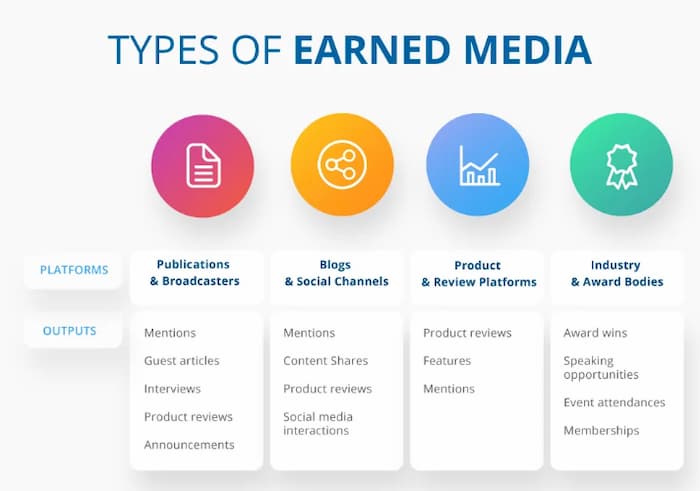
In addition to being cited as a resource by those in your industry, you also are eligible for what is called earned media. That is, giving journalists and reporters something to write about that gets your company into some of the bigger publications and ultimately in front of thousands of readers.

Earned media is a powerful way to create brand awareness and assert your company as an authority and industry leader.

Types of earned media that your company can pursue to improve the authority your brand has in your industry

Decision stage

The decision stage is where your buyer is ready to make a purchase. They have established what they need and who the top choices are and need only the final push to make the purchase. Publishing content at this stage involves offering discounts, coupons and promotions to entice your visitors to make a decision.

Your product pages and services pages are where the conversions from visitors to clients are made. It’s necessary to have a page that inspires confidence in your product or service and that’s easy to navigate, making the purchase as easy as possible.

Loyalty and advocacy stage

This stage of the buyer journey can be the most valuable to your business. Consider the amount of time and resources to educate, convince and convert just one new client. Who better to market to than existing clients who have already purchased with you?! These are your most valuable assets to your business.

If they’ve already purchased with your company, there’s a very good chance they will purchase from you again since you’ve already gained their trust.

Apart from future sales, you want to keep your clients extremely happy, so that they’re able to turn around and tell other people how great your company is. Referrals are the highest form of marketing, and what better way to grow than to have happy clients tell other people how you’ve helped them.

Content at the advocacy stage includes sending coupons, VIP promotions, personalized offers and anything that expresses your gratitude for their loyalty.

Increase the lifetime buyer value for each of your clients by giving them the best customer service possible. The more you give, the more you get back.

Conversion rate optimization

To get the most out of your product and service pages, you need to measure and track the behaviour of your visitors to see what they do on your page. If there are specific patterns that are leading your visitor exit without converting, you will need to change those aspects of your page that are influencing that action.

Improving the conversion rate on your pages can be done using many different tools, however, Google Analytics can provide the user engagement statistics you need to improve the conversions on your page. 

Track metrics such as bounce rate, time spent on pages, average pages per session, exit page and the user flow to determine the weaker points of your website and where you can improve.

Bounce rate

The bounce rate is the total number of users that back out of a page without interacting with anything else. This statistic can be useful for determining whether the content on your page is a match to intent, whether the content is engaging or whether you have a technical deficiency that’s causing visitors to leave.

For example, if your page speed is too slow to hold the attention of users, this results in high bounce rates. Lightning-quick pages that load under 2 seconds keep more visitors on your page and lead to higher user engagement.

Keep in mind that the bounce rate can be misleading if users are going to a page and getting exactly what they need from your website. For instance, if people are going to your site to get the address or phone number, they may bounce right off as soon as they get what they need.

Identify the cause of a high bounce rate to determine whether you need to improve the quality of your page. In many cases, improving the bounce rate will lead to more time spent on your site, higher click-through rates, more user engagement and ultimately higher conversion rates.

The improvement in user engagement statistics is considered positive ranking signals-especially on the first page of results, which can lead to higher SERP positions.

Click-through rates

The click-through rate is an important metric to analyze in your content at the awareness and consideration stages of the buyer journey. You want to make sure you’re moving people along the marketing funnel and that they are engaging in your content by clicking through to related articles.

If users are not clicking further through your website, it’s important to understand what they’re doing and what your content is lacking to create low CTRs. 

Adding internal links to related content is the simplest solution to moving users along to more pages within your website.

A more difficult task is to re-evaluate the content that visitors are bouncing from to improve the copy, change the topic or remove the page altogether if it’s not able to achieve its purpose.

Time spent on-site

The average time spent on a website is an indication of how many visitors are interacting with your content. People must be getting through the content you’ve published to know whether they’re reading it through or bailing on it after a few paragraphs.

If there’s a 3000-word article that people are landing on, and they’re leaving after 45 seconds-it’s an indication that this piece of content is not doing its job. It would take at least 5 minutes to get through long-form content so look closer at where the disconnect is between you’re your content and your audience.

If people are not spending enough time, adding videos, images or more multimedia are alternative options to increase dwell time. 

Conversion rates

To track goals, you need to set them up in Google Analytics. Every page on your site should have the desired action you want your visitors to take. Create goals on your website to effectively track where you’re losing visitors and where you’re succeeding in moving them along the buyer’s journey.

Create conversion goals at the awareness and consideration stages

If you’re creating content at the awareness level, the goal is to click through the links on your page that take them through to content at the next stages. Create tracking links that indicate whether the visitors clicked on the internal links you’ve provided.

If you’re not getting the click you can test whether it’s the content, by providing different options or if it’s the placement, by presenting the option to click on internal pages a different way.

Conversion goals at this stage of the marketing funnel will help to identify the content that people are most engaged in. This can serve as a way to build more content around the successful topic ideas that are getting the most clicks.

Conversions at the decision stage

Improving your conversions at the decision stage has a direct impact on your revenue. Make sure you’re taking advantage of all the potential ways to track what your visitors are doing on your page.

There are heat maps and split testing software that can help with the details.

With heat maps, you can see how far down the user scrolled on your pages as well as what buttons were clicked the most.

Split testing software can help you get into the finer details of things like the colour of your buttons. For example, choosing different colours of buttons can lead to small increases in conversion rates. 

Track every option that’s available to track within your content to create the most understanding of what your visitors are doing and most importantly, what they like and don’t like. The data you generate gives you the means to improve the user experience your website offers and positively influence the actions visitors take on your website.

Map out the sales funnel to your e-commerce website

One of the most important aspects of developing your website is planning the site structure ahead of time and documenting how you intend to drive traffic. This means incorporating SEO at the earliest stages of your website’s development.

Whether you’re just starting or your website has been up for years, go through your content starting at the conversion pages first. Work your way up by layering your content from the bottom of the marketing funnel to the top. This strategy provides a way to convert the traffic you’re already getting and slowly increase the volume as you go.

Establish a basic marketing funnel and track your results. As your website continues to generate data, you’ll be able to make the changes necessary to constantly improve your traffic and conversions which leads to more sales, revenue and a long list of happy clients.

DIgital Ducats Inc. specializes in optimizing websites for increased conversions and sales. Learn more about our custom-fit SEO services and how we can optimize your website to generate more revenue for your business.

Written by Christian Carere · Categorized: Content strategy, Web development

Dec 17 2020

SEO in 2021: Changes Are Coming…

Although many of the main ranking factors will remain important, the industry forecast suggests we should expect a few important changes to SEO in 2021. There’s not a lot that you haven’t heard before, but change takes time and in 2021 there are a few changes that will officially have landed and will change the way we optimize websites. This article will give you insight into what changes to expect with SEO in 2021.

Core Web Vitals

It should come as no surprise that Google is moving towards more accurate ways of measuring user experience and user engagement. One of the key metrics that are going to play a big part in this movement is Google’s Core Web Vitals.

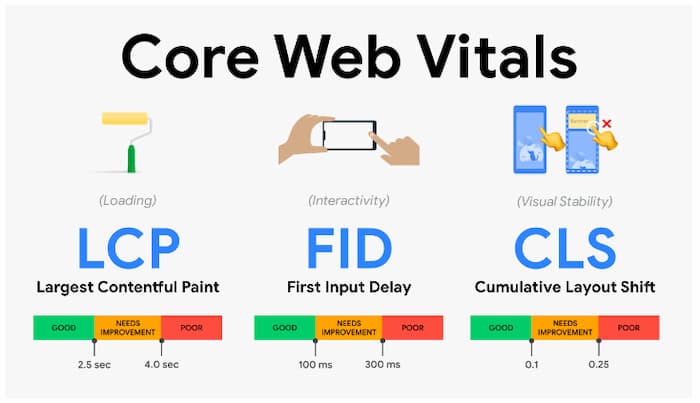
Banner image on core web vitals, one of the changes to SEO in 2021 to expect

Core Web Vitals were added to Google Search Console in May 2020 as a way to give publishers more insight into what pages need attention. Core Web Vitals gives you the means for identifying:

1)   Largest Contentful Paint

2)  First input delay

3)   Cumulatie Layour Shift

It’s every search engine’s mission to display websites that provide the best solutions to search intent as well as the best experience for users. A big part of the user experience is the time in which it takes a page to load. Search console provides users with the necessary information and alerts to maintain the speed performance of your website.

Search console reports the type of errors being generated since core web vitals will be one of the tools to use since UX-and page speed more specifically are one of the changes in SEO that will count as a ranking factor

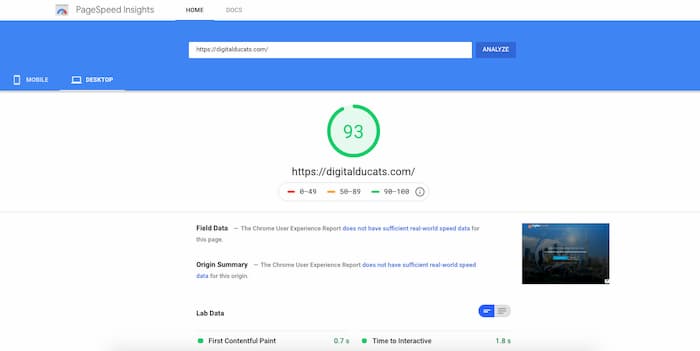
Although you may have a fantastic score for desktop page speed,

Desktop page speed for Digital Ducats Inc.

Pay attention to the mobile version of your page speed since this is the version that Google indexes first. 

mobile page speed for digital ducats inc.

Don’t be alarmed if your score seems atrociously low. It can be common for a lot of websites that have long-form content with a lot of images. The point is 2021 will require you to continuously work towards increasing your site speed. It should be a regular part of your maintenance routine.

Keep in mind that just because your site loads faster than anyone else’s, won’t mean you’re going to rank in the number one position. The popular opinion is that Google won’t be rewarding the fastest pages as much as penalizing extremely slow pages.

Click here for tips on how to improve your page speed.

Ranking passages

Google has already begun to rank passages, that is, a few sentences from articles that directly answer a search query. You may have already seen a bit of this happening when you click on a featured snippet that takes you to the page with the answer highlighted in yellow. 

This is a pretty big deal because it means that you can drive more traffic without being ranked on the first page.

The way to optimize for passages is to make sure your content is sectioned off in distinct segments. Use the appropriate h-tags to create subtitles that clearly indicate what your content is about. This makes it easier for search engines to find and categorize the information on your website.

ranking passages will be a change to SEO in 2021 that we should expect

This doesn’t change the way Google will be ranking pages-that will remain the same, however, this is a new addition to the way search engines will be displaying search results that should be taken into consideration when writing SEO content.

Establishing domain authority

If you thought link building was hard already-well, it’s getting harder! Domain authority is becoming a more difficult task to improve without getting links from the experts within your field. Google wants to display websites that can be relied on for quality information.

This will put a bigger emphasis on earned media, visual content and original research. This is the kind of content that will put your website on the map and land you some high-authority links.

Expertise Authority and Trust

If you’re website states facts that are incorrect according to an authority site in your industry, your credibility is shot and Google will choose to display another site over yours.

What will move the needle the most for young developing websites is to acquire links from the biggest site in their niche. You need links from the experts to validate your expertise. When you can get links from the authority sites within your niche, you become an authority in your own rights.

E.A.T. has already become a major aspect of the YMYL industries. Any type of medical publication needs to be written by a doctor or professional in the field. For it to rank, that professional should have the proper credentials to validate their work as well.

As we venture forth further into 2021, we’re going to see more of the EAT principle in effect.

The second wave of featured snippets

The featured snippet is increasingly appearing in search results. It’s becoming apparent that it absorbs a significant number of clicks for a search and is a valuable position to add for branding. Good SEO in 2021 will involve going after more featured snippets for increased search visibility.

To maximize the possibility to appear in a featured snippet, you need to make your content “snippable.” For example, publish definitions and keep your answers between 40-60 words. Paragraph snippets are the most popular form of snippet-which accounts for roughly 80% of all featured snippets.

Remember you need to rank on the first page of search results to be eligible to win a feature. Work on creating more opportunities for traffic through feature snippet campaigns.

Local SEO

Local SEO has always been important but because of the global pandemic, it will pay off double time to maintain a local SEO strategy. Keep publishing local content and feed your Google My Business profile content to maximize the search visibility of your website in your city/area.

People are going out less and purchasing from businesses that are close to home. Make sure your GMB profile is up to date in every aspect and you’re actively engaged in adding local content to your site and profile as well as answering questions that may appear on your profile.

CTR is increasingly becoming more important

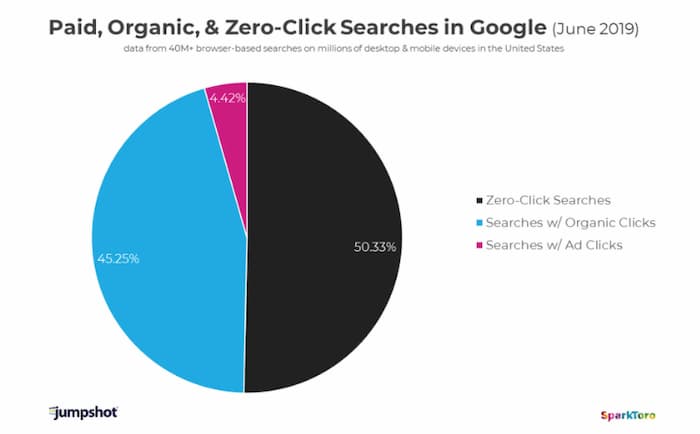
The organic click-through rate is steadily dwindling due to Google SERP features absorbing all of the clicks. 

Zero click phenomenon will continue with SEO in 2021

In 2021 it will be increasingly important to improve the click-through rate of your pages directly on the SERP to maximize the traffic a first page appearance drives.

Structured data markup is one of the additions you can make to your pages to encourage rich results. Make your search listing more attractive in the search results to attract more attention and take up more space in the SERP.

The FAQ rich result is a perfect example of a rich result that demands more attention from the larger area the search listing takes up.

Example of FAQ rich result since SDM will be a higher priority for SEOs in 2021

Additionally you can improve things like your headlines and meta descriptions. If there are older pages that are currently ranking, sometimes an update can make the difference in attracting more visitors to your page.

Search intent shifts and what you thought might be enticing a year ago, maybe a little out-dated and can use a facelift to drum up more clicks.

Search intent

It will be necessary to become a search intent ninja in 2021 to make sure your keywords and content are a perfect match to what users expect to see. Search engines are becoming more and more accurate at identifying exactly what users want when they type in a search and if you’re going against the grain your pages will be left in the dust.

Make sure you’re doing your homework when you’re establishing the true intent of a keyword. The more accurate you are in pinpointing intent, the more likely you are to rank in a top position.

Prepare for a new era of search engine optimization

Although claiming “a new era” is a little melodramatic, next year will bring about a few different changes in the way we optimize websites. Search engines are always updating and adjusting to make things a little easier for users. Change isn’t always bad and like every new update, we experience new opportunities lie ahead.

Ask us about custom search engine optimization services to find out how what we can do for your business.

Written by Christian Carere · Categorized: Web development

  • « Go to Previous Page
  • Go to page 1
  • Interim pages omitted …
  • Go to page 10
  • Go to page 11
  • Go to page 12
  • Go to page 13
  • Go to page 14
  • Interim pages omitted …
  • Go to page 32
  • Go to Next Page »

Footer

Need professional SEO advice?

Give us a call to learn more about how we can help your business

Call for a consultation Request a proposal

Request a free website analysis and proposal for your company by filling out the ” Request a Proposal” form.

  • Privacy Policy
  • Terms Of Service
  • Cities we’ve served

© 2026 · Digital Ducats Inc.