• Skip to main content
  • Skip to footer

Digital Ducats Inc.

SEO Consulting & Services

  • Home
  • About
    • SEO Consulting
  • Services
    • SEO
    • Local SEO
  • Contact
    • Pricing
    • Write For Us
  • Blog
You are here: Home / Blog

Dec 16 2020

How To Find the True Search Intent Of A Keyword

SEOs talk a lot about search intent as a major factor for achieving search visibility. The significance of search intent is that search engines want users to be able to find what they’re looking for with the least amount of effort. If you know what a user is looking for, you can publish the content that can be displayed as the best result to a search query. This article outlines how to find the true search intent of a keyword to drive more targeted traffic from higher-ranking positions on the SERP.

This function of SEO is critical because if you miss the mark identifying the intent, no matter how good your content is, no matter how many backlinks your page has, you will NEVER maintain a position on the first page of Google. This makes identifying and satisfying search intent a fundamental aspect of developing keyword and content strategies.

Basic forms of intent

At the highest level, you can break down search intent into three major areas; informational, navigational and transactional. Each of these categories represents a basic motivation for initiating a search.

Informational

As it turns out, informational searches account for about 80% of the total searches made on search engines. Providing useful information on your website can accelerate the growth of traffic being driven to the top level of your marketing funnel. 
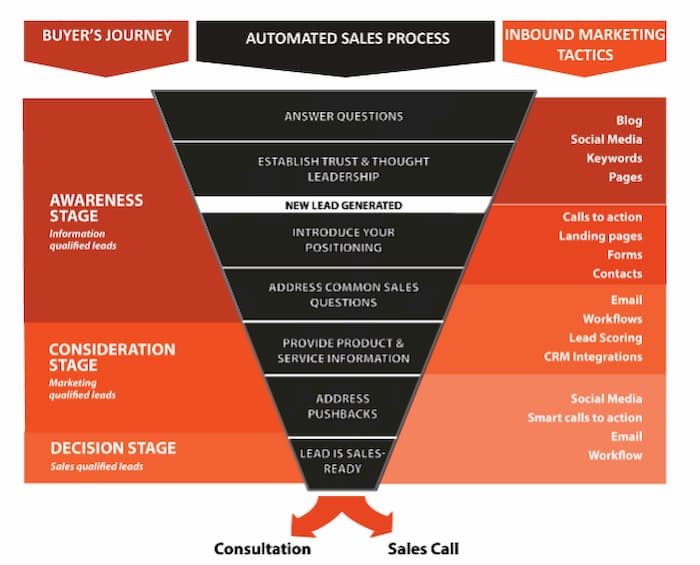
Marketing funnel concept helps categorize search intent

By making visitors more aware of their problems and the solutions that you offer, you brand your company as an expert in your niche. Publishing SEO content regularly facilitates your ability to reach a larger group of people searching for information about the problems your product or service solves.

Navigational searches

These types of searches are when users already know what they’re looking for and are looking for a way to get there. There are millions of searches for the term “Facebook login” every single day made by people who want to get to Facebook.

Although navigational searches can drum up a significant number of searches, they are typically not keywords you would use in your SEO strategy.

Transactional searches

Users who want to make a purchase will use transactional keywords that represent buyer intent. Transactional searches represent users searching for a way to buy a product that they have already researched and are ready to purchase.

One way to research transactional keywords is to use Google Keyword Planner. Here you can find the level of competition, the average price paid for a click from that keyword (cost per click or CPC) and the approximate volume of the keyword being searched.

Determine general intent with a SERP Analysis

The first step to identifying search intent is to analyze the first page of search results. You can tell a lot from the features that a search engine displays in response to a query.

For example, if you were to search the keyword microwave oven you would find a slightly mixed bag of results. Users who search this term could be at the buying stage or they could be in the research stage.

The first three results are category pages for big-box stores selling microwaves.
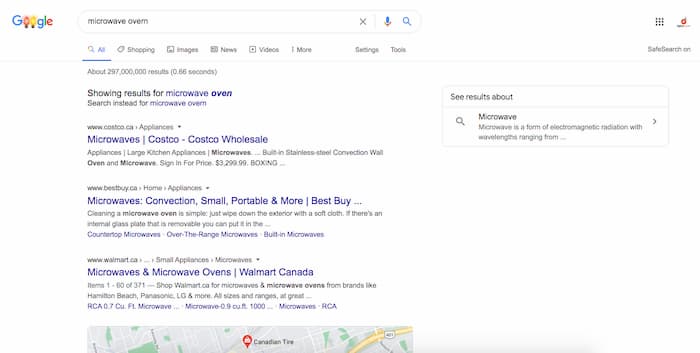
How to identify the true intent of a keyword by analyzing the organic search results

Further down we have a local pack for people who want to visit a store that carries microwaves.
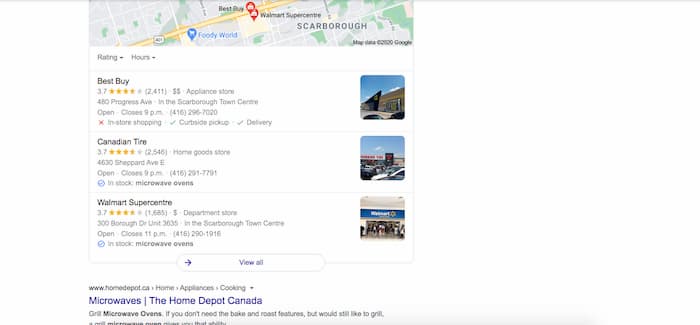
IMage of a local pack indicating the existence of local intent

Lastly, we have a section Google titles “Research microwave oven” and displays articles that compare brands and models.
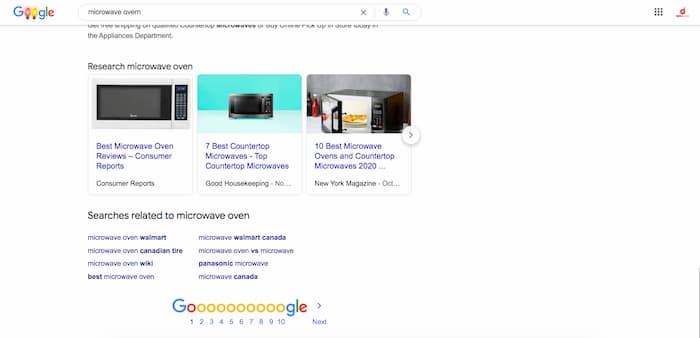
A research section in the search results shows tinformational intent

If we were to change the search to Walmart microwave oven, we immediately see the intent of the search switch to mainly transactional. Evidence of this is the Google Ads that immediately pop up above the fold.
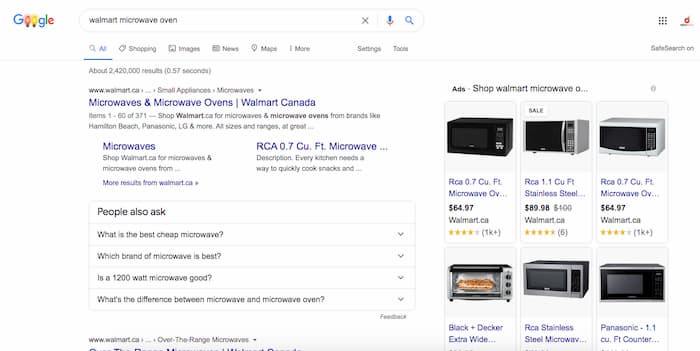
Branded search for walmart microwave oven is considered to have transactional search intent

The organic results are primarily Walmart pages because this is a branded search. It’s clear that the user is in the purchase stage and is ready to buy a microwave, making this a transactional search. 

If we type in the keyword best microwave, you can once again see how the intent shifts to an informational search. The articles displayed on the top 10 are all targeting the consideration stage of the marketing funnel. 
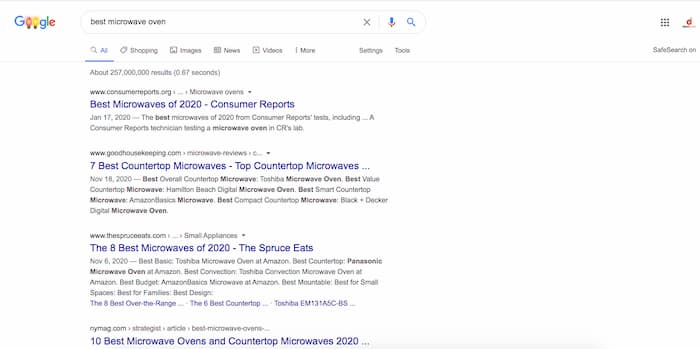
Example of informational search intent which is usually the case whenever "best" is in front of a keyword

This is an informational search because users want to research and compare options. Evidence of this is in the fact that the search results are mainly blog posts that compare different microwaves.

The lack of Google Ads is also another indication that the main intent of the user is to gather information and they’re not quite ready to buy yet.

Identify the content type that ranks best

To rank highly for informational search terms, you have to pinpoint the underlying motivation of the user and address their intent better than any other page. The titles of the top 10 organic results are a good indication of the type of content that has the best chances of ranking.

The term best microwaves clue us in to the fact that the user is looking for a) a buyer’s guide on how to choose the best microwave or b) The best features that microwaves offer. Every search listing in the top ten for this term is either a listicle (numbered list of “X of the best microwaves” or a buyers guide.

To publish content that has the best chance at ranking, you would publish an article written in this form.

Account for complete topic coverage

To publish a page that outperforms the competition you need to be able to provide the user with what they need to end their search. The proof is in the pudding and by going through the top three results, you can get an idea of the level of depth and topic coverage required to satisfy the intent.

Example of analyzing the top search result to cover all topics

If you scan through Consumer Reports, the number one search result, they’ve grouped microwaves into two major categories; countertop and over the range.

They compare five microwaves in each category and provide links to buy the microwaves from multiple vendors.

To compete with this page in terms of content, your page would need to cover each of those aspects and provide some sort of value-added aspect. 

An example could be by adding more detailed images, a video that summarizes the content or more products in your comparison.

Create audience-centric content

Search engine optimization is constantly including more ways to measure audience-centric content. User engagement statistics enable search engines to gauge how well a piece of content can hold the attention of visitors and ultimately satisfy the underlying intent of a search.

Identify search intent during part of the keyword research process to optimize to be found by the most accurate audience. Understanding what a user is looking for enables you to publish content that hits the mark and ranks highly in the search results.

Anything less and you can be sure any first page appearances will be short-lived. Content that nails intent creates long-term value and high search visibility that drive streams of highly targeted traffic.
Written by Christian Carere · Categorized: Content strategy, keyword research, Web development

Dec 10 2020

Domain Authority & What It Means For Your Website

You may have heard the phrase domain authority being passed around quite a bit and it’s probably for good reason. Many SEOs use the term to describe the likeliness of a website to rank since it refers to the aggregate link equity a domain possesses.

The truth is that domain authority or DA is a term and value that has been formulated and branded by Moz. Other companies have their own versions of how they measure it but the entire concept is a proprietary metric Google used in its algorithm called PageRank.

What is PageRank?

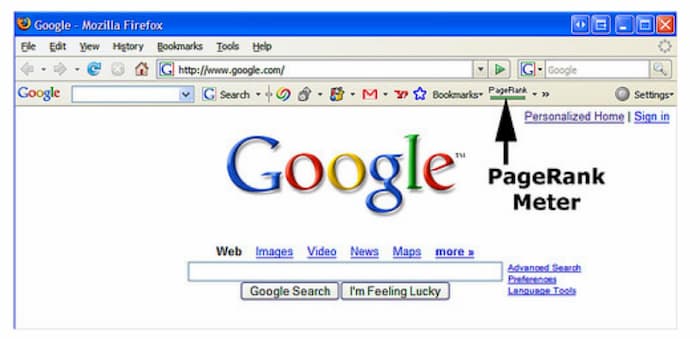
To be honest, no one knows for sure what exactly went into the PageRank calculation, but what we do know is that it had a lot to do with external backlinks. Google used to disclose the PageRank of every page on the internet. This way you would know how powerful a page was and whether it had a strong ability to rank.

Google's old display of pagerank which is now replaced by domain authority

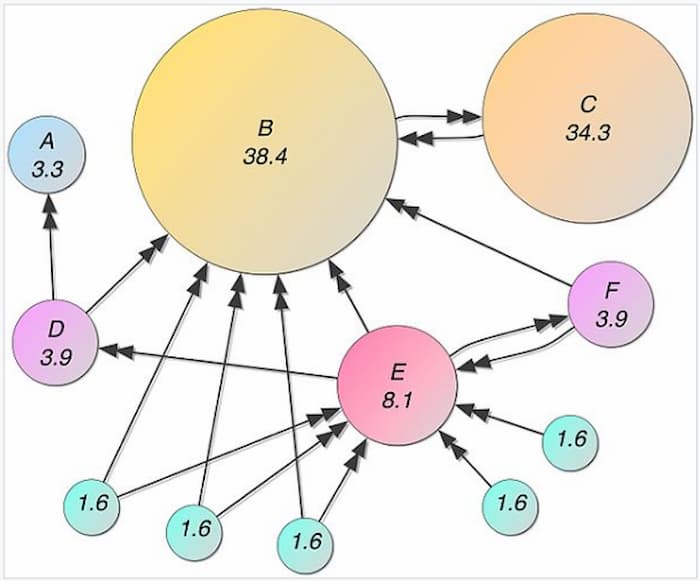
PageRank is based on one of Google’s earliest patents. It states that the popularity of a site could be measured by how many websites linked to it. This is baked into the Google ranking algorithm and remains true today since backlinks are among the top three ranking factors.

The more backlinks a website possesses from relevant websites, the more ranking power it gains. This flow of “link juice” is commonly referred to as “authority.” When a website accumulates thousands of links from related websites, its authority grows.

The concept of pagerank visualized by numerical values of interlinked websites. This somewhat resembles page and domain authority

In 2016, Google stopped publicly displaying PageRank because it contributed to rank manipulation. People would focus on PageRank rather than relevance when linking to other websites in an attempt to boost the ranking ability of their page.

When PageRank stopped being published, a few companies developed their own system for assigning a similar value to web pages. Moz was among the first to come up with DA or domain authority, which measured the aggregate link equity of a domain.

Page authority vs. domain authority

Page authority represents the aggregate link equity of a specific page. Google doesn’t rank domains in the search results it ranks pages. This makes PA or page authority a more accurate measure of the ranking ability of a specific page.

The content on a page is what counts as being relevant to a search. This means that even if your domain authority is considerably lower than another website, you can compete with their pages if you have enough support from other websites linking to your page to bridge the gap in authority-assuming your content is a better solution to search intent.

Advantage of high DA

Keep in mind that a high authority domain has a head start on low authority domains when they publish a new page.

For example, a website with a DA of 80 can publish a brand new blog post whose page authority automatically starts at 45 DA.

Whereas when a website with a DA of 33 publishes a new blog post the new page will start with a DA of 18.

Therefore it will take more backlinks for the lower DA website to even out the page authority when competing for the same keyword in the search results.

The importance of domain authority

The truth is that the higher the authority, the easier it is to rank. It’s easy to get hung up on page authority and domain authority because there’s a specific value to compete with, however, it’s not the only thing that will rank a web page.

Google has actually stated that domain authority doesn’t exist.

we don't really have "overall domain authority". A text link with anchor text is better though

— Gary 鯨理/경리 Illyes (@methode) October 27, 2016

Here’s a video of John Mueller actually stating they don’t use overall website authority scoring.

That may be true for them but for SEOs and businessmen, it helps to know what you’re up against when you’re considering keywords to target. If you see 8 out of 10 websites on the first page with a DA over 80, you know you’re in for a long battle to get anywhere near the first page.

Domain authority places your domain in a general category that’s comparable to other websites. It gives you an idea of how close the website is in terms of credibility and authority.

DA in link building

Link building is not an easy task these days, so having a high domain authority is a big advantage to ranking in the search results. Linking from high DA websites is a big advantage because they drive your DA up higher.

PA in link building

Page authority is more accurate in measuring link authority when it comes to ranking for keywords. It gives pages a chance to compete with high DA websites. When there is good content on a page that serves the intent of the search and other websites are linking to it like crazy, it’s going to move up in the search results.

This doesn’t necessarily mean that it’s only because of the links and actual value of PA. It’s a combination of the fact that people are linking to the content because it’s obviously worth linking to in the first place.

There are plenty of instances where low DA sites rank on the same page as high DA websites. It just depends on the content, the optimiztion and how many links the lower DA site has to compete with the higher authority websites.

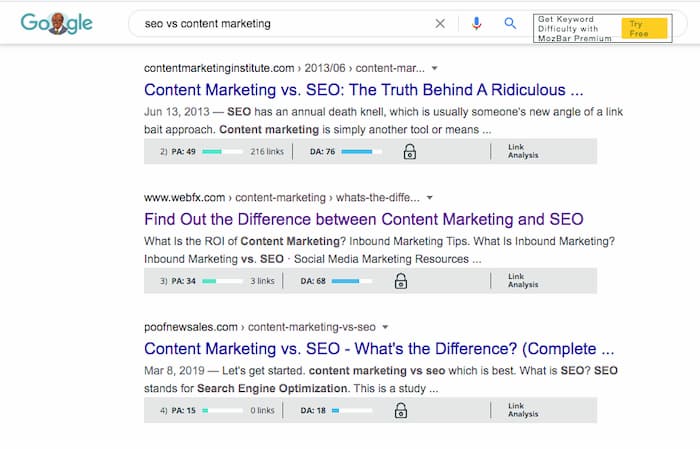
Here’s an example of a website with a low DA and NO links ranking on the first page with high DA websites:

Low authority website ranking on the first page grouped with high DA websites

Other measures of DA

Moz was not the only company to come up with a measurement for authority. There are several companies that use a similar system to measure the quality and quantity of backlinks that a page and domain possess.

Here are a few:

Ahrefs: DR and UR (domain rating and URL rating)

Majestic: TF and CF (Trust flow and Citation Flow )

SEMRush: Authority score

Conclusion

In an effort to gauge the competition, many companies have come up with their own systems for measuring overall authority. Although it does not represent the actual value of PageRank, they are a measure of the aggregate link equity that each page or domain possesses.

Domain authority is not an exact measurement for determining rank, but a tool that is commonly used to gauge the level of difficulty in acquiring a similar number of backlinks to compete and outperform competing pages.

The takeaway here is that although it’s an important ranking factor, it not the measurement of DA that matters most since it’s a combination of ranking factors that make up a ranking. Use DA as a general guide for determining the strength of competition and as a way to look deeper into what makes a page rank highly.

Written by Christian Carere · Categorized: Link building, Web development

Dec 09 2020

The Difference Between SEO and Content Marketing

There are a number of different strategies within the digital marketing spectrum. Most of which are their own unique and distinct entities that can easily be differentiated between one another. SEO and content marketing are unique in that sense.

A PPC campaign is different from a website design. Social media marketing is completely different from email marketing. When it comes to SEO and content marketing, however, the lines are more blurred because they work together pefectly.

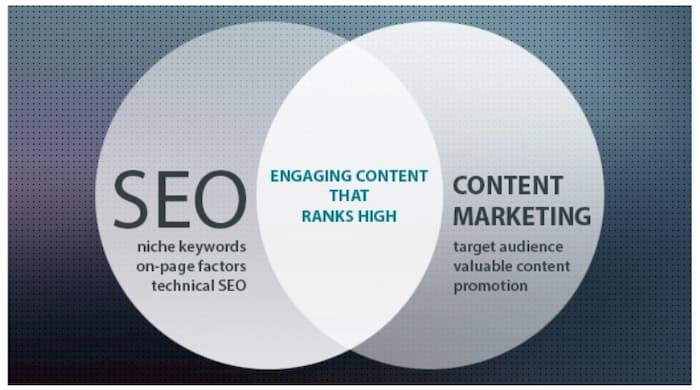
The overlap between SEO and content marketing
Image source: Lyfe Marketing

People get confused about the two strategies since quite a large part of each strategy overlaps with the other. This article should straighten out any misconceptions you may have about the two and give you a better understanding of how they are used together to maximize results.

What is SEO?

Search engine optimization services incorporate a variety of tactics to improve the likelihood of content being found by users and search engines. SEO uses keyword research, keyword targeting, keyword mapping, on-page optimization, off-page optimization, content creation and technical SEO elements to improve the overall optimization of a page or piece of content.

SEO has a narrow focus

SEO has a more specific focus because it is primarily keyword-based. It’s true; search engines have evolved from ranking web pages solely by keywords, however, keyword targeting is necessary to make sure your page gets in front of the right audience. The result is that an optimized page will not only rank for one keyword, but a series of keyword variations as well.

Search engine optimization is an analytical process for not only identifying the audience, but for finding out what they type to search for topics and what is required to appear at the top of the search results.

SEO is technical

SEO involves incremental changes and additions that continuously move your page closer to the top of the searches. SEO goes beyond the content to improve on technical aspects of performance that search engines credit as positive ranking signals.

Technical issues that affect indexing are a major component to SEO. Improving page speed is also a factor that affects the ranking and engagement statistics of a web page. Maintaining longer dwell times, higher click-through rates and increasing the average number of pages per session are all calculated efforts to improve the quality of content on a website.

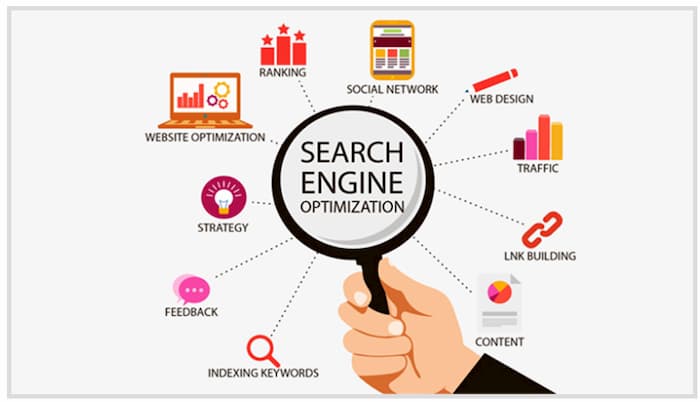
benefits of SEO
Image source

So how does this tie in to content marketing? First let’s define what content marketing means to a business.

What is content marketing?

Content marketing means identifying an audience and creating content to educate and/or entertain based on their interests. Content is typically created for a broader audience that appeals to all stages of the buyer journey.

Content marketing can be for social media, increasing conversions on a website or creating awareness by appearing on popular websites. Content marketing can come in the form of research, storytelling, articles, images, videos, slide shows and literally any form of multimedia.

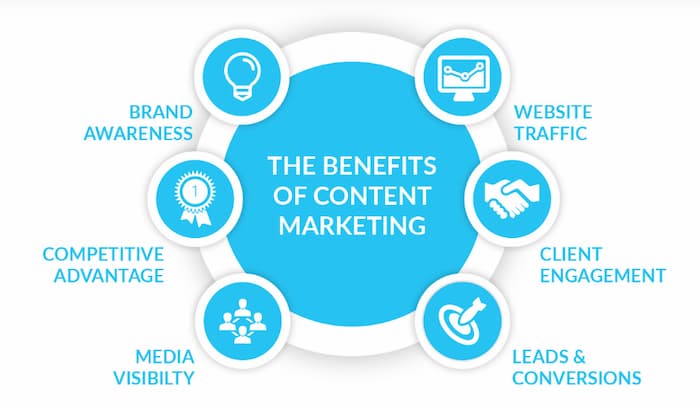
benefits of content marketing
Image source

What’s the difference between SEO and content marketing?

The difference between SEO and content marketing lies in the scope of which each has in terms of an audience. SEO has a narrower focus that is keyword based. SEO focuses on the intent of the audience and identifies the technical requirements to reach that audience.

Content marketing has a broad focus that can apply to an audience with multiple intents. There are no technical requirements to create the content necessary to serve its purpose.

How content marketing and SEO overlap

Combining SEO and content marketing is where we see powerful results. 

First of all, SEO can’t exist without content. 

SEO optimizes content to be found by a specific group of searchers. Without any content to optimize, there is no SEO.

Content marketing becomes a powerful method of marketing when it’s optimized to appear in front of a specific audience. By identifying what people are looking for in searches, you can create content that satisfies their intent.

Good content brings brand recognition, brand loyalty and more confidence in making a purchase from your company. 

By identifying the major keywords being used to search for your products and the problems and solutions related to using your product or service you can reach a specific group that is more likely to convert from visitors to new clients.

SEO establishes the parameters for what content is needed to generate more traffic to your website. Content marketing supplies those requirements.

Create content that’s in high demand

At the end of the day, you want to create content that people are actively looking for on Google. The process that’s proven to be the most effective for driving targeted traffic is simple:

  • Establish the true intent of keywords that represent high business value.
  • Create content that satisfies the intent of the search.
  • Optimize content to appear for your keyword topic.
  • Improve ranking and increase traffic to your pages by building links and promoting on social media and other content distribution channels.

This four-step process works to create new streams of high converting traffic. This system requires targeted SEO content writing with consistent production to create long-lasting results in the search engines. The result is increased revenue from more traffic and new clients.

Speak to a professional today and learn how to drive traffic with an SEO content strategy custom-fit to your website. For more details visit our SEO services page.

Written by Christian Carere · Categorized: Content strategy, SEO strategy, Web development

  • « Go to Previous Page
  • Go to page 1
  • Interim pages omitted …
  • Go to page 11
  • Go to page 12
  • Go to page 13
  • Go to page 14
  • Go to page 15
  • Interim pages omitted …
  • Go to page 32
  • Go to Next Page »

Footer

Need professional SEO advice?

Give us a call to learn more about how we can help your business

Call for a consultation Request a proposal

Request a free website analysis and proposal for your company by filling out the ” Request a Proposal” form.

  • Privacy Policy
  • Terms Of Service
  • Cities we’ve served

© 2026 · Digital Ducats Inc.