• Skip to main content
  • Skip to footer

Digital Ducats Inc.

SEO Consulting & Services

  • Home
  • About
    • SEO Consulting
  • Services
    • SEO
    • Local SEO
  • Contact
    • Pricing
    • Write For Us
  • Blog
You are here: Home / Archives for Content strategy

Content strategy

Jul 29 2021

Social Media Analytics For Small Businesses

Today, social media has evolved into a powerful tool to help you reach your target audience and grow your small business. For this reason, if you want to take this seriously, you need to make decisions based on the data that social media analytics provides small businesses rather than a gut feeling.

Fortunately, most social media platforms offer analytics and reports on how your content is doing and how the audience is receiving it. But, the question is, are you using this information to your advantage?

Here are five ways you can use social media analytics for your business plan that you can start implementing today!
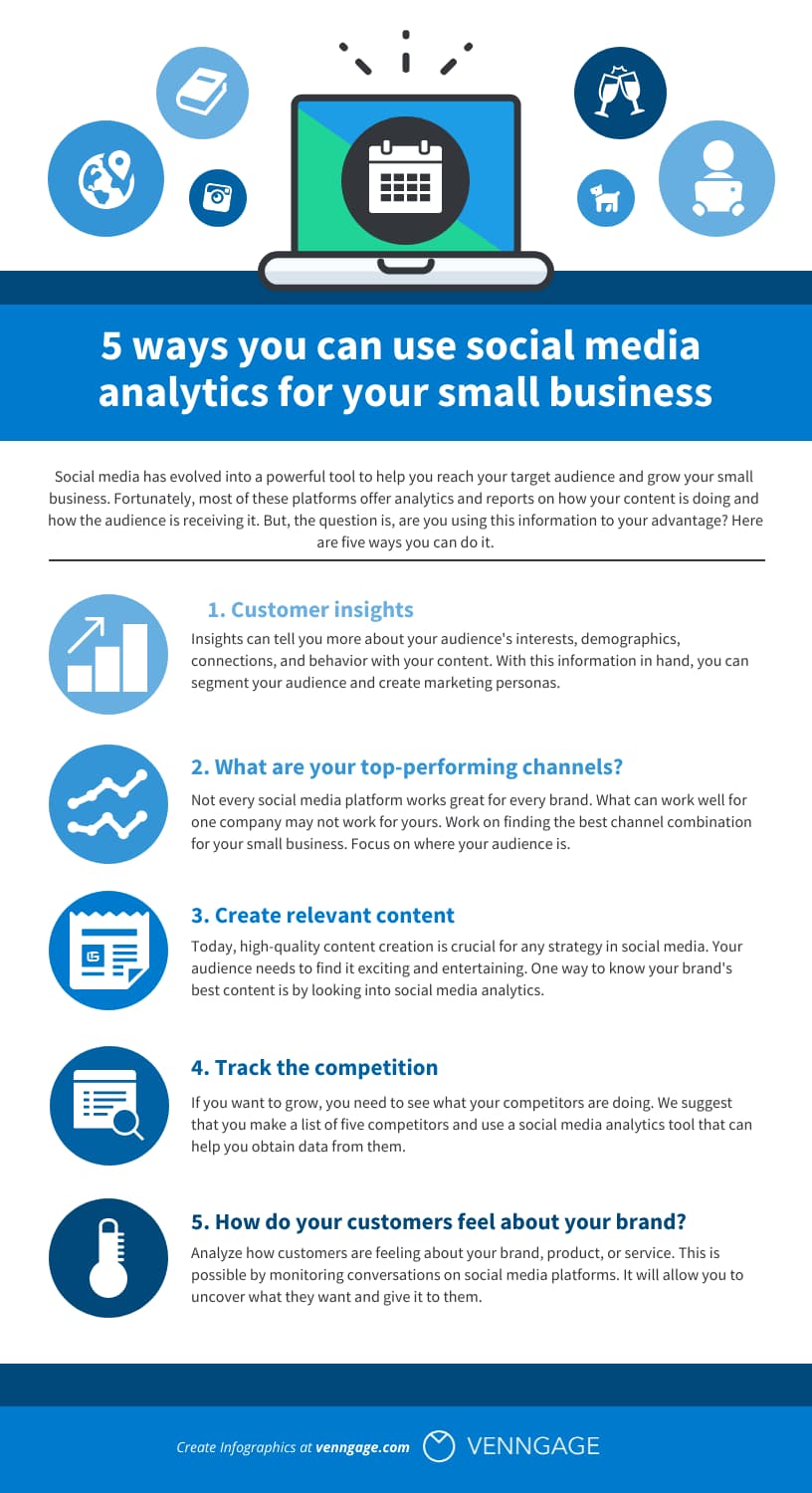
Social media analytics for small businesses infographic

1. Customer insights

Social media is not only about getting likes, people commenting on what you post and share. The key to real success lies in looking at the right metrics and uncovering opportunities.

Insights can tell you more about your audience’s interests, demographics, connections, and behaviour with your content. With this information in hand, you can segment your audience and create marketing personas.

You can also understand better what your audience is looking for, what their needs and wants are, and how you can satisfy them with your products or services.

Therefore, when you are writing a business plan, you can use this information to decide what products and services you should continue to offer to the target audience to get the best results possible.

What can be considered an insight?

Insights are not just “data.” It needs to be also insightful, and they should meet certain criteria.

First of all, the data should be new. This means that if you already suspected or knew about a piece of information, it is not an insight.

Insights are also unexpected and relevant. If the information does not match your business goals or values, then you cannot use it.

Finally, insights should inspire you to take action.

Where can you traditionally gather insights?

There are many ways you can gather insights for your small business and the marketing strategies you want to develop. One of them is focus groups, but you can also do surveys and questionnaires.

However, as we mentioned above, social media already provides very useful insights that you can take advantage of without having to invest in focus groups, surveys, or more.

2. What are your top-performing channels?

Not every social media platform works great for every brand. What can work well for one company may not work for yours. The good news is that there are many social media channels to choose from: Twitter, Facebook, Instagram, TikTok, and more.

Many people often ask themselves if they should be on every channel. Still, even if you have the opportunity to do so, it may not be the best idea.

Work on finding the best channel combination for your small business. Focus on where your audience is and choose channels to produce great content and engage with potential customers.

The best way to know this is, of course, by looking at the social media analytics of each channel you are using and deciding to keep only those who are performing well.

Which social media channels matter?

As Neil Patel – a digital marketing guru – explains, the first question you should ask yourself about social media is “where is my audience participating in?”. Where are they spending their time? Also, just because you have followers does not mean that you have an audience! There are many fake accounts out there and many inactive accounts as well.

Also, you should ask yourself where your audience is active; otherwise, the site may be of no use to you. Finally, ask yourself what your audience is searching for. Remember that people use social media for socializing but also for searching.

How to choose the best social media channels?

If a brand is getting many leads from a specific social media channel, it does not mean that it will also work for yours; therefore, you do not have to be there.

Facebook has more than 2.7 billion monthly active users, which makes it the largest social network today. However, they are browning photos and profiles, not really interested in anything else.

The opportunity for brands on Facebook is to participate in pages, groups, and events to gather a real presence.

Then we have Twitter, where things are constantly happening. It is a place where you can provide customer service and generate leads; however, not as much as you can do on Facebook.

For B2B businesses, LinkedIn is the place to be. Here, you can connect with professionals and decision-makers.

But, don’t leave out Instagram, YouTube, and maybe TikTok. Why not? If it makes sense for your brand to be there, then you should try it! Also, consider that today video content is becoming more important than ever. You should analyze if your brand could benefit from them.

3. Create relevant content

Today, high-quality content creation is crucial for any strategy in social media. Your audience needs to find it exciting and entertaining. One way to know your brand’s best content is by looking into social media analytics.

This way, you can develop a more ingenious content strategy, focused and targeted to your audience.

You can analyze what content your audience engages with the most and the topics they respond well to are. Then, you can optimize your social media marketing plan and create content that resonates with your followers.

How to make your content more relevant?

There are many ways you can make your content more relevant, and the first step is to create and cater to a buyer persona. No, there is no such thing as content that is relevant to everyone or that you want to sell to reach everybody.

Relevance is audience-dependent, and it has to do with generating a good conversation. The best way to achieve it is by creating one or more buyer personas that will help you understand the characteristics of your target audience, what their needs and wants are, and how you can be relevant to them.

Then, you also need to understand user intent and create a list of keywords. And yes, we are talking about SEO, but the truth is that Search Engine Optimization will help our content reach the audiences we are trying to connect with. Once you have the list of keywords with opportunities, use them in the right places.

Additionally, your content will be relevant if it solves a problem and is timely. Most of the searches people do online are about solving a problem they have, and if you have the answer, then it is your website where they will go to. But, make sure your content is timely and matches current events, whatever those are in your niche.

Finally, make the content as long as it needs to be. You can have great, relevant content that is just a few hundred words long. Longer articles do not mean more relevant and valuable articles.

4. Track the competition

If you want to grow, you need to see what your competitors are doing. We suggest that you make a list of five competitors and use a social media analytics tool that can help you obtain data from them. You can also do a manual evaluation of their profiles and accounts.

Where are they present? What kind of content do they post? How is their engagement, and how do they respond to comments they receive?

All of this information will give you ideas for your brand and perhaps a little inspiration too.

How can you track your competitors?

It does not matter what industry you are in; you will always have competitors seeking your audience’s attention, for traffic, for followers, for sale, and so on.

Therefore, competitor analysis is incredibly important, and there are many online tools available and can help you achieve it. Here’s a helpful list you can use:

  1. Sprout Social: It helps you understand your competitors’ performance on social media from different angles and data points. You can also benchmark your growth against several profiles with a few clicks.
  2. Phlanx: In a few words, it is an Instagram engagement calculator. It gives you clues on how active an account’s followers are and therefore has insights about the competition’s Instagram presence.
  3. Social Blade: This online tool assesses follower counts on the likes of YouTube, Instagram, and Twitter. It assigns a grade to every social profile you search.
  4. SEMRush: This is another very popular tool today for competition analysis and SEO. You can pull your competitor’s backlinks and monitor their ranking and if there have been any changes. Plus, you will be able to know who else is competing for your traffic.
  5. Ahrefs: Check any URL’s top organic keywords with this tool, plus also receive an estimate of the traffic a competitor receives on those keywords.
  6. MozBar: This free Google Chrome extension will allow you to check the domain authority, DA, of any website. This way, you can analyze how competing sites are doing in a Google query with just a glance.
  7. Buzzsumo: This tool will allow you to look at the top-performing content for you and your competitors.
  8. Similarweb: Here, you can better understand where the competitors’ traffic is coming from and what topics their visitors search for.

These are just a few tools from many more that are available out there. We recommend that you choose one or a combination of several so that your small business can gather the data it needs to grow.

5. How do your customers feel about your brand?

Finally, you can analyze how customers are feeling about your brand, product, or service. This is possible by monitoring conversations on social media platforms. It will allow you to uncover what they want and give it to them.

Also, you can uncover challenges, pain points, and more to take advantage of for your strategy. You can even prepare for a potential crisis or prevent it if you know what people are saying about your brand.

Associate your brand with positive emotions

We can bet that personally, you would prefer to be surrounded by people who are positive rather than negative. In fact, it is likely that you avoid being in a negative environment altogether. The same happens with brands and products.

People love to surround themselves with positivity, which is why you should focus on the emotions your brand conveys through the messages it shares: They should be positive and promote a great experience that creates trust.

Positive emotions help create an atmosphere for customers in which they become more trusting towards your brand.

Also, for customers to associate your brand with positivity and a “nice place to be,” you need consistency. However, this consistency needs to occur on an individual level, which is possible by designing diverse and rich marketing communications to transmit their message based on personal experiences. 

Storytelling copywriting is very popular today because of this. Everyone likes a good and captivating story, and it will help people feel closer to you and more positive towards you and your brand or company.

Another important action is personalization, which not only makes people feel special but makes them feel they matter to the brand. The customer-brand relationship becomes more genuine and human.

In conclusion

There are many moments in life where trusting your gut is the right way to go. However, social media strategies are not those. 

To create engaging content, leveraging your social media presence, and grow your small business, you need to use data as part of the planning process. It can even be useful for newsletter strategies, ads, and more.

It is a constant process of analyzing, publishing, reviewing, and making changes to get the best possible results and to grow your business as much as you can. It is a work that never ends but is in constant transformation. The good news is that there are many tools available today and that some of them offer a free version that can be enough for small businesses.

Ermelinda Maglione
Ermelinda Maglione

Ermelinda Maglione is a journalist and specialist in digital journalism. She has more than 16 years of digital writing and copywriting experience, especially in marketing, social media, and SEO. Currently, she is a Content Marketer for Venngage.
venngage.com

Written by Ermelinda Maglione · Categorized: Content strategy, Social media

Apr 05 2021

Marketing Funnels: Get More From Your Website Traffic

Marketing funnels are a solution to get the most from the volume of traffic that lands on your website. Search engine optimization drives traffic that attracts visitors at various stages in the buyer cycle. Many visitors may not be ready to purchase immediately and therefore require more information and nurturing to convert them into clients. Marketing funnels provide a system for moving your website visitors closer to purchase with your company. 

Create content to address The Buyer’s Journey

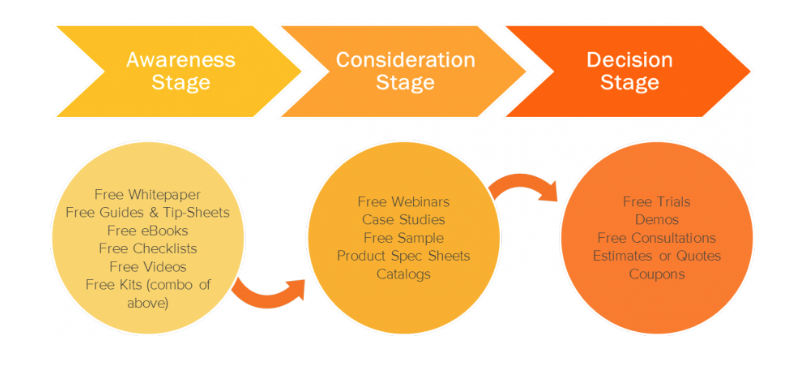
Generally, the buyer’s journey is divided into three main categories; Awareness, Consideration, and Decision.

the buyer journey and the content to include when incorporating SEO with web design

The awareness stage

At the awareness stage, visitors are just learning about the problems they have and what the potential solutions are for solving those problems. This is where they first may encounter your company through a blog post that is aimed at explaining the basics of your niche.

An example of a blog post at the awareness stage of a person searching for SEO would be How do I make my website number one on Google?

The answer to this question is search engine optimization but as far as the user goes, they may not realize what this is until they read the article. Articles such as this would be aimed at expanding the audience in which your content targets.

The content that you publish at this level in your marketing funnels are considered TOFU content (Top Of The Funnel content). Due to the broad nature of the topics, the audience is the largest at this stage of the buyer journey and therefore will also have the greatest drop-off in interest (hence, the funnel concept).

Top to the bottom of the funnel content

Getting people to your site is only one aspect of your growth efforts. When you’ve effectively captured the interest of a new website visitor, the next step is to move them to the consideration stage of the buyer’s journey.

The consideration stage

When a potential client is in the consideration stage, they already aware of their problem and require more information to guide them to a purchase decision.

For example, if you’re searching for an SEO company, you may want to know about the benefits of SEO to consider whether it’s a good fit for your business. Reading about what SEO can do for your company would certainly give you more incentive to move forward with your decision.

Content that provides incentives, facts, and social proof can be considered MOFU content (Middle Of The Funnel Content). Essentially this is content that moves a potential buyer to the decision-making stage.
The decision stage

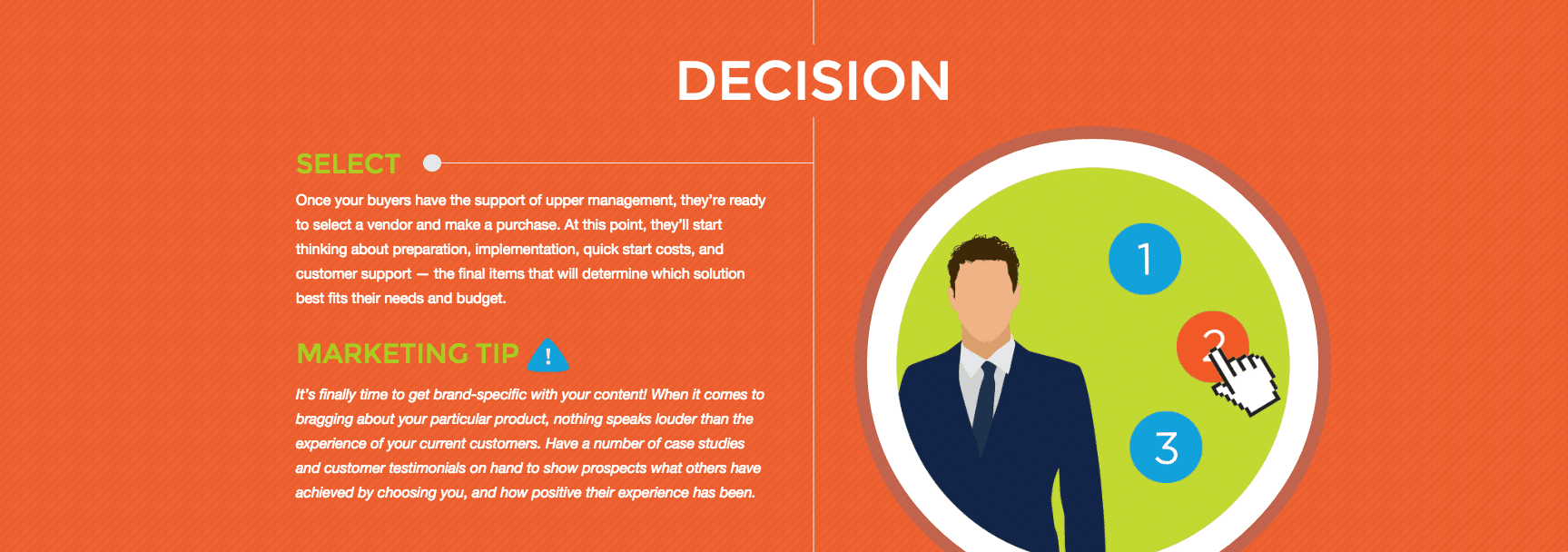
The last segment of the buyer journey is called the decision stage. It’s where the buyer is past the research stage and is ready to purchase.  At this point in marketing funnels, the content that is needed is called BOFU content (Bottom Of The Funnel content).

Decision stage content

Examples of content that convinces a buyer to purchase from your company can be landing pages, case studies, service pages, product pages, and squeeze pages. Essentially, any page that is geared towards convincing the visitor to make a purchase is bottom-of-the-funnel content.

The ultimate goal for your website is to generate revenue. An effective marketing funnel means all content on your site should in some way be leading your website visitors to a specific action that moves them closer to purchasing. That means moving visitors to content further down the funnel through a specific call to action (read more, download, opt-in, or purchase).

Customize your sales funnels

While the buyer journey is a good concept as a basic model, you can optimize your marketing funnel to be more effective by adding detail to each stage. The level of detail is based on the type of clients you deal with regularly.

In many industries, the process for going from learning about a product (or brand), comparing options, and purchasing a product may be completed in one session. This means that you can create content that addresses each of these stages all on one page. Many landing pages for retail products are published to do exactly that.

In this example, LinkedIn is offering a free credit for advertising as well as a strategy guide in exchange for an email address. This is an excellent example of how to get prospects to move from consideration to decision with an incentive as well as free trial to see how effective the product is firsthand.

LinkedIn using a targeted opt-in box in one of their marketing funnels

In other industries, the lead-time for selling B2B services or big-ticket items is often much longer and requires more nurturing during the research stage. For these types of clients, your marketing funnel would need to be more detailed and include more micro-stages to move them along.

Detailed digital marketing funnel

5 reasons to consider email marketing within your sales funnel

As mentioned earlier, SEO brings many different types of visitors to your door. No matter what stage they are at in the buyer journey, it’s important to identify what your potential clients need to give them enough confidence to making an informed decision. Email marketing is an effective solution for layering content in your marketing funnels and getting the most out of your website traffic for the following reasons:

Build relationships

When you capture an email address from an interested website visitor, it provides you with a way to maintain contact and to continue to move that visitor further within your marketing funnel. Email marketing allows you to learn more about your audience and respond with more content that they’re interested in learning about.

Personalization is high on the list for many companies now and what better way to build a relationship than with content that is specifically tailored to your audience? List segmentation, surveys and questionnaires can help you optimize your campaign and get insights into your audience.

Build confidence in your brand

An email marketing system provides your company with a way to continue to help your potential buyer find more what they’re looking for as well as present the reasons why your company is the best option for what they need.

If your product or service requires a longer lead-time before closing a sale because there’s more research involved before making a decision, your sales funnel would include sending informational emails before trying to close a prospect. Structure your campaign to teach your prospect more about the inner workings of your niche to build confidence in your brand.

Increase conversions

The ultimate goal of digital marketing is to generate more revenue. When you consistently remind prospects about your company and the products you offer, you increase the likelihood of acquiring them as customers.

An email campaign can increase conversions by getting your product in front of more interested website visitors (subscribers) more times as opposed to losing them forever when they leave your website.

Increase repeat sales revenue

Once you sell to a client, it doesn’t mean the end of your relationship. Happy clients will often become repeat customers. Use your email list to notify new and existing clients of promotions and sales. An email list can increase the number of sales you make for seasonal specials as well as the regular flow of prospects that go through your marketing funnel.

Promote brand advocacy

There’s no better form of marketing than word-of-mouth marketing. When you have happy customers, they will recommend your services and products and are 75% more likely to become advocates. It’s as simple as that. Brand advocacy adds another form of advertising that is achieved by incorporating content creation for existing clients.

Brand advocacy starts with a great customer experience

Examples of content that is geared towards brand advocacy can be follow-up emails about the service they received, surveys, giveaways, and contests. Maximize the lifetime value of a client by learning more about their preferences and making changes to accommodate them as best you can.

Optimize your conversions with an effective marketing funnel

The traffic your website generates will always consist of visitors at different stages in the buyer journey. Identify what content they’re looking for and what they need to move forward in the buyer cycle to facilitate more conversions.

Develop effective marketing funnels on your website to create the perfect tool for lead generation. Your website should be your number one salesperson and contribute to your revenue, leads and new clients daily.

Need help getting more visitors to your website? Contact us today for a discovery meeting and learn about the best available options to grow your business to the next level. For a free website analysis fill out the form below.

Christian Carere
Christian Carere

Christian Carere is the owner and founder of Digital Ducats Inc. in Toronto and heads the SEO team at Austin Bryant Consulting in Plano, TX.  Christian has been published on publications such as Search Engine Watch, Venngage, Small Biz Daily, Grasshopper, Data Box, Socialnomics, and Mention.

old.digitalducats.com/

Written by Christian Carere · Categorized: Content strategy, Email Marketing, Web development

Jan 27 2021

7 Advanced SEO Strategies To Grow Website Traffic

Everyone has a website these days, but not everyone is ranking on the first page. How do you send droves of traffic to your website when thousands of others are competing for the same keywords? Here are some well-known advanced SEO strategies that are proven to increase website traffic for more leads and new clients.

  1. Repurpose content
  2. Re-evaluate your keyword strategy
  3. Build high-quality links
  4. Update, Merge, Delete
  5. Invest in video marketing
  6. Optimize, optimize, optimize…
  7. Optimize for local traffic
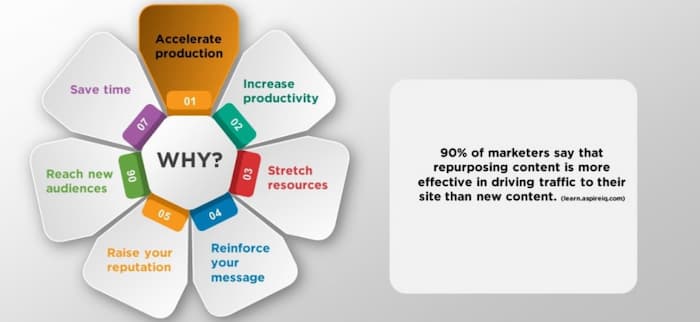
Reasons to repurpose content as an expert SEO tactic

Repurpose content

Choose one of your top-performing pages and repurpose the content into another form to take advantage of existing interest and the traffic already flowing to the page.

What does this mean exactly?

Let’s say you have a blog post on 7Advances SEO Strategies that get a high volume of search traffic. Use the content from that post and turn it into a video, podcast, infographic, slideshow or anything you believe will get a good response from your audience.

Why does repurposing content generate more traffic?

Using an alternative form of content gives you another way to deliver your content. Users all have different preferences on how they choose to consume content and so by providing multiple versions you open up new channels of interest.

Those that may have skipped through or skipped your blog post entirely may choose to watch a video or listen to an audio version.

The bonus of repurposing content that it’s not as hard to do as producing content from scratch. A good deal of the work is already done since you have a finished product. The content is already there it’s just a matter of putting it together in a way that users can consume.

Repurpose your blog post into a new infographic

Turning a blog post into an infographic is a popular method of repurposing content. Visualized data has a much higher retention rate for people because it is a combination of images and facts. Images help visitors retain the most important points of a blog post.

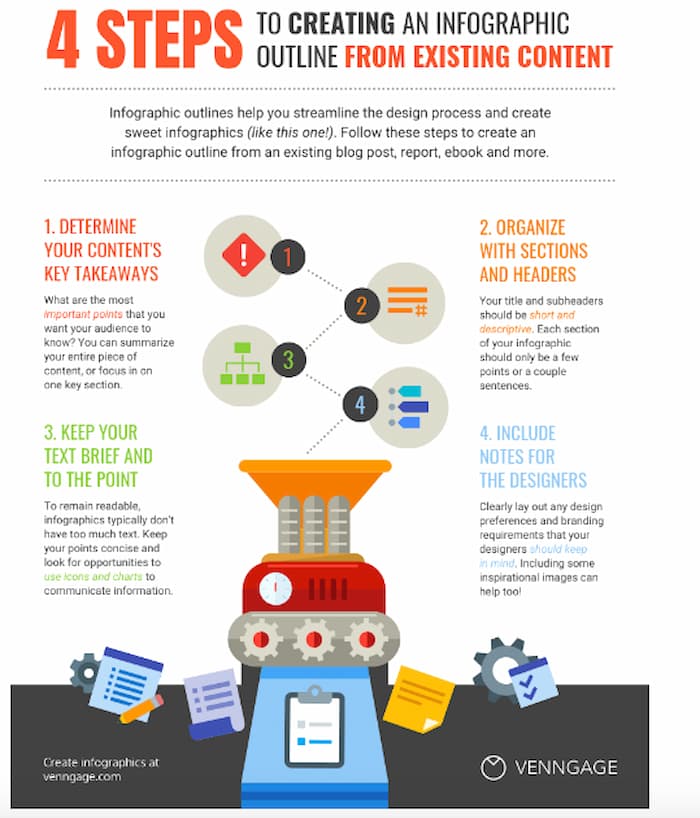
Step one: The first step is to determine your key data points. 

What do you want readers to remember when they see your blog post? This will form the skeleton of your infographic.

Step two: Organize your infographic with sections and headers. 

The key to a good looking infographic is to make it look extremely organized. If everything is balanced and aesthetical it will make more sense to users when they read through the content.

Step three: Keep your text brief and to the point. 

The idea behind making the infographic is to give your audience the most important data points. Don’t try to transpose the entire blog post onto your image. Otherwise, they could just read the blog post.

Step four: Include notes for the designers. 

Be as descriptive as possible when making notes for the designers. You want your ideas to materialize as close to your vision as possible. Tell designers exactly what to do when it comes to branding, colours and images.

Here is an infographic from Venngage that walks you through these exact steps:

Infographic on how to repurpose content which is considered one of the advanced SEO strategies

Publish a video

Hey, have you heard about that new website called YouTube?! It should be obvious by now that if you’re going to publish a video, you’ll want to do it on YouTube. Not only is it the second-largest search engine in the world, but also, videos rank on Google all the time for high volume keywords. 

(Click here to learn about video trends in 2021)

Add YouTube traffic to your monthly search volume

Drive traffic from both Google and YouTube by publishing a video optimized for an important keyword that will drive traffic. YouTube is not as competitive as Google when it comes to ranking for keywords, which is something, you can capitalize on.

If you’re shy about being on camera, use the images from your infographic to make a video/infographic. You’ll need to be the narrator and be super engaging if you’re not going to show your face on the video.

Tips for optimizing your video

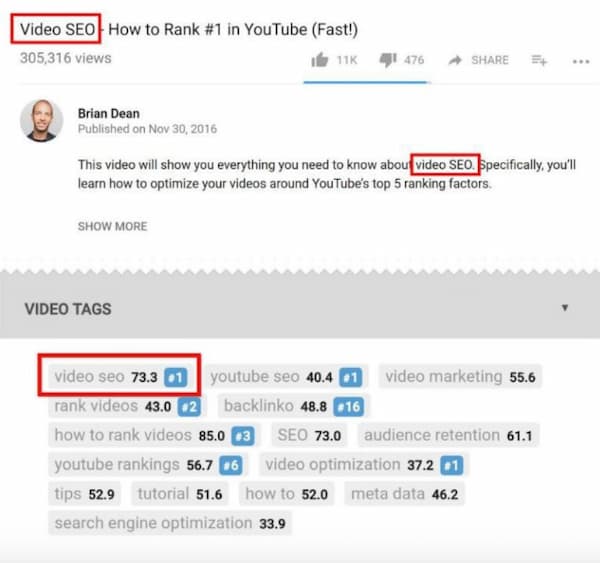
Make sure your main keyword is in the title, filename and tags. Take your video optimization to the next level by including a keyword-rich video transcript in the description. Add Chapters within your description to break up your video into segments. Take note of the top ranking videos and duplicate the tags they use since it also plays a big role in how YouTube sees your video.

This image highlights where keywords are located in YouTube video optimization. This is an advanced SEO tactics that will earn you a lot of traffic

Keep in mind that if people get bored and leave your video before it finishes, it will sink your YouTube ranking. Make sure there are no flat and boring segments. If you can’t help but be super boring then make your videos into short clips. Engagement is the key here.

Publish a slideshow

Slideshows are. away to repurpose content
Slideshare logo

If you’re going to go as far as publishing a video, you can easily import it to Slideshare to publish a slideshow. That’s not the only option for creating a slideshow. PowerPoint presentations convert perfectly and you can always make a slideshow from scratch.

Slideshows allow you to separate your content from the masses by providing a form of multimedia that isn’t as common as infographics and videos. They require user interaction which entices visitors to stay on your page longer and boosts engagement statistics.

Slideshare also has an average of about 80 million unique visitors a month with approximately 38 million registered users. This option can serve as an excellent source of traffic for B2B marketing.

Create bite-sized information for social media marketing

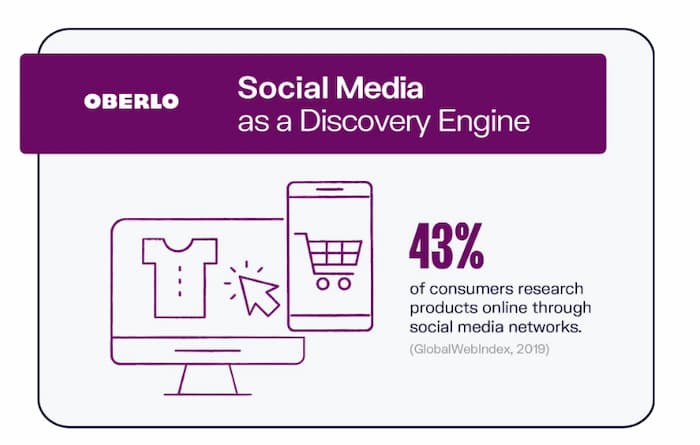
Divide your blog post into the most important points and post pieces of it on your social media one piece at a time. This can give your posts a longer lifespan for capturing interest and driving traffic to the blog post on your website. Oberlo does this really well with its infographics like this stat that was cut from their social media marketing infographic.

Example of making bite sized info for social media. Another advanced SEO tactis

Rather than one post of your entire blog article, you can use multiple posts that are more like teasers to get people to visit your page to read the whole thing. Not to sound like a broken record, but infographics are perfect for this type of social media marketing.

If you’ve turned your blog post into an infographic already you can use each segment as a social media post. Each post will be one of the main data points you’ve chosen for your infographic. With this already done you already have images and the most important messages ready to post.

Save time, resources and boost traffic with repurposed content

If you’re producing content regularly, repurposing content should be a regular part of your routine. It’s not easy to go through years of producing content regularly without experiencing overlap in topic and ideation.

Why not improve the quality of existing content and expand the reach it has by using multiple sources of traffic?

Re-evaluate your keyword strategy

There’s a common misconception that your keyword strategy is a “one and done” type of task. This couldn’t be further from the truth. Your keyword strategy should be re-evaluated periodically to expand on areas that are working to improve your bottom line.

Re-optimize for keyword variations

If there are keywords that are bringing in high converting visitors, you’ll need to pay closer attention to those phrases to build more content surrounding those issues and topics.

Why settle for one high-converting keyword when you can optimize for four or five similar phrases that work to produce the same results? There are many cases where you can get the same page to rank for more keyword variations by making small adjustments to optimize the page. To capitalize on those opportunities, you have to be aware of the keywords that are working to boost your business.

Publish relevant content

The content you publish is heavily influenced by the topics that are important to your audience as well as weighing in the business value the target keywords represent to your company. What you decided were the most popular keywords 5 years ago, heck, even one year ago may have changed in priority and almost most definitely in volume.

It’s important to stay updated on what is being searched the most to continue producing relevant content for your audience. Refreshing your keyword strategy is a way to ensure you’re up to date and delivering fresh and relevant content that drives traffic.

Steal ideas from your competition

An effective keyword strategy is not complete without doing a competitive analysis. Just as you may review popular terms being searched by your audience, you also want to check in on your competition to what terms they’re driving traffic from as well.

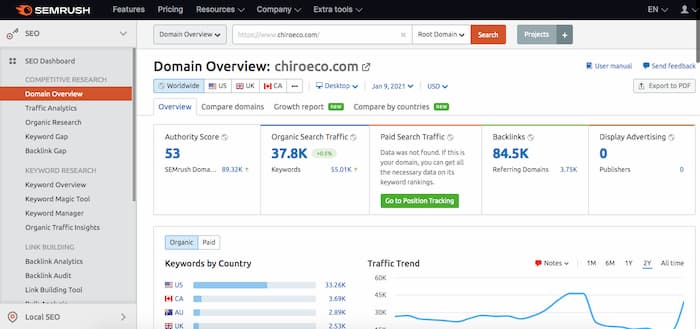
You can get ideas by running a competing URL through analytic software to see the both paid and organic traffic that is flowing through their site.

SEMRush software screenshot

If they’re executing an optimized PPC campaign, then paid traffic can speak volumes about what terms are making money for their company. Why else would they be paying for traffic if they weren’t making money from it?

The organic traffic that’s being driven is an indication of the content that’s being produced. If there are keywords they rank for that you don’t, take a closer look at the pages that rank to analyze the content and see if it’s a good fit for your audience.

If there’s business value in the search terms, you have new keywords and fresh content ideas to add to your keyword/content strategy.

A keyword strategy is a living entity

Think of your keyword strategy as something that is constantly evolving. Just as your rose bush needs priming and pruning, your keyword is also in need of fine-tuning to get the best results. Don’t stop adding keywords that work and taking some away those that don’t from your overall strategy. As your website develops over the years, re-evaluating your keyword strategy maintains relevant content and boosts traffic.

Build high-quality links

There’s no doubt that one of the advanced SEO strategies, high-quality backlinks increases the traffic to your website. Consider what makes a high-quality link and it’s a guaranteed fact that if you’re acquiring high-quality backlinks, you’re increasing search visibility.

If the link is on a highly relevant website that receives a lot of traffic, you’ll receive referral traffic with highly engaged visitors.

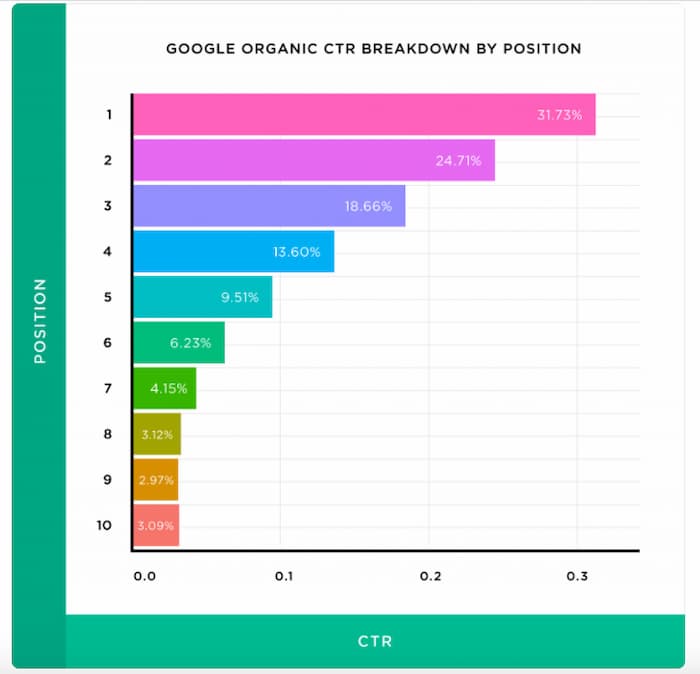
If the website has massive domain authority then that domain authority is transferred to your website, thereby raising your ranking ability. With improved rankings, the click-through rate from the SERP skyrockets.

IMage showing the CTR for SERP positions

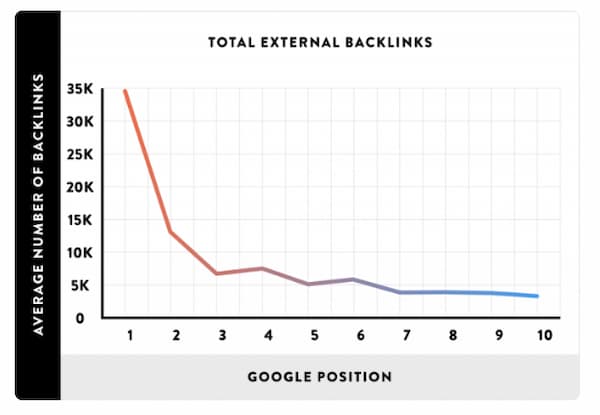
To be in the top 5 (top 3 positions are the bulk of the traffic) you need backlinks. The argument of what comes first, the chicken or the egg can be applied to this situation. Some debate that being in the top 3 ranked position leads to more backlinks, whereas others might say you need to acquire the backlinks to get to the top 3 positions.

Chart showing the relationship between backlinks and Google Ranking

Regardless of how you see it, it’s important to make high-quality link building a part of your routine for developing websites that rank at the top of the search results.

What’s the best way to build high-quality backlinks?

In an ideal world, the content on your website would naturally attract high-quality backlinks. Producing good content is a non-negotiable requirement to compete in the top 3 spots, but it’s not enough to acquire backlinks in a reasonable amount of time.

For a page to accumulate a high number of backlinks naturally, people have to know about it. It needs to be promoted through the proper channels and (ironically) have links built to it to get traffic flowing. Here are a few ways to build links to your pages to get your content in front of the right audience.

Outreach campaigns

This is one of the few methods reproducing natural link building at an accelerated rate. The concept of natural link building is people find your page, they like it so much that they link to it from their web properties.

In its simplest form, outreach campaigns are you reaching out to other website owners and telling them about your content and hope they like it enough to link to it. The major problem with this tactic is that it gets an abysmal conversion rate. Most simple outreach campaigns average an 8% conversion rate.

Here are a few themed outreach campaigns that boost your conversion rates to result in more links built to your page.

Broken link building

Broken link building is identifying broken links on your prospects page, contacting them to inform them of it and offering your link as a substitute for that link.

This tends to get a higher conversion rate because website owners care about the user experience of their pages. If there is a link that leads a user to a deleted page then it’s considered the link is contributing to a bad user experience.

By offering a page with content that is similar to what used to be there, you have more leverage by offering more value in linking to your website.

Read more on how to execute a broken link building campaign here.

Unlinked mentions

This form of outreach is themed to contacting website owners or authors who have mentioned your brand without linking to it. This receives a higher conversion rate on average because if your brand was worth mentioning, to begin with, most website owners won’t have a problem linking to your website.

Read more on how to execute an Unlinked Mentions link building campaign here.

Link reclamation

This type of campaign targets website owners that have linked to your website, but for some reason, your link was deleted. Links are deleted all the time, whether it by mistake, through updates or moved pages-it happens.

You can save a high percentage of lost links by simply reaching out to owners and asking them to replace your link.

Guest posting

This form of link building is probably among one of the top choices for business owners and SEO companies because it allows the opportunity for branding. Publishing an article on a popular website allows a company to demonstrate their expertise to an outside audience as well as a link back to their website.

Guest posting can land some high-quality backlinks when the websites you link from are highly relevant and have high domain authority.

Editorial links are also considered the crème de la crème of all the types of links you can get.

Read more on how to Guest Post here.

Update, merge, delete old blog posts

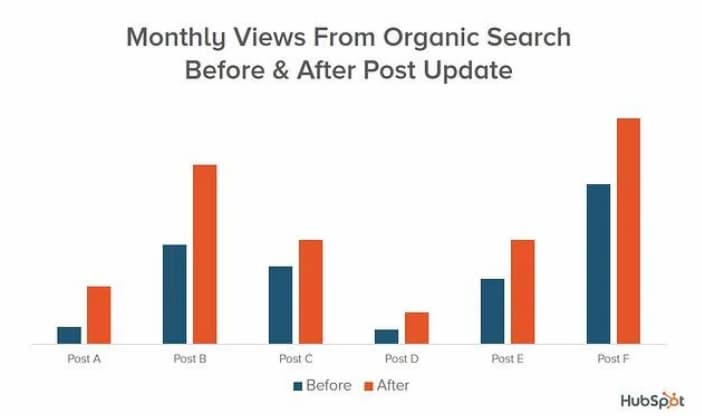
As a way to keep your blog content fresh, relevant and ranking highly, it’s important to update, merge and delete underperforming content. This is one of the advanced SEO strategies to add to a periodic routine for improved search visibility and high volumes of traffic.

Chart showing the impact of one of the advanced SEO strategies Hubspot used which was updating old blog posts

First off, Google prefers fresh content to stale content. There are some niches where fresh content is a ranking factor because of the continuous changes that can occur in the niche.

SEO is a prime example of a niche where things can change dramatically over a year. In many cases, there’s content that becomes irrelevant and out-dated making it completely obsolete.

Update old blog posts

Look for opportunities to update older blog posts that have slowly lost the traffic it once generated. The chances are that newer posts have been published that cover more information, cover new information, are more updated or just have more multimedia and value-added features.

Merge underwhelming blog posts

There are often situations where you’ve published blog posts that target similar keywords and answer similar search intent. If these blog posts are not ranking in the top 5 spots on the first page, you merge the two to create a monster blog post with more capability of ranking highly.

Combine the content of both pages to make your article a more comprehensive version. You will need to choose which page to keep and which one to delete based on the keywords within the URL and the backlinks that point to each page. It’s necessary to use a 301 redirect to tell search engines that content has moved from the deleted page to the merged page.

Google has made 301 redirects very clean in terms of transferring power from one URL to another, however, err on the cautious side and consider keeping the page that has more backlinks pointing to it. You can also use the volume of traffic and the keywords in the URL as part of choosing which page to delete.

Delete old posts with no traffic

It’s been proven that deleting pages that do not receive traffic can help increase your overall website rankings. Find pages that don’t rank well, or don’t drive traffic and delete the ones that aren’t contributing to your business.

The reasons to delete pages from your blog should match the following criteria:

  • The page has not received traffic within 90 days.
  • No backlinks are pointing to the page.
  • It’s a low-quality blog post.
  • There’s no business value associated with the post.

Use a 301 direct redirect to send users to new pages in case external links are pointing to those pages. You also want to save the link juice and send it to a similar page on your website.

Invest in video marketing

Video marketing boasts a slew of statistics that are pretty hard to ignore. One reason that stands out is that videos increase conversions by 80% when you add them to a landing page. This is backed by the fact that almost 90% of marketers are using video marketing in their digital marketing strategy.

Capitalize on social media traffic

Videos have been the preferred form of content for some time now by over 70% of people. The beauty of publishing a video is that once it’s on YouTube not only can you benefit from YouTube traffic but you can use it across multiple social media websites as well.

Facebook reports that video is the most shared form of content. Facebook stories, Insta stories are proving to be some of the most popular ways to get users’ attention.

Incorporate “Stories” for high engagement rates

The FOMO effect (Fear Of Missing Out) seems to be strong with most social media users. The idea of losing out on the opportunity to view a video (as such is the case with Stories) has proven effective for generating higher engagement rates.

Increase ranking on Google search

There’s evidence to support that incorporating video on your ranking pages can help push your ranking higher. Higher engagement statistics create a positive ranking signal and if you’re already ranking on the first page, it could be the added boost that pushes your website towards the first position.

Rankbrain image of the AI assessing user engagement and assigning rank

Rankbrain factors in the user engagement statistics of a page to help determine what page satisfies search intent at the highest level. The most noticeable engagement statistic that increases is the average time spent on a page after adding a video. With more users spending more time on your page, the message is being sent that they are enjoying the content you’ve created, making your page more popular.

Increase traffic from Google SERP features

Your video can also appear in video carousels, the video tab on Google search, featured snippets, and the PAA box. As long as you have a link from your video to your web page, your video provides additional traffic to your website.

Optimize, optimize, optimize…

There’s always room to enhance optimization and get your page to generate more traffic. Optimization can occur in a few different areas both on-page content and building off-page.

Target featured snippets

Featured snippets are continuously appearing more frequently on Google, which is creating more opportunities for traffic and branding. Optimizing your content to appear in this feature is an absolute must when it receives the highest CTR. The fact that Google displays your website as the featured result contributes to the excellent branding of your company as industry leaders.

To learn more about optimizing for featured snippets click here.

Target PAA boxes

People Also Ask Boxes can also add a substantial number of visitors to your monthly volume of search traffic. If you rank for one of the questions in the PAA box, there’s a good chance you rank for several variations of that question.

You can optimize for the PAA box by answering popular questions that appear in the box. Tag your question using an h2 or h3 tag and use short, succinctly summarized answers directly after the question.

Optimize for search intent

Optimizing for search intent is a continual process. Make sure your content adequately covers the same topics as any of the competing pages in the top 10 results.

You can create a better page by expanding your topic coverage or improving your multimedia.

Optimize using anchor text links

The number of optimized anchor text links pointing to a page affects the page’s optimization. You can enhance the overall optimization of a page for a specific keyword by concentrating or diluting the anchor text ratio of the keyword you’re targeting.

(Read more on anchor text optimization here.)

Optimize for local traffic

Capitalize on high converting local traffic by optimizing your website with a local SEO strategy. Whether you have a brick and mortar business or not, it makes sense to pick up on searches being made within your area that can land you some extra business.

Creating a Google My Business profile is non-negotiable. It’s one of the easiest things to do-although optimizing your profile can be a little more involved.

Local SEO strategy includes Google My Business (image is the logo)

How to optimize your GMB profile

The first order of business is to fill out the basic information about your business. Make sure you enter data on every single field that’s available. The more information you provide to Google, the more searches your listing can appear for.

Small details count

Some businesses fail to enter their store hours. Let’s say that your store is open late yet if someone searches “X type of stores open late” you won’t appear because you didn’t enter store hours. Make the effort to include the small and simple details since they can land you more traffic.

Categories

Choose the categories that most applicable to your business. Search for important keywords you want your website to rank on the first page. Double-check what categories the companies listed in the local pack have declared. The difference between being a men’s tailor and a men’s clothing store can have an impact on how high your listing is ranked for specific keywords.

Add citations

To rank as a local business you need to have links from local websites and local directories. List your business in the top directories that are well known, such as Bing. You can transfer your GMB profile directly to a Bing account.

Use other websites like Yelp, Yellow Pages, Foursquare to get local traction in the search results. See more on the local link building here.

Increase traffic systematically using expert SEO tactics

The traffic generation ideas mentioned above are considered advanced SEO strategies and can be used to increase the volume of traffic your website receives regularly.

If you don’t have time to implement these SEO strategies yourself, feel free to send us a message for professional assistance. We’ll give you a full site analysis free of charge and let you know which of these tactics will help you generate the most traffic to your website.

Christian Carere
Christian Carere

Christian Carere is the owner and founder of Digital Ducats Inc. in Toronto and heads the SEO team at Austin Bryant Consulting in Plano, TX.  Christian has been published on publications such as Search Engine Watch, Venngage, Small Biz Daily, Grasshopper, Data Box, Socialnomics, and Mention.

old.digitalducats.com/

Written by Christian Carere · Categorized: Content strategy, keyword research, Link building, Local SEO, On-page optimization, SEO strategy, Technical SEO

Jan 22 2021

11 Tactics To Increase Landing Page Conversions

Landing pages are an essential part of the marketing funnel. The sole purpose of a landing page is to achieve a specific goal conversion that moves visitors closer to purchasing from your company (deeper into your marketing funnel) or guides them to the purchase itself. When you are able to increase landing page conversions you directly increase the number of leads and revenue your website generates.

Before we go any further, let’s take care of the basics.

What is a landing page?

A landing page is a page that is specifically designed to explain an offer to visitors, demonstrate the benefits and guide them to a specific conversion. Landing pages are used for lead generation and increasing sales a company generates from its website.

Why are landing pages so valuable?

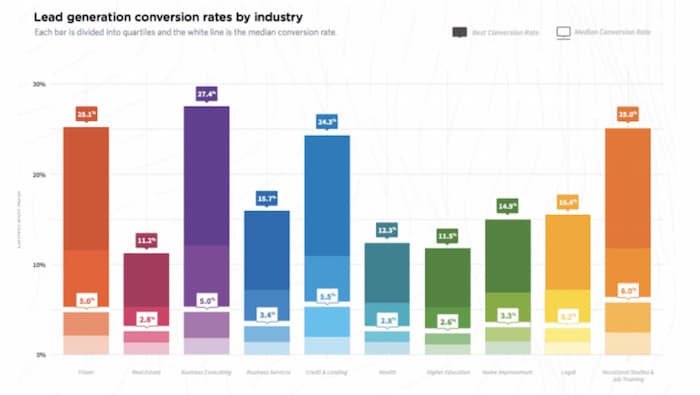
Ultimately, landing pages are used to increase revenue. The average conversion rate of landing pages (across industries) falls between 3-5.5% according to a recent study by Unbounce.

Bar chart showing the average conversion rates by industry on landing pages

Create multiple landing pages on your website to facilitate more conversions and ultimately increase the revenue your website generates. Here are a few tips and tactics to help you increase landing page conversions.

#1-Update your headline for higher CTRs

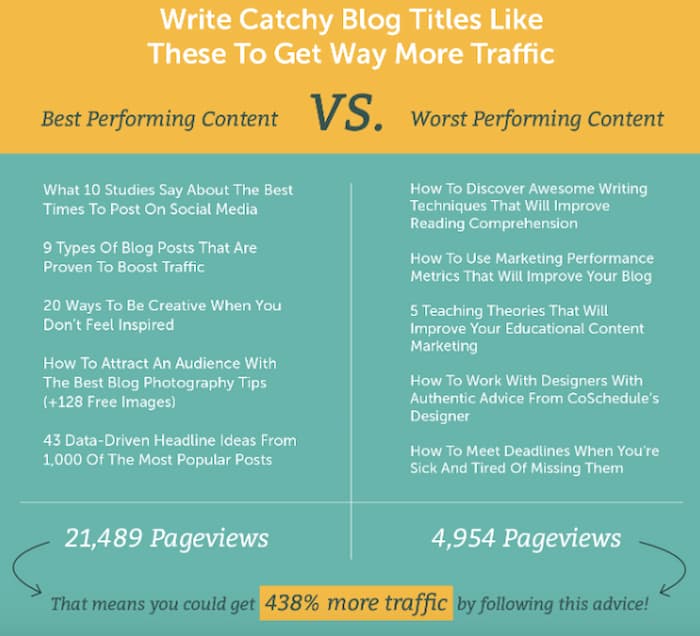
Your headline is the main attraction when a user is choosing between pages in a search result. Spend time crafting multiple headlines to get the most attention from your audience and increase click-through rates.

Infographic showing catchy headlines and how they improve click-through rate

Update your headline periodically to keep it fresh and relevant to users. When you find a headline that is working well you’ll need to split-test before making any final decisions.  

There are dozens of tools you can use (see AdEspresso below) that allow you to test the effectiveness of multiple headlines.

Adespresso example of a headline split-test to increase landing page conversions

#2-Use social proof within your copy to boost confidence

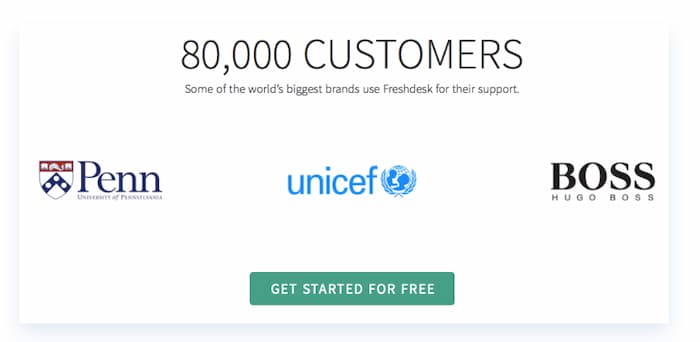
Did you know that 72% of people trust an online review just as much as a personal recommendation? Think of the impact reviews and testimonials can have on the credibility of your business. It’s imperative to include social proof of your product or service within the copy of your landing page.

Freshdesk is an example of how to use social proof to increase landing page conversions by showing how many clients already use their service

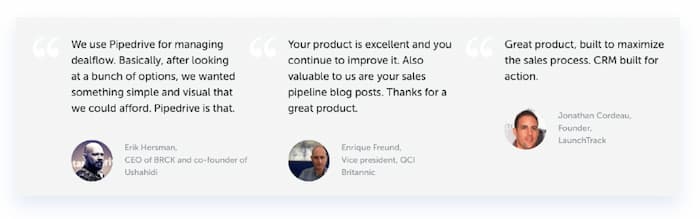
If possible get a few clients to write a testimonial specifically speaking about what your product or service has done for their lives. Include a photo to give your testimonial the most credibility.

Increase landing page conversions by using the testimonials of clients and influencers

If you have a strong social media following or a large subscribership, that can also be used to provide social proof of the value of your content.

#3-Focus on one Call To Action

Choose a single CTA to limit your visitor’s options for what they can do on your landing page. With only one option, you increase the probability of your visitors completing the goal conversion since there are no other distractions to lead them away from making a decision.

If you give your audience more than one option it can confuse them as to what they need to do which in many cases results in no action. Constant prodding and guiding in the same direction is a recipe for success on a landing page.

Here is an example of a good single CTA by Digital Marketer. The only option is to fill out the contact form in order to receive the download. No confusion there.

Use a single CTA like Digital Marketer to avoid confusion and increase conversions on your landing page

#4-Use contrasting colours on your CTA buttons

It’s just common sense to make your CTA buttons stand out as much as possible. Use colours to make your CTA stand out and scream “Push me” to increase landing page conversions from more user interactions.

Example of how to make a CTA button stand out by using contrasting colour

The more the user is drawn to the button, the more likely they are to push it. Make your buttons noticeable and attention-grabbing for the best results.

#5-Split test everything

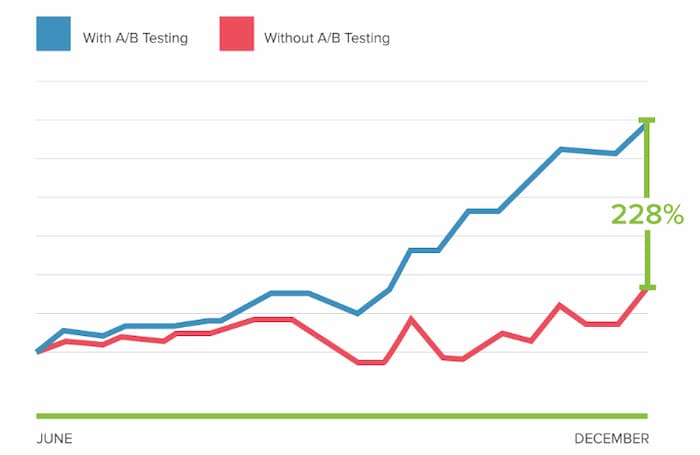
To maximize the conversion rates on a landing page you have to split test everything interchangeable. For example, it’s impossible to know whether a green CTA will be more effective than an orange CTA without getting the data from real user interactions.

Test different headlines, length of opt-in forms, background colours, CTA buttons, images, videos and everything that can be tested. Split testing the things on your page that could affect the conversion rate will optimize your page and maximize your results.

Here are a few examples of the difference split-testing has made:

Three examples of companies that experienced growth in landing page conversions

#6-Make sure your headline matches the offer

One problem that site owners can encounter is a mismatch between the headline and the actual offer/content. Avoid sensational headlines to attract more visitors without actually backing the headline up with the content.

If a visitor doesn’t see what the headline promises, they’re going to leave the page immediately. A misleading headline leads to higher bounce rates and lower conversions.

#7-Use high-quality images

The use of images has been known to help users retain more information as well as make content easier to digest. Use high-quality images to help convey a stronger message and set the tone of your offer. It’s no secret that visual content is an essential part of creating high-quality content. As the list of multimedia continues to expand, users expect more than just text to consider a page worth reading.

#8-Embed a video

If a picture is worth a thousand words, you can only imagine what a video will do for your message. Videos have been known to increase conversions by as much as 80%.

Increase conversion rate of your landing page by 80% with a video

A video provides a more personalized touch and is the preferred method of consuming information by over 70% of users. Try using an explainer video to provide an additional method of getting through to your audience on topics that range from basic to advanced.

Vidyard created a landing page and split tested the results of using a video using Unbounce. 

Vidyard landing page with video

The results were definitive.

Video landing page results show increase in conversions
Vidyard landing page split test results

#9-Touch on a pain point

One of the most powerful reactions you can elicit from your audience is the avoidance of pain. People want to avoid pain at all costs. Touch the most common pain points associated with your product and then explain how your product provides the perfect solution.

The connection between your product as a way to eliminate the pain associated with a problem increases conversion rates. 

Here is an example of how this landing page plays on the frustration of low conversion statistics. 

Example of headline that addresses pain points to increase landing page conversions

#10-Touch on a pleasure point

Paint the picture of the most attractive benefits of using your product to elicit feelings of pleasure. By creating the scenery and most desired situation of what you’re offering you can show your audience the feelings that could be theirs should they decide to move forward in the buyer journey.

Here is an example of Fastrack using the idea of selling your home quick and painless as a way to increase landing page conversions.

Example of Fastrack using pleasure points to increase conversions on their landing page

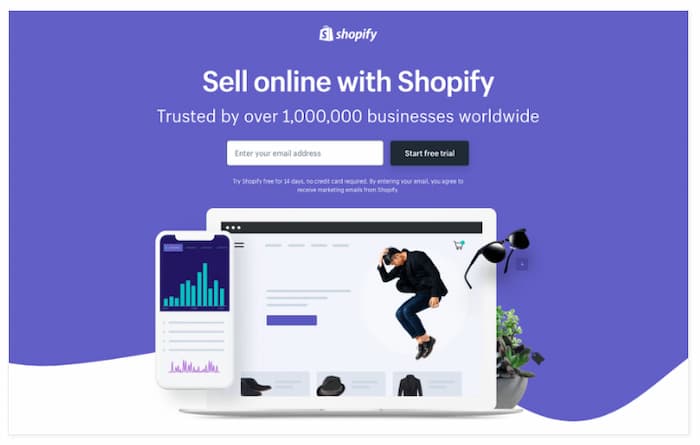
#11-Remove links and navigation

Landing pages are highly focused on achieving a single conversion goal, which means there is no need to lead your visitors to other pages. Remove all links and the navigation bar (if possible) to eliminate the distraction of clicking through to another page on or off-site.

Landing pages that only allow one action-the goal conversion, tend to convert at higher rates than those that allow users to leave without achieving the goal.

Here is an example of how Shopify corners users into one option on their landing page.

Shopify is a prime example of a website that removes navigation to increase landing page conversions

Watch landing page conversion rates rise dramatically

One of the most important things to remember when optimizing your landing pages is that there are no absolute rules that apply to every industry. To maximize conversions you have to monitor, track and split test results. This leads to a better understanding of your audience and how they react to various aspects of your page.

Most companies find that creating more landing pages raises the overall conversion rates of a website. Use landing pages for specific keywords and remember that the way your users are finding your page is important to how you optimize your page.

Mobile optimization will be different from email marketing or pay per click optimization. Either way, you choose, continue to discover the options that will increase landing page conversion rates to generate more revenue and new clients for your business.

Christian Carere
Christian Carere

Christian Carere is the owner and founder of Digital Ducats Inc. in Toronto and heads the SEO team at Austin Bryant Consulting in Plano, TX.  Christian has been published on publications such as Search Engine Watch, Venngage, Small Biz Daily, Grasshopper, Data Box, Socialnomics, and Mention.

old.digitalducats.com/

Written by Christian Carere · Categorized: Content strategy, SEO strategy, Web development

Jan 17 2021

Attract More Website Visitors On A Shoestring Budget

The situation is you’ve launched your new website and yet the damn thing cost you damn near every penny you own. It was a mistake not to consider SEO with your web design, however, you’re at the point where you need to attract more website visitors, but you’re not sure how.

If this is the case, you’re definitely reading the right article. This article provides a basic outline to attract more website visitors without all the expensive tags and tools. The truth is if you know your clients inside out you’ve already got half the battle won.

Although there is a lot of technical advice and work that needs to be integrated into your website, if you can nail down the following fundamental tasks, you can create a solid SEO foundation for your website and attract more website visitors from your efforts.

Create a buyer persona

Have you taken the time to sit down and think about who your clients actually are? Piece together details about your ideal client to create a buyer persona. This concept is invaluable since it serves as a guide for all of your marketing efforts.

Buyer persona example to attract more website visitors

A strong buyer persona surfaces many of the subtle details about the personality, traits, characteristics and tendencies of your ideal client. Using these details creates an advantage when it comes to creating content that resonates more deeply within your target audience.

We can even take it a step back from content creation and focus on the value a buyer persona has for keyword selection. Understanding the language, tone and major interests of your target audience gives you greater insights into the types of search phrases that are being used in searches.

Use this exercise as a powerful tool for focusing your entire SEO strategy. Identify who your buyers are, how they think, as well as their personal preferences to increase the impact of your efforts.

Choose the right keywords

Once you have a good understanding of who your audience is, you can create a list of keywords that would benefit your website the most. Keep in mind that just because your ideal client may use a keyword is a search doesn’t mean it’s the best fit for your website. You’ll need to consider the difficulty and value of the word to your business.

Avoid difficult keywords

If you’re a business owner doing your own SEO, you want to take the path with the least resistance. Sometimes you can tell when a keyword is highly competitive and sometimes it’s not as obvious.

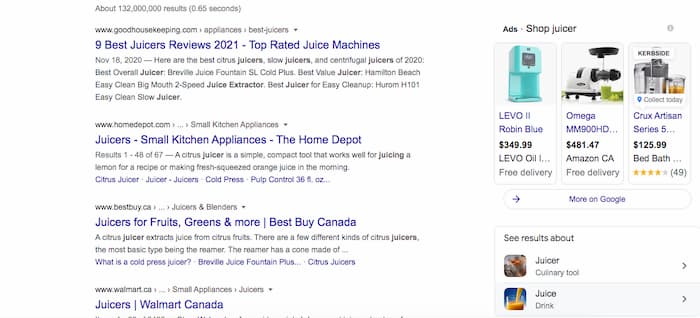
For example, if you’re in the retail industry and one of your potential keywords produces a search result with Walmart, Amazon, Ebay, and a number of retail giants, you may want to pass on that keyword. 

Search for juicer reveals tough competition between retail giants
Search for the keyword “juicer” results in big-box companies competing for spots on 1st page

Without an intimate knowledge of on-page optimization, link building or any experience in outranking websites, you’re not going to beat these websites.

Look for comparable websites to compete with

The solution is to look for keywords where the search results produce comparable websites on the first page. This is where you want to start. Choose keywords where you can compete by publishing better content than what is out there.

Structure your keyword strategy

You can’t always avoid the difficult keywords in your industry. Sometimes they are the best options for taking your business to the next level. A keyword strategy is what will prioritize the keywords you’re pursuing for short-term wins and long-term goals.

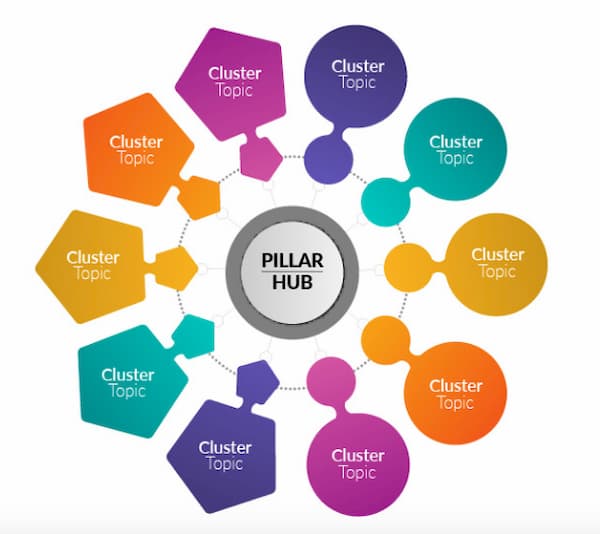
Use a topical structure to form your content schedule and prioritize the major keyword targets. Using pillar pages and cluster content is an excellent structure for developing a marketing funnel that moves your readers along the buyer journey.

Marketing funnel that matches the buyer journey to attract more website visitors

Publish answers to the questions people are asking

When you consider the fact that 80% of the total searches on Google are informational searches, it makes sense that being a resource puts your website in front of a larger audience. When you can be the best solution to a keyword search, your website surfaces more often on the first page of Google.

Blogging is a top method of traffic generation

This is a big reason why blogging has become one of the best ways to produce leads and build awareness of your brand. Your blog content should be based on providing answers to commonly asked questions and publishing solutions to commonly faced problems. When your content can help a visitor with an issue they’re facing, it builds trust and confidence in your expertise.

Publish long-form, in-depth content

There is much to be said about search intent since it is the primary ranking factor that search engines use to display the top 10 results, however, there are distinct advantages to publishing long-form, in-depth content. It’s not the length that provides the value, but the depth (which in most cases is the reason it ends up being long-form content).

“Ultimate guides” are more common

Publishing an “Ultimate Guide” has its advantages. When you can cover a topic in its entirety, it becomes a resource for those who are searching to learn more about the topic. There are multiple keywords that your content asset ranks for because it addresses multiple aspects of the keyword topic.

LInk on how to make an ultimate guide to attract more visitors to your website from additional keywords
Image source: Coschedule

Producing a content asset that becomes “the final destination” of a search will generate high volumes of traffic. Look for opportunities to create a content asset within your niche to create evergreen content that lives on indefinitely because of the value it provides.

Publish content as often as possible

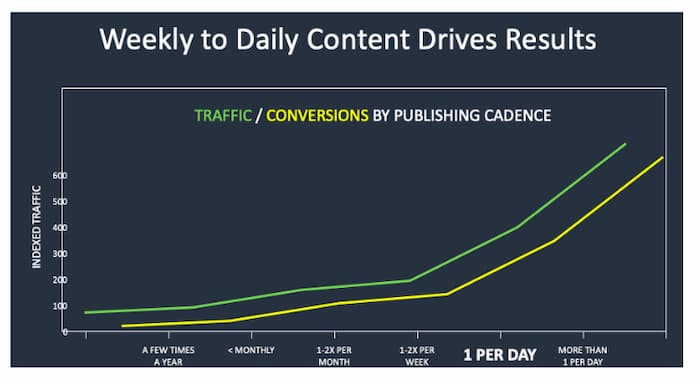
The more often you publish content, the more leads you generate for your business. In fact, a study revealed that small to medium-sized businesses that publish 11 times a month experience 3.5 times more leads than those that published twice a month.

Chart showing how a more blog content drives more traffic and conversions

Just to be clear, don’t publish content, just for the sake of publishing content. If your pages are subpar in quality and don’t drive traffic, your website could become bloated which will drag down your search visibility.

Publish content with the intent of being the best

Publish content with the intention of ranking in the number one position. Make it a mission to be the best solution to search intent. If you’re approach is to continuously produce content that outperforms your competition, you’ll see a difference in the number of keywords your website ranks for which will be reflected by increased traffic.

Target a new keyword with each page you publish

Every page on your website should target a specific and separate keyword. Avoid publishing pages that target the same keyword, phrase or have the same search intent. This is where your keyword strategy comes into play.

Stick to your keyword strategy

It’s best practice to map out the keywords your website will target. Create a content schedule based on the topic cluster you’ve outlined for your website. This way your website is organized topically and you can visualize the way your content covers a broad topic.

Topic clusters attract more website visitors from an organized approach

If you publish pages that target the same keyword, they are essentially competing with each other. This can spread the resources thin on the efforts you put into ranking that page to the top 10 search results. Rather than focusing on two pages, you can combine content and point backlinks to one page for a higher rank in the top ten.

In most cases, it’s better to have one page that ranks in the top three results as opposed to two pages that rank outside the top three results. The reason is there’s a huge drop in the average click-through rate that a website receives from positions 1-3 to 4-10.

Average CTR based on the ranking position on the first page of search results

Be an expert where your expertise is needed

People are always looking for answers online. Google is becoming the go-to solution for providing the fastest results, but not all people search this way. There are still those that seek help on social media and niche forums. You can drive targeted traffic to your website by helping people with answers to their questions on these sites.

Social media

Every industry has a social media website or two that works well for generating leads. Make sure you’re on the website that is best suited to your business. You can’t really go wrong with Facebook since there’s a group for everything. After all, they have about 3 billion users that are on the site so it’s likely you can drum up some business using them as a source.

Be smart about it. Linkedin is excellent for big-ticket sales and for B2B marketing. Instagram and Pinterest convert extremely well for retail product sales.

Get some help with free software

You can use tools like Buzzsumo to find out what’s being talked about and shared the most in your niche. Join these groups and conversations to get involved with what people are saying and more importantly what questions they are asking.

Answer questions honestly and avoid being overly promotional. People appreciate transparency and they appreciate good advice even more. 

Drop a link or two to your website whenever it applies to give people a way to learn more about what you offer while sending them to an article that is relevant to the conversation.

Niche forums

You can accomplish the same task of answering questions on niche forums. In fact, it may be easier to get to a lot of questions since the main reason people are on forums is to ask and answer questions. 

Quroa

Quora is one of the largest Q & A websites where you can get a high volume of traffic to your site by answering the right questions.

Quora is ideal because they allow full HTML responses with links (nofollow only) which means you can take excerpts of your blog posts and paste them in as answers with a link to read more. You can literally help people while promoting the content you’ve already written.

The bonus to Quora is that many of the questions on Quora happen to surface on the first page of Google search results. If your answer is the most upvoted, you not only get the thousands of views from Quora but the search traffic from Google as well.

Monitor keyword mentions

Use software such as Mention or Brand Mentions to be alerted to conversations where your keywords are mentioned. If there are conversations on social media going on that you can contribute to, wouldn’t it make sense to be alerted so you can join in and give your two cents?

Attract more visitors to your website on a regular basis

This entire article has been dancing around the plain facts that if you have expertise to offer make it easy for people to find you by helping them. When you make helping people your first priority you improve your ability to target the things that mean the most to your ideal visitor. This approach makes your content more effective and builds more trust in your brand.

On one hand, search engine optimization is getting more complicated because there are so many things that go into an optimized website. 

On the other hand, the importance of providing an exceptional user experience has never waned and has remained THE most important factor that trumps all ranking factors.

Create your website for the benefit of users and use your expertise to help those in need. Put this concept into a keyword-targeted content schedule and you’ve created the best SEO foundation possible for attracting more website visitors.

Christian Carere
Christian Carere

Christian Carere is the owner and founder of Digital Ducats Inc. in Toronto and heads the SEO team at Austin Bryant Consulting in Plano, TX.  Christian has been published on publications such as Search Engine Watch, Venngage, Small Biz Daily, Grasshopper, Data Box, Socialnomics, and Mention.

old.digitalducats.com/

Written by Christian Carere · Categorized: Content strategy, Web development

  • « Go to Previous Page
  • Go to page 1
  • Go to page 2
  • Go to page 3
  • Go to page 4
  • Interim pages omitted …
  • Go to page 7
  • Go to Next Page »

Footer

Need professional SEO advice?

Give us a call to learn more about how we can help your business

Call for a consultation Request a proposal

Request a free website analysis and proposal for your company by filling out the ” Request a Proposal” form.

  • Privacy Policy
  • Terms Of Service
  • Cities we’ve served

© 2026 · Digital Ducats Inc.